Read Transcript
Child: Welcome to my mommy’s podcast!
Katie: This podcast is brought to you by LMNT, and this is a company you might’ve heard me talk about before, and I really love their products because proper hydration leads to better sleep. It sharpens focus, it improves energy, and so much more. But hydration is not about just drinking water because being optimally hydrated, a state called euhydration is about optimizing your body’s fluid ratios. And this fluid balance depends on many factors, including the intake and excretion of electrolytes, which many people don’t get the right amounts of. Electrolytes are charged minerals that conduct electricity to power your nervous system. I talk a lot about nervous system on this podcast.
They also regulate hydration status by balancing fluids inside and outside of our cells. LMNT was created with a science-backed electrolyte ratio of 100 milligrams of sodium, 200 milligrams of potassium, and 60 milligrams of magnesium with no sugar. Since electrolytes are a key component of hydration, here’s what happens when we get our electrolytes dialed in.
We have more steady energy, improved cognitive function, suffer fewer headaches and muscle cramps, we can perform better for longer, and especially the support fasting or low carb diet because when we stop eating carbs like during a fast, the absence of insulin allows the kidneys to release sodium.
So replacing that lost sodium with electrolytes can help you feel good on a fast. Since LMNT is zero sugar, it also doesn’t break up fast. Electrolytes are also important for maintaining blood pressure, regulating digestion and proper fluid balance. Keeping skin hydrated, which is a big one that I feel like often gets missed and so much more.
I feel like proper electrolytes is a missing piece for a lot of people and I love LMNTs new canned drinks, which are sparkling water with all the same ratios and minerals I just talked about, and they are delicious. You can check it out and learn more at drinklmnt.com/wellnessmama. And at that link you will receive a free sample pack with any order.
This episode is sponsored by BON CHARGE, and I love so many of their products from their red light face mask to their sauna blankets and everything in between. They focus on high-end wellness tech, and if you’re interested in how light can help you, which I talk a lot about, BON CHARGE has so much to offer.
Studies have found that specific red light frequencies can help reduce fine lines and wrinkles when used at the correct brightness and strengths. And some products don’t get these correct. The frequencies of red and near infrared light stimulate cellular activity at a mitochondrial level, which I talk a lot about on this podcast.
This can create better energy efficiency in a given location of the body. For instance, red light on your face gives more cellular energy for biological processes. This can help to decelerate the signs of aging and lead to firmer, plumper skin. So the long-term results you can see when using an LED mask over time are things like, reduction in the appearance of fine lines, reduction in the appearance of wrinkles, reduction in under eye bags, firmer skin, tighter skin, reduction in signs of aging, scar fading, plumper looking skin, reduction in visibility of blemishes, and visibly clearer looking skin.
I’m always a fan of getting natural light from outdoors, but for people who are wanting to kind of tackle the aging process head on, this is in a way to kind of give your body some extra benefit from these specific wavelengths of light.
The safe, non-invasive beauty treatment is going to be around for a while, and for a good reason given the results people are seeing. If you wanna check out the BON CHARGE Red Light Face mask, and all of their products, you can go to https://boncharge.com/wellnessmama and use the code wellnessmama for 20% off.
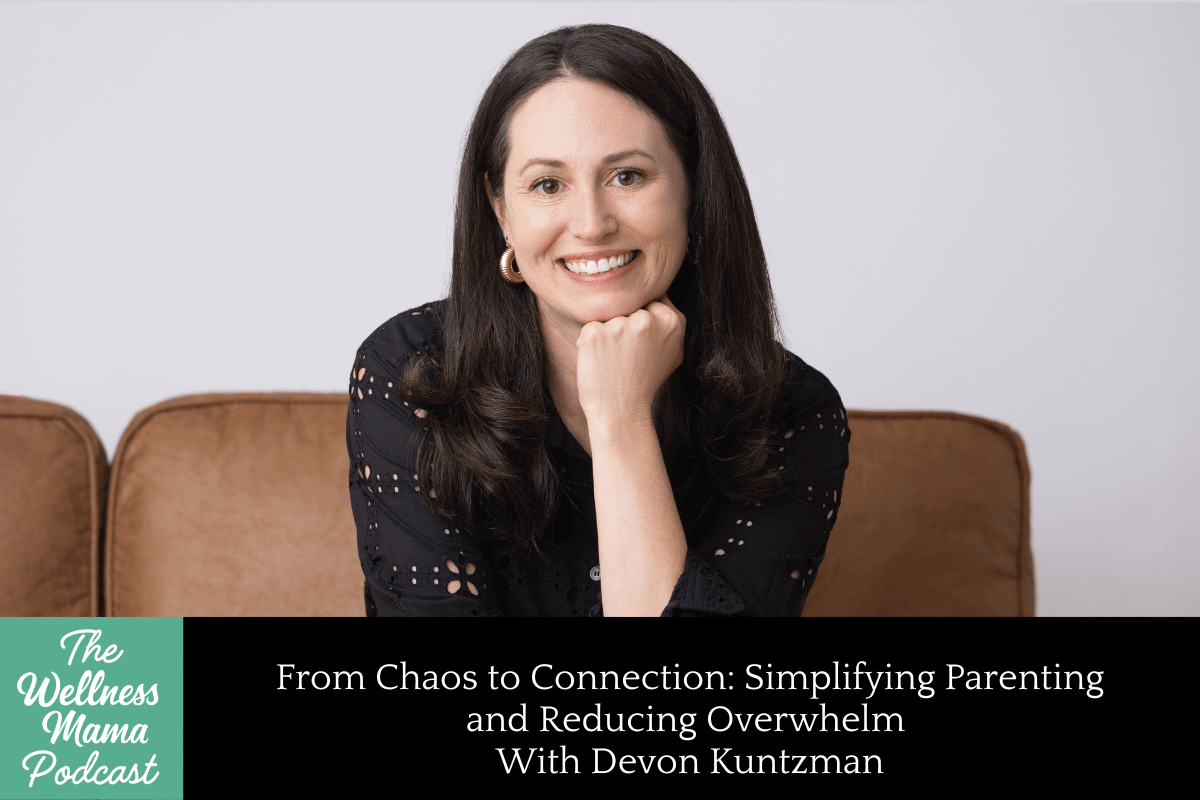
Katie: Hello and welcome to the Wellness Mama Podcast. I’m Katie from wellnessmama.com and I am back for round two with Devon Kuntzman on moving from chaos to connection how to simplify parenting and reduce overwhelm especially in the modern world. And we delve into practical and actionable ways to do this by the way we set up our environment, the way we set up our schedule and our structure, how we model things in our own lives.
As well as things like the big topics like screen time, bedtime. How to work with their natural tendencies and build in movement and nature and the things kids need. How to cultivate independence in an age appropriate way. How to reduce power struggles and so much more. If you’re not familiar with Devon, she is the founder of Transforming Toddlerhood and the original toddler parenting coach on Instagram who is trusted by millions of parents worldwide.
Her approach is about flipping the script on the terrible twos and helping families navigate this time period with confidence and connection. And I will say her strategies have, some of them, have worked for me really really well and I think when we can make this focus in the toddler years it also translates to less power struggles in the teen years as well. She has a new book also called Transforming Toddlerhood that is available anywhere books are sold and linked in the show notes. But let’s jump in.
Katie: Devon, welcome back. Thanks for being here again.
Devon: I’m so excited to be back.
Katie: Well, if you guys missed it, I’ll link to our first episode together in the show notes, which was all about parenting and keeping calm when your child is in chaos, especially in the toddler years. And Devon has an amazing book that really dives deep into that subject, and I’ll link to that in the show notes here as well. And in this episode, I’d love to deep dive into another topic that I feel like is universally relevant for parents and one that seems maybe top of mind and culture today in a way that hasn’t been in past generations.
And that is kind of that movement from chaos or kind of like autopilot into connection and how to bring more peace into parenting through simplifying. Like, I know often I get asked like questions along the lines of like, how do you do it all with six kids and work? And I feel like part of it is that I have chosen not to take on some of the chaos that often comes with modern parenting. And each of my kids is not in like five travel activities. And we try not to schedule things at night around dinner time.
And like I’ve sort of by necessity through having so many kids develop some strategies that I think have helped with my mental overwhelm. And I love that you’ve tackled this from a much more tangible perspective, not just a, I have now six toddlers at the beginning and I have to figure this out perspective, but with intentionality and strategies. So in this episode, I would love to really dive into the topic of how do we create more connection and calm in our home, especially when there’s multiple kids of multiple ages and all that comes with modern parenting.
Devon: Yes, this is such an important subject because we know that parenting is challenging as it is, and then in today’s society where we’re living very fast-paced lives where instant gratification is rewarded around every corner and there’s just so much going on and we don’t necessarily have the community and village that maybe our parents had and that our grandparents had.
It can kind of feel lonely and isolating to be a parent and that like we have to take on everything at once. And so it can, that going at that pace and having this, these feelings can really start to overdo our nervous systems where we’re feeling really stressed and can have trouble sleeping, and can just lead to us not being able to show up as the parent we envision.
So thinking about how we can simplify our routines, our environments, and our expectations can go a long way in cutting through a lot of the chaos that we experience as parents.
Katie: I love that it does seem like we’re definitely navigating, maybe every generation feels this way, but like we’re navigating more than at least some generations have in the past, at the very least with technology obviously in screen time. And this being the first generation that has had access to so much technology their whole entire lives. With kind of us as parents being the first generation where that shift really happened and it became such a ubiquitous part of our lives. And I love this focus on ways to simplify. I love that you said routines and environment because I feel like the environment especially can be huge and I would love to hear your strategies around that. I know I’ve developed some over the years myself but I feel like that part often gets overlooked as well, as well as with the routine piece. Like we tend to seemingly take on so much in this quest of like trying to be the best parents we can be and making sure our kids have access to every opportunity. But in exchange, perhaps we’re giving them the most stressed out version of our ourselves as parents in trying to navigate all that.
Devon: Hmm, absolutely. Well, you know, I agree with you that the environment can be so underutilized and really overlooked, and our environment is actually almost like our parenting partner in a lot of ways. And what I mean by that is the way that we structure our environment, it can help and support our parenting or it can hinder our parenting.
So for example when you have young children, if you need a place for them to be able to play and really work on increasing their ability to play independently, it’s really helpful to have what people call a yes space set up. A space that is fully you know, toddler and kid proof. So, you know, there’s not like a glass vase to knock over and like things are anchored to the wall like a dresser or a toy shelf or something like this.
So, and there’s, you know, covers on outlets, things like this. So that it’s a place where your child can move freely within that space so you don’t have to be there hovering, saying, oh wait, don’t do this, don’t touch that. And so that can allow our kids to have more independent play and us to be able to sit back a little bit more and not have to feel like we’re hovering so much. Another example of how we can use the environment to help us, that, as like our parenting partner, is this idea of setting limits. So I love using this example. For a while we live in 1200 square feet, so we live in a small space and for a while we had a toy shelf that went right up against, like the side of a couch.
And then once my toddler learned to climb, he was trying to climb over the edge of the couch and get on top of the toy shelf. And I asked him, you know, several times not to do this, but he’s 20 months old at the time. And, you know, it was way too tempting and way too exciting. So instead of getting frustrated and having to sit there and set that limit so many times before he would finally understand, because the younger child is the more often we need to set the limit to help them and help them follow through.
I decided to move the toy shelf to a different spot. So now there is nothing for him to climb onto when he went over the side of the couch. And then. No more climbing over the side of the couch, no more climbing on a toy shelf. It was all done because I changed the environment. So I really encourage parents to look for ways that you can use your environment as like your parenting partner to support the limits and expectations that you’re setting.
Katie: I love that. And when a lot of mine were young, we also lived in a very small space with lots of toddlers. And so like you, I got to get creative on how that looked, and I love that some of those strategies have continued even now that they’re older. And like I try to think of ways to work with them and sort of their natural tendencies and things like in my mind, toddlers were made to move.
They’re like amazing little movement machines from a you know, physiological perspective. They have perfect squats, like all their movement patterns are incredible. So I was like, how do I help cultivate what they already do so beautifully? Because I was over there trying to relearn how to squat and pull up and all these things that I had lost. And so one of the things I did was make our home very like, interactive and movement friendly. because I was like, that’s what they wanna do. They sleep better when they get lots of movement. So how can I like build an area where like the whole house basically is conducive to them moving in natural ways. So years ago we switched out our coffee table, for instance, for a little mini rebound or trampoline which I feel like is very safe. It’s very hard to get injured falling six inches off the ground or however far it is. And inadvertently they would just start bouncing often when they were talking or playing and like putting things like that.
And then as they got older, there’s like climbing rings in their bedrooms. And so even the older ones still do workouts kind of in their bedroom because it’s just there. It’s in their way. Or we have a climbing hang board in our kitchen, which is not very aesthetic and I don’t care because the kids do pull-ups while they’re waiting for dinner sometimes or whatever it is. I feel like anytime we can just make the environment conducive to what they already wanna do, versus like telling them, don’t do that, don’t climb on that, get off of that. Like, I got rid of all the breakable vases long ago because my kids were more important to me than glass vases. And I think like the outside space too, if we have it available, can be also tremendous in that.
Like I speak so much on here about the benefits of time outside and how most of us have not chronic conditions, but simply nature deficit disorder. And that, especially for kids, the more time outside, the better. So it became a priority of like, how do we create a space where it’s fenced in outside, they can play as much and as long as they want.
They can climb things, they can make mud pies, they can garden, whatever it is. Like how do we become their ally and having creative outdoor spaces to explore too.
Devon: Yes. It’s like creating that yes space inside and that yes space outside. And I love these ideas that you’re giving because in the end, we don’t need a very large space to be able to accomplish this. And anytime that we can encourage movement for a child instead of restricting movement, especially movement that would be classified as heavy work.
So this idea of doing pull-ups and things like this where there’s resistance or jumping on the rebounder, this is, can be very, very regulating because it gives sensory input to kids and it helps regulate their sensory system and their nervous system. So they’re going to end up being calmer in the long run.
And so this idea of cultivating movement instead of restricting movement is so important. And especially toddlers are wired to experiment and explore, and they do this through movement. So say you have a toddler who all of a sudden is very interested in climbing and clearly it’s not really safe to maybe climb like the bar stools at your like island or some in the kitchen.
So we have to find other ways. So instead of telling our child not to climb, we wanna find a way to meet that need within our boundaries. So this is a really important skill, is looking at how can we meet our child’s need within our boundaries. So that might be having a Pickler Triangle, having like a Swedish climbing ladder, having you know, a tree outside that can be climbed.
And so just looking for ways, how do I meet this need within boundaries. Same thing like dogs water dish, toddlers love playing and like water. And so if they’re constantly getting in the dog’s water dish, this is a sign that your child needs a place to play with water that is within your boundaries.
The other thing I like to say about movement is how can you support movement and cultivating independence? So do you wanna get like a kitchen helper, a toddler tower so your child can support and be in the kitchen and learn some basic kitchen skills and be a part of cooking, which can also help reduce picky eating.
Or can we put a faucet extender on the faucet so your child can turn on the water to wash their hands independently? Looking for different ways to support independence. Can you put stickers in your toddler’s shoes so they can tell the left from the right so they know which shoe goes on which foot?
Looking for different ways that we can cultivate and support independence. And I have lots of ideas in my book for all of these things. Getting your toddler in the kitchen supporting independence is going to go a long way. And I think the last thing for the environment is rotating toys. If you have the ability to take some toys away, put them in a closet or somewhere under the bed and then rotate them out every couple of weeks or so, you’re going to notice your child getting reinterested and reinvigorated in their play, which is going to lead to more independent play.
And it’s going to give you more of a break. And sometimes it’s like Christmas all over again. Every two day… every two weeks, because children really forget very quickly about the toys once they’re out of sight.
Katie: I love that. That’s a great tip that I had forgotten. I used to do that because of space constraints. I would rotate boxes out of the attic. And now that they’re older, it’s more of like, I just have a very big book budget and I’m always buying books. And that’s one thing I’m like, I prioritize like creative play and books and if they want things in that category, I just will get them for them. But I love that you brought up the topic of independence. I feel like this is one that is very, I think about a lot. And one thing I think actually has been maybe easier for me with having so many kids than if I only had one.
Because there came a point where I truly could not do everything for all of them all the time, even if I wanted to. But I sort of developed this strategy of I won’t do anything for them that they’re capable of doing themselves. And over time I realized like this was a way also of honoring them and their agency and not, and respecting their capability. I also found places where I got to stretch my own limits in that because I realized when we actually pay attention, kids are incredibly capable at a young age and they want to do those things when they’re young.
They want to load the dishwasher, they want to learn how to do laundry. Like those are exciting things for them because they’re things we do. So by not doing those things for them once they were capable, I found that like it helped cultivate independence for them at a pretty early age. And I’ve shared on here before and kind of gotten some pushback sometimes, but by like five, most of my kids were doing their own laundry because they could and they wanted to when they were given the tools and like I did the handholding with them and taught them and they had the strategies. So I would love to talk a little bit more about fostering independence because I do feel like sometimes maybe in the modern world some of our parenting stress comes from us taking on emotional responsibility for things they’re capable of doing for longer than we need to.
Devon: Yes, absolutely. And that’s why I dedicated a whole chapter in my book to raising a helper and looking at independence, looking for ways to get children involved in household tasks. Because here’s the thing, when the younger your child is, we have a unique opportunity when kids are so curious about the world and they wanna be with us every moment.
So we can use that to our advantage to get them involved in different daily tasks around the house, whether that’s loading and unloading the dishwasher maybe like gathering the little bag in a small trash can in a bathroom or something like that. You know, it’s like a little toddler size, little trash bag.
Or giving them a broom that’s their size, whether it’s a hand broom or like a stick broom. And letting them sweep, but giving them lots of opportunities to get involved. Because if you want a school age child who is truly a team player and excited to be a part of the family and not have to really like, entice your child to do things with, by like paying them for chores, then you can start that young and then you’re going to have a child who, it’s just normal everyday life to be part of the family and working toward those daily tasks. Now, of course, you’re not going to expect your toddler to make their bed perfectly or to like fold their clothes perfectly, but you can get your toddler involved in the process and work on scaffolding or building those skills.
So then once they’re five, once they’re seven, once they’re 10, they have developed these skills and then you’re doing it alongside each other. And this also, it creates an opportunity for quality time spending quality time together, because I think oftentimes we think, I’m too busy. I need to cook dinner, I need to do the laundry.
I need to do this, that, and the other. And then we can start feeling guilty like, oh, I wish I had more time to spend with my kids, but I have so much on my plate. We get stressed. But actually, if we can integrate our kids into these things, then it just increases the amount of quality time we’re able to spend in the family as well. So it’s just like wins all the way around. I feel like.
Katie: And there’s a couple other topics that I feel like kind of fall under this umbrella that maybe can be sources of stress and chaos in the modern world. And also that figuring out can be, really can help contribute to calm in the house. And I feel like one of these has been probably a parenting topic for all of history and one is new. So the new one is obviously screen time. And I know there’s a lot of varied opinions about this. My strategy personally was always I didn’t want my young kids to have screens at all, so I tried to avoid screens until they were at least three.
So that just wasn’t a thing I was navigating when they were super little. Not that I think that’s the only or best approach by any means. That’s just what worked for me. But I would love any strategies you have on screen time. because I have seen some data that kids who get a lot of screen time, for instance, can tend to be like more volatile or have less regulation than kids who have less screen time.
And there’s seemingly a lot that goes under this umbrella. But what’s your approach or how do you guide parents on the topic of screen time?
Devon: Yeah, absolutely. So I dedicate an entire chapter of my book to screen time as well because it is so important. And I have a lot of research studies in there for everyone to take a look at, to truly like, understand, okay, what are the pros and cons of screens and how can we create healthy screen time habits?
Because in the end, as you know, someone who’s out here supporting parents, I want to help you and your family create healthy screen habits. And what’s so interesting, that it’s not just about excessive screen time for kids, like we know excessive screen time can cause emotional regulation issues. It could cause, it can impact speech and different things like this. Can impact sleep. It can impact reactivity, but also it depends on your child’s personality and temperament. Some kids are more sensitive to screens than other children, and sometimes it’s also cumulative effect. So it might look like screens aren’t really having an impact, but as more time goes by or as screen time increases, it starts to have a bigger impact.
But on top of that, our screen use impacts children’s behavior as well. And there’s a lot of research out there that shows that when we use screens, it can impact how we react to our kids’ behavior and it can impact our child’s behavior because they’re working harder to get our connection, get our attention and to connect with us.
And so I’m not saying that we all have to like throw our phones in the garbage can or something like this. Like a lot of us work from our phones and use our phones for lots of different things to support us. But what we really wanna focus on, whether it’s us as the adults or for our children, is how do we create healthy habits?
And so having really clear parameters around screen time can be really, really helpful. The less screen time, the better for the younger that a child is. And personally in our home, we don’t really use a lot of screens, but say we’re going on like a long car ride over like an hour and a half or so, we’re traveling by plane, then, you know, we’ll let our son watch a couple of shows that we have already, like, pre viewed that we’re like, okay, we like these shows here. Because it’s not only about the amount of time a child’s watching a screen, but also the type of shows. Because a lot of shows today especially the favorite shows that are marketed to kids are actually designed in a way using what researchers have learned to keep people addicted to screens.
A lot of children’s shows that are marketed to children are created intentionally to keep your child glued to the screen. So you want to find shows that are lower stimulation. And so if you buy my book and go to the book resources page on my website, you’ll see I have a PDF download of lower stimulation shows that are definitely less addictive.
But really the overall focus is how can we create healthy habits, which is going to involve setting parameters and boundaries and following through on them, and really getting clear on what that means for your unique family.
Katie: I love that. Yeah, definitely not that, like I said, I’m not absolute and my older kids now have phones for work and driving and they actually run businesses online. So I’m not anti screen time, but I do feel like developing those habits in a healthy way early is so key and modeling, which honestly for me as a mom, having a business online is the toughest part, is not their screen time, but my own and having boundaries for myself.
I feel like universally in parenting, what we model is so powerful. And so even when I, it’s tough, I model charging my phone in the kitchen, leaving my phone in the kitchen at night, not having it in my room, not ever having screen time in my room. So my room is a place of like rest and trying just to be present with them when we’re having dinner time or conversation and not be distracted by my phone. The other one that I hear a lot of stress from parents at various ages and have experienced myself is around bedtime. And I know this is another interesting topic, and my approach probably is pretty unconventional because I homeschool. And so mornings can be a lot less structured than they are for a lot of families. But I realized for me personally, I’ll say my approach and I would love to hear differing approaches from you, but just that I realized at some point that joke about, wait, why are this the person who wants to go to bed, putting the people to bed who don’t wanna go to bed, and how important modeling is.
So as they got older, and especially with teens, I realized like, oh, okay, I want them to go to bed because I wanna go to bed. I can focus on my own need and create a bedtime routine. Set us a time that they know that mom’s going to bed at 9:30 and build structure around that and model it. Even if my older ones stay up and read, even if whatever.
And I know some psychologists that I’ve had on have said teenagers, especially their brains are wired a little later. So in the teen years, they do wanna stay up later and sleep later, which isn’t always possible, but they’re just kind of biologically wired to that wolf brain for a while. so that’s been my approach and what’s worked for me obviously with older kids. I know bedtime can be a source of stress and that not every family, of course, can let their kids stay up late and get up late if they have school constraints. But what are some strategies for navigating bedtime within the boundaries of a family unit who might have time constraints?
Devon: Yes. This is such a great question. I really, really love this. So first what you said about modeling is so important, and I love to use this in the example of brushing teeth. So toddlers can often be very resistant to brushing their teeth. And so think about it, we like go into the bathroom and we’re like, you know, hovering over our child, staring them down, trying to like shove the toothbrush in their mouth, right?
Think about like toddlers, the whole point of toddlerhood is for your child to become their own unique individual and develop a sense of self for the first time. So when we’re, the more we try to force something on a child, a toddler, the more they’re going to push back. But at the same time, brushing teeth is a non-negotiable, right?
Because you’re like I need to keep my child’s, you know, health and hygiene. Like that’s my responsibility as the adult. So something that can be so powerful is going into the bathroom and setting up your child’s toothbrush and then starting to brush your own teeth. The less you put pressure on your child, but instead model the behavior the further you’re going to get.
And so it’s a really, modeling is a great way to take the pressure off and team up with your child and work hand in hand with your child versus trying to force them into doing something. So modeling is so important. The second thing I would say is reduce the number of transitions. So sometimes we have just inadvertently way too many transitions before bedtime.
Like, you know, we go to the room to like, we go to bathroom, take a bath, then we go to the room to get dressed, and then we come back to the bathroom to brush teeth, and then we go back to the room to read stories. But then we go to the kitchen to get a snack and then we go here… It’s like way too many transitions.
The more transitions you have, the more opportunities you’re creating for pushback. So how can you get more done in one location, right? So can you like, do the bath and then like brush your kids’ teeth like in the bedroom and get them dressed in the bedroom and read stories in the bedroom. So now there’s no more transitions or can you do more things in the bathroom than go straight from the bed, the bathroom to the bedroom.
But looking for ways to reduce transitions is going to be really supportive. The next thing that’s going to be helpful, which kind of builds on what I was saying with the first thing, is creating buy-in. By creating buy-in what I mean is that we want kids to have a sense of control. So giving your child a choice within boundaries can be really helpful.
Whether that’s which pajamas they wear, whether it’s they if they brush their teeth before their bath or after giving your child a sense of control can be really supportive and having a visual routine chart. So now if the, there’s a visual routine chart of like what they’re supposed to do, between like, you know, after eating dinner and then lights out, then your child can go check that chart with you and then you guys can work through it together as a team, versus you being the one who’s like giving out all the orders and directions, the chart actually takes care of that for you.
And then you get to be a partner with your child and like make it fun and exciting to go through these things together. So those would probably be my top tips for just simplifying bedtime and reducing some of the chaos.
Katie: And are there any other like big categories that we haven’t touched on yet that like really come into play with reducing the overwhelm and simplifying parenting in the modern world?
Devon: Yeah. So I would say the other thing is just maybe around expectations, right? It’s like checking in with our expectations and kind of simplifying our expectations and also maybe slowing down the pace at which we’re going in life. I’d like to talk about both of those. So when it comes to expectations, parents are always asking me, well, how do I know what I can expect for my child?
Your child’s behavior, what you see over like a week or a few days, is going to tell you what they’re capable of. This doesn’t mean that you throw expectations out the window when they’re not able to meet them, or that you punish your child for not being able to meet your expectations. It means that you help them, you help them gain the skills and build the skills to be able to do whatever it is.
So if it’s for example, your child is, you know, doesn’t have a lot of impulse control. Then you wanna play games like Simon says, or musical chairs, things like this, or red light, green light to start increasing impulse control skills or you know, if you have a child who, let’s say is constantly like getting dysregulated and like upset, having a lot of tantrums you wanna work on in the calm moments, some social emotional skills that are going to help them better identify their feelings and emotions and learn some grounding and calming techniques, which might be as simple as blowing bubbles, like just getting out some bubbles and blowing those to help, you know, get a child, a young child breathing.
That’s often like a really great first step. And then when it comes to just our pace of life, sometimes less is more and slowing down, saying no, being able to set boundaries and say no to certain things can be so helpful. And sometimes we feel the pressure. Like for example over the weekend I spent the night with my son and husband at my parents’ house. And my son was having a great time kicking around the soccer ball, and my husband used to be a professional soccer player in Europe. And so, you know, of course everyone’s excited for my son to play soccer. And you know, my, so my parents were saying, well, you know, you should just get him in a soccer game. It’s soccer.
He’s, and he’s three. And they’re like, it’s just 45 minutes on Saturdays. There’s not even practices or anything. And I’m like, yeah, but, we go to the farmer’s market on Saturday mornings and we meet up with friends and we go to the coffee shop and we really love those things. And so sometimes it’s okay to say no.
And it’s so tempting to put your child in all of these structured activities. And it’s not that structured activities are good or bad, but we actually do other structured activities that I feel are more important at this age, like swimming lessons and getting my child to be water safe. I would rather prioritize over my son playing soccer.
So that’s what we’re choosing to do and it’s okay to say no to something else. And yeah, I think leaving time for unstructured play for your child, especially in the first five years of life, is actually more important for their growth and development than having structured activities.
Katie: I love that. I definitely agree with that and have seen that play out with mine. And then they also will develop interest as they get older and there’s a time and a place for that. I personally love children who can drive age. And then I’m like, do all the activities you want. Like you now have complete time freedom.
Like pursue all of your interest. And also I’ve realized like sometimes, at least in my case, there were times when I thought I wanted my kids to do an activity and circling back to our first episode, it was actually something that was coming from an unmet need or thing I wish I had done myself. So I used to encourage music lessons in them and we get pushback.
And then I realized, oh, I’m encouraging this because I wish I had done more music lessons as a kid. And so I started taking voice lessons. And then of course as modeling works, they all kind of got interested in music in their own ways as they got older. But I realized like, oh, I wanna take voice lessons.
So rather than push my kids into it, I can just do it because that’s what I actually want to begin with.
Devon: Yeah. I love that. That’s so amazing. And I think something else to think about, is like, okay, where am I putting my own expectations or my own, like unmet needs on our kids, like you said. And then this other thing is thinking about activities as a family, right? Like what activities can you participate in as a family, which is also another great thing to look at.
So for example, my family, we go on a lot of bike rides because my son has a bike seat on our bike and we go on all types of like bike adventures. And sometimes on the weekend we go on a 22 mile bike ride and go have all these adventures and it can be really fun. Or for example, we just bought my son skis, he’s three, skis this past weekend because he’s excited to go skiing with my husband and all of my cousins. And so that’s a really exciting family activity. So looking at like activities and structure through the lens of what can we do as a family and things that strengthen our family bond, I think can be a really unique and fun lens to look at it through as well, because especially young children want to be with family.
So how can we do activities that benefit the whole family at this age?
Katie: I love that approach too, and I know there’s so many more. I think you said you have 45 chapters in your new book and more than we can cover in a podcast episode, and I’ll make sure we, I link to our other episode and to your website and your social, but where can people find the book and find you?
Devon: Yes, so you can find me at Transforming Toddlerhood on Instagram or transformingtoddlerhood.com, and the book is sold everywhere that you would buy a book. Whether you want to listen to me read it to you on Audible or if you’d like to purchase it from your local bookstore, you can find it everywhere.
Or you can go to transformingtoddlerhood.com/book to find all the retailers.
Katie: Amazing. Well, Devon, this has been so fun. I feel like probably a very helpful conversation with a lot of really practical strategies and key takeaways people can implement right now, as well as of course, so much more that you go into in the book, which I feel like is truly like a field guide for the early years of parenting.
Thank you so much for your time and for all that you’ve shared.
Devon: Thank you very much for having me.
Katie: And thank you as always for sharing your most valuable resources, your time, your energy, and your attention with us today. We’re both so grateful that you did and I hope that you will join me again on the next episode of The Wellness Mama Podcast.





Leave a Reply