Read Transcript
Child: Welcome to my mommy’s podcast!
Katie: And this episode is brought to you by Apollo Neuro. This is a tool that has really helped me feel more relaxed and de-stress. It’s an Apollo wearable that can be worn anywhere on your body, and it tracks sleep like other wearables. But unlike other wearables, it actually improves my sleep automatically.
Apollo was designed by a team of scientists and doctors to emit silent, soothing soundwave vibrations that actually feel really good and work in the moment, so it feels like a hug. These waves are proven in scientific studies to help us shift into recovery mode, so we experience less stress, better mood, more energy, and better sleep.
The sleep setting is probably my favorite. Apollo is also the first wearable proven to significantly increase HRV, which is heart rate variability, which is a leading biomarker for health and longevity. It works at the most foundational level to improve nervous system balance through our sense of touch.
Just like getting a warm hug from a friend or snuggling a pet. Apollo connects to an app on your phone so you can choose the settings for mood and energy and the level you need. I’ve used mine for years and I definitely noticed the benefits. I especially love it when traveling as well. It’s especially great for moms because it has no side effects and it’s safe if you’re pregnant or nursing.
You can learn more about Apollo and get your own by going to apolloneuro.com/wellnessmama. So find out more and get your own by going to apolloneuro.com/wellnessmama and use the code WELLNESSMAMA all caps and one word, for a discount.
This podcast is brought to you by BIOptimizers and in particular, their product that holds my heart, which is their Magnesium Breakthrough. My goal this year is to continue to focus on my wellness and to create more harmony and resonance, and we all know that the foundation of health is a good night’s sleep.
I talk about that so much on this podcast. And magnesium is the one nutrient that helps my sleep so much as well as so many other aspects of my health because magnesium is vital for so many things within the body, and it is nearly impossible to get enough from food anymore. And Magnesium Breakthrough from BIOptimizers is in a category of its own.
They have seven different forms of magnesium in one supplement, and since magnesium is involved in over 600 different biochemical reactions in the body, no other supplement on the market offers all seven types of magnesium in one bottle. Pretty much every function of your body is upgraded when you take magnesium regularly from the quality of your sleep to your brain function, from metabolism to stress levels, and so much more.
This is one of the few supplements that lives on my nightstand and I’m a little odd, but I take every morning because I actually get energy from it though most people notice that it’s better at night. Now studies point to a lot of benefits of magnesium, including that it may help improve sleep quality, especially by supporting healthy sleep onset and have more peaceful nights.
Magnesium is also involved in stress management support and it may help maintain energy levels and positive mood while also supporting mental clearness and relaxation. Magnesium is also important for healthy and balanced muscle tone and providing the building blocks to strong bones, and it promotes a balanced stress response, supports relaxation.
And I feel much calmer when I’m regularly taking magnesium. So let’s face it, even if your 2025 resolution is not all about focusing on your health like mine is, how are you going to be able to achieve your goals in any area without enough quality sleep and stress management? Check out Magnesium Breakthrough and make it part of your daily routine this year as well.
For better sleep, better stress response, and much more. They have a 365 day money back guarantee and you can find it at Bioptimizers.com/wellnessmama and use the code Wellnessmama for a discount.
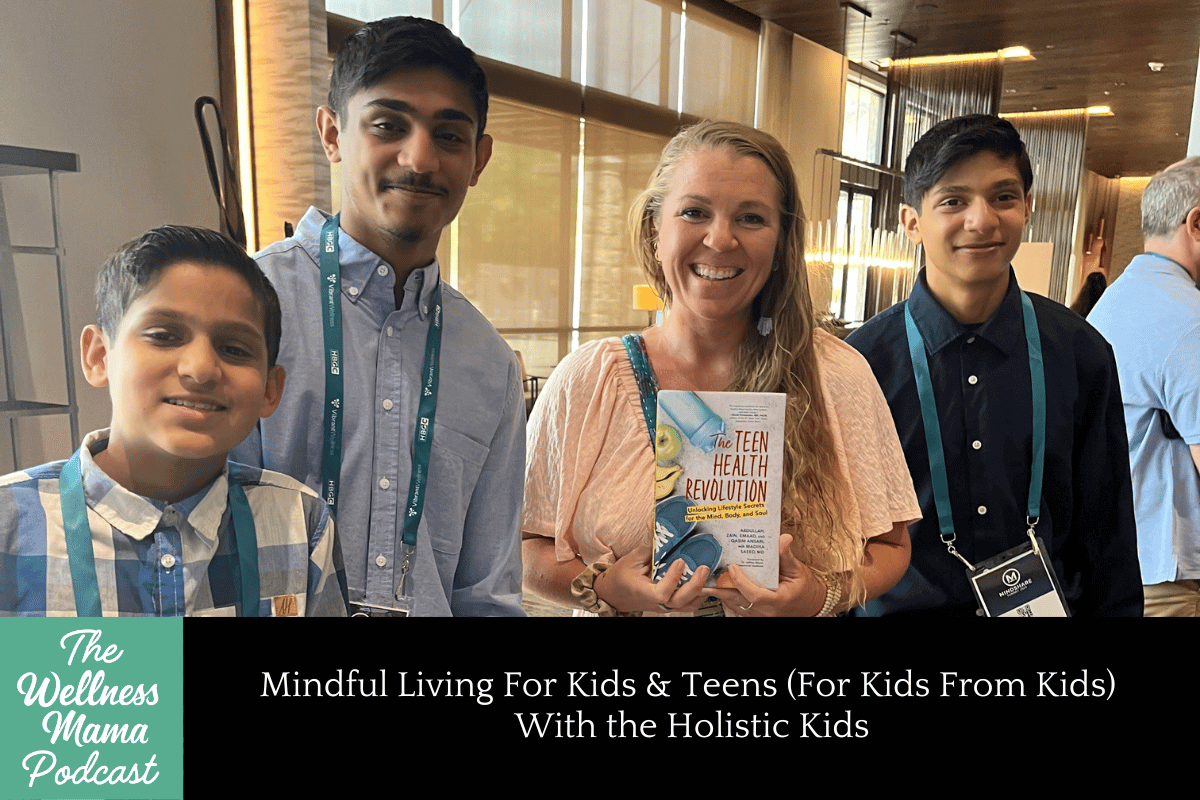
Katie: Hello and welcome to the Wellness Mama Podcast. I’m Katie from wellnessmama.com, and this episode is a special one because my guest today, there are four, are kids and teens, not adults, but they are nonetheless very much health experts and speaking to both parents and to kids and teens on what they see as some of the biggest problems facing their generation today. I’m here with The Holistic Kids who have their own podcasts, which I will link to in the show notes, as well as who are authors of a new book called The Teen Health Revolution. Which I will link to as well. And in this first episode together we go into the topic of mindful living for kids and teens and why this is so important.
And I love hearing their take on it as well as hearing their take on things like why kids and teens sometimes have trouble opening up to their parents. And what we as parents can do to actually open those lines of communication in a way that is applicable to our kids and that they will respond to. As well as they talk about things like purpose, mindfulness, meditation, screen time, a lot of the issues facing their generation today.
So without further ado, let’s join Abdullah, Zain, Emaad, and Qasim, who are the hosts of the Holistic Kids Show. The Holistic Kids welcome. I’m so excited you’re here. I’ve gotten to be on your podcast and now I’m so excited to chat with you on mine today. Welcome. Thanks for being here.
Holistic Kids: It really is our pleasure.
Katie: Well, I think we’re gonna get to tackle two really important topics. So you guys stay tuned. We’re gonna actually record two episodes together, both highly relevant topics for kids and teens. So these are ones we can listen to with our kids. If you have kids in the car, perfect episodes to listen to while you’re driving with your kids. In the first one I’m really excited to go deep on the topic of mindfulness with you guys because this is a topic that is popular I feel like in health, the health world and among adults and maybe not quite so much with teens and kids yet. And I think it could be such a valuable tool for teens and kids to learn early in life and certainly one I wish I had learned earlier.
So, to kind of intro this topic and build the foundation for this conversation, maybe walk me through your guys’ understanding of mindfulness and how it applies to your life as kids and teens.
Holistic Kids: Well, right now our generation is suffering. I mean, we saw people in our school, in our schools, right, with all kinds of conditions. From asthma to ADHD, to eczema. So we are poisoning ourselves and we don’t even know it. We’re suffering silently, which is what I like to say. Despite even our parents being doctors and a lot of other people in our community’s parents being doctors, kids don’t want to talk about their issues.
They don’t wanna talk about, especially teens, we don’t wanna talk about what’s going on with our lives, and that’s why this topic is so important. So we can bring light to this. Especially during the pandemic, me and Abdullah, we started The Holistic Kids Show podcast because we couldn’t, we couldn’t stay silent.
We saw all of the issues that were going on. Everyone was burrowed inside of their homes on screens, and whenever they would go out, everyone was freaking out. And it was a very, everyone was scared in the world. So, we wanted to bring light, especially to our podcast, give kids especially, some hope that, you know, we are doing this and we gather all the experts so kids can learn from these experts with other kids who are also learning. That’s why I put our motto is for teens by teens, because that’s really, for kids, by kids, for kids, by kids. Because that’s really what all of this is about. Teens, when it comes to adults, we just think, oh, okay, this like old person is telling us what to do. That’s why we decide to come into the picture and be like, okay guys, we need to wake up.
Like seriously, like nobody’s mindful now. It’s just like all negative. Mm-hmm And that’s why even Emaad had some like issues as well that this, that really want, made us wanna focus on health.
Yeah. I had sinus issues at a very young age. That really pushed me to keep doing this, and I don’t want everybody else to have the thing, same thing that I did.
Yeah. And that’s why it, as it changed our lives, we want, we saw the power to help change other lives as well.
Katie: Well and you guys brought up something interesting, I feel like I have a rare opportunity as a parent of teens to talk to some other teens who are not my own kids and get some insight here. So you mentioned that teens don’t necessarily wanna talk about their problems to their parents. And I feel like this is actually true of kids of lots of ages.
And I would love to hear from your guys’ perspective, we’ll go more into mindfulness for sure, but why do you think it is that kids and teens maybe have trouble sometimes talking to their parents? And what can those of us listening who are parents do to create open lines of communication that actually feel good and supportive at different ages for kids and teens?
Because I know for parents that’s a very important thing, but maybe sometimes we don’t fully speak the language or fully understand what you guys need and want. So any insight you’re willing to share there without betraying the Code of Kid and Teen Trust, I would love to hear.
Holistic Kids: So I think that if adults they can just be very open to anything that kids or teens want to say without judgment can be one of the biggest things. If like adults can just listen to teens without having their own bias or opinion on it first. And then being kindly talking to them about maybe what’s another opinion or like what’s their side and then like what’s the adult side of something. And actually what some, we heard some advice when we were on our podcast. We interviewed somebody and they said that teens, I mean parents, should listen to learn and not listen to apply. And then give advice. Because nowadays, I know parents are re… we understand you guys are very concerned about what’s going on in our lives, but sometimes we just wanna talk without you guys replying.
We just wanna share our feelings without you guys actually putting in your input sometimes. Mm-hmm. Because we feel like as soon as we start talking, then you’re gonna say, oh, what you think. And I think that’s why a lot of teens avoid these kind of conversations. Mm-hmm. Yeah.
Katie: That makes sense to me. And that’s really powerful insight of listening to listen, not to give advice or opinions or reply. That’s, I think really, really important for parents to hear. And I’ve noticed with my teens, even though I have a really good communication with them, it feels like often something needs to be their idea because they’re in that phase of individuation and they’re supposed to be, that’s actually psychologically exactly healthy.
But anything I’m like, if I tried to push something for instance, they might instinctively resist that more than if they were allowed to just find that information and make that decision themselves. And so I’m learning as a parent, how do I navigate being there and being supportive and always being around when they need me without being, you know, Wellness Mama as their mom, trying to get them to do everything the way I know online to do it.
So I love that perspective that you guys give and I think that actually is a perfect tie in to mindfulness because certainly this is not a topic that probably a lot of teens and kids are super familiar with. Although I gotta say, I have so much faith in the next generation and in our future, seeing you guys and your peers at your ages, I feel like you guys are so far ahead of the curve that certainly my generation was at your age.
So perhaps you guys are much more in tune with mindfulness than your parents are, and we can learn from you. However, I would love to go deeper into what problems come from not being mindful that are specific to kids and teens and what can kids, what are the benefits for you guys at different ages of being mindful especially when you guys get to choose it and lead that, not have it kind of put on you by your parents.
Holistic Kids: So right now there’s like a, there’s, there was a global report that poor mental health, rising obesity rates, you know, exposure to violence, climate change, that these are key challenges that teens are facing today. And actually more statistics came out, which are even more scary. That one in ten US teens have ADHD or a behavioral problem.
One in three teen girls have thought about suicide. One in three kids, teens, have pre-diabetes. Three fourths of adolescents experience depression and anxiety. There’s been a steady increase in suicides among US teens over the past few decades, and this is crazy. One in, one in eight kids have actually tried to commit suicide, and every eleven minutes someone actually dies of suicide. And so, I’m so glad you brought this up, because this issue really is affecting teens all around the world, not just in America.
And it’s one of the most important topics that we, that we need to a hundred percent discuss and show other people that this is an important topic. And that’s why investing in adolescent health can actually transform our wellbeing. We need to start focusing on, first of all, how can someone go from a state of mindlessness, like they’re just living their lives, putting whatever they want to eat into their mouths, to a state of actually thinking about what they want to, what they’re going to do, and what they’re eating, what they’re consuming on the internet. I mean, I know kids that stay up until 3:00 AM, kids and probably adults, scrolling on TikTok because they just don’t know what to do. Does anyone add on to that?
I mean, yeah. Because teen health, it’s, a lot of kids and teens, especially in our schools, they’re obsessed with TikTok. I remember when they were, everyone was saying, oh, TikToks getting banned. People were freaking out. They were crazy. They were going, they were like, they were like, some people were even crying. They were like, yeah. They didn’t know. They didn’t even know what they were gonna do with their lives because, what, like TikTok or all Instagram reels or all of these other social media platforms, they’re designed to keep you addicted.
They’re designed to keep you attached to their, to the platform. So I think that was also a really big point to take out.
Also, because mindfulness means being fully present in the world. And when you get on, like with your mindfulness, you can lock their full potential. Like teens are scrolling, eating whatever, staying up late.
Like what? Like what Abdullah said about being like staying up to 3:00 AM, sitting on the couch, bragging, sitting on the couch, on the game every day and blindly following, putting toxins in our body.
I came out you told the, like I think you told us about the story.
Yeah, the story was basically my class, I went to school, and they were all like bragging how they did eight hours of screen time and I’m like, oh my goodness.
All like Minecraft or something. And I was like, oh my goodness, like touch grass. And also about like cell phones. We are living with a leash and I’m pre… I think one, three out of four Americans confess that using their… confess that using their phones on the toilet 96 of Gen Zers saying that they cannot go to the bathroom without their phones.
And this is a hundred percent true. We even see it at our schools. They can’t go to the bathroom without using the, without taking the phones. Yeah. Every couple seconds they’re like, oh, where’s my phone? Where’s my phone come on. It’s just craziness and that’s why we need to wake up. Mm-hmm. We saw this firsthand and we, teens, we need to seriously wake up. This is, this shouldn’t be how we’re living our lives. Mm-hmm. Yeah.
Katie: Well, you guys bring up such an important point. I think that idea that our diet is not just the food that we consume, it’s what else we’re exposed to. Like the things we see on our screens, the environments that we put ourselves in, like our actual physical environment as well. And I love so much the work you guys are doing because you are addressing this like you said, from kids to kids. Which I think is gonna long term be so much more valuable than if parents try to just regulate this from sort of the top down. And truly, you guys are in a very unique spot because you are the first generation really navigating this your entire lives. Like there were not cell phones and screens when I was your age, but you guys have grown up in a world where this has always been the case and is likely something you will, will always be the case in your life.
So something you’re always gonna have to learn to navigate, that’s not gonna be regulated for you. And like you guys explained, the screen time is absolutely kind of off the charts in different age groups of kids now and for adults too. And it doesn’t seem like that trend is shifting anytime soon, which means for all of us adults included, that’s the decision we get to make on our own, to have like a little bit more discernment and autonomy and presence in our lives versus always being connected to the screen.
But I would love to kind of shift into what are some practical strategies? What does making that shift look like as a child of different ages as a teenager, and what does it look like for you guys practically to integrate more mindfulness into your life and to make some of those decisions? Since you guys really are the pioneering generation who are first having to figure this out.
Holistic Kids: So first, one of our favorite tips, especially for teens nowadays, nature. Once you go to nature without using your phone, deep mindful breathing, go, like, there’s something called like habit stacking, which we love.
Oh, yes. Yeah. So habit stacking is when you, stack a lot of these habits. So a big habit stack that I like to do is that I like to wake up early in the morning. I like to get a glass of water and I like to sit outside mindfully, drinking water in the sunshine, listening and looking at the trees, listening to the birds, the sounds of like the cars just being so mindful and present in the world that we live in today, which is in, which is very left off, especially when like teens and especially like adults running from one place to one place stuffing everything in their mouths.
We really need to find time to just drink water outside early in the morning…
Or maybe like, do any of your own habit stack that is important. Like be mindful.
And like something I do, because obviously I’m in high school so we have exam after exam, we’re going from one class to another. This drama and that drama, you know, all of this happening.
And what I love to do is just figure out what are you, like, in the moment stop yourself to ask yourself what am I smelling in this moment? What am I feeling in this moment specifically? What do I see in this moment? What am I tasting in this moment? And that really grounds you back to reality because we’re living in a world that’s basically, you know, unrealistic with all these unrealistic expectations.
You go on your social media, you see this person as that, that person as another thing going on. Sometimes it just feels so good just to get back to the real world.
Yeah, and like when you’re on social media, you see someone have this and like it kinda like more negative because like you see something that you don’t have and it’s like gratitude that you don’t have and you just think so un positive.
Katie: Those are such good points. And you guys touched on one of my favorite themes and made it applicable to teens and kids, which is the idea that we are meant to live a lot more connected to nature and to light and to the outdoors than we do today. And screens are largely responsible for part of that at least.
But I’ve now started calling this nature deficit disorder, which I think is really tied into so many of the problems we experience today and how much truly can be fixed by going and putting our barefeet on the earth and just getting a little bit of natural sunlight and that idea of like presence, you guys are so wise beyond your years to think of that and the Ram Dass idea of just simply to be here now because worry and stress tend to live in the past and in the future.
And if we can learn, and I’m still learning, very much still learning, but to just be present in the moment, there’s often much less stress in that place. And I feel like this ties into another idea. That is really relevant for a lot of kids and I feel like one that maybe a lot of kids don’t get the chance to address until they’re older or they’re kind of told that’s a thing to figure out after college, which is the idea of purpose.
And so I would love to hear how you guys think of purpose, especially in its relation to mindfulness and how kids and teens can cultivate that in their lives beyond just a career that they’re gonna have in the future one day, but like having and cultivating purpose in their immediate lives today.
Holistic Kids: Well… So, what, something we do every single day, and Zain could tell you about this, just to have a purpose in our day, is we, I know it might sound like, you know, why would he say something like that? But we like to actually like help our mom out, especially with when it comes to cleaning, doing the dishes, just helping to keep the house in order adds that small sense of purpose that I think is super necessary. Zain can tell you more about that.
Yes. And also being mindful about lots of different things. Because when you have purpose is like when you think, when you’re, when you’re also present in the moment and you think about what you’re doing. What you put in your mouth, what you, or like when you wake up, what you eat, how you eat. Like all these different things that you could look at your life being mindful about. Like electronics, how much time are you spending on the screen? Or how much time are you meditating? How much time are you outside? What are you doing outside? What are you doing on the screen? Are you supposed to be looking at this?
Like, there’s so much things that you should be looking at your life with but is often left out in the modern society, especially with teens.
And how, yeah, and how Zain brought up, asking yourself these questions. There’s something so important that me, all of us, and especially our mom, love to incorporate into our lives. It really changed our lives, actually I think. I’m a hundred percent certain to say it changed our lives. Gratitude. Because studies actually come out, have come out and said that gratitude changes even your heart rhythm in a healthy way. You know, HRV or heart rate variability is how the heart varies, you know, beat to beat. And we want a nice pattern that can, that will tell us that we are happy, peaceful, calm, and that’s where gratitude comes into play. You know what our mom taught us when we were very young, she was insistent that every single day when we wake up, we say 10 things that we’re grateful for, right?
Yeah. We even made a song.
Qasim you wanna tell us the song? He’s a little embarrassed. Yeah. He’s a little nervous. Yeah.
It was like, I’m grateful, like you kinda like all these things. Like, I’m grateful for my eyes, I’m grateful for my nose. And you just keep going down what you’re grateful for.
Yeah. Like with the song, thanks to the song, it songs especially, they get stuck in your mind very easily. So always having these negative songs in your mind is not good for your health. So what our mom did is that she made this song that is all about gratitude and being grateful for things. So now this gratitude, positivity is all stuck in your mind, and especially you know as kids it’s a very playful song that you can sing along to. But we have to tell them this song, you know, we, it was, we used to say, we’re thankful for our eyes we’re thankful for our ears. Sing for our belly button. We used to, every single day, we used to add something into the song. Maybe I’m thankful for our mom, thankful for, you know, the leaves outside. Thankful for this. Mm-hmm. And that’s why it was just so important as a young kid to have that implemented into our lives. And so now as a teen, it reflects that. Mm-hmm. And you like carry that as you get older. Mm-hmm. And so that’s why you tell ma mentioned, like, get back to the topic. You mentioned recreating a sense of purpose for teens especially. Because as a society, we’re a hundred percent losing our purpose. And we have many illusions, like social media and scrolling value, and we’re lacking a lot of skill in those basic things. And nowadays, we’re basically wasting our lives away in this fake reality.
And so we forget why we’re here on this planet. And we teens, we need to get in, we’re already getting into the workforce, we’re getting into the job fields, and we need something that we can a hundred percent express ourselves and and tell ourselves that we are here for this. A purpose. Do what you like, love. And that’s why we need to find our purpose. Like I keep saying that we are grateful in the world, and if we’re grateful in the world, we can completely change our, the future for ourselves and we can change other people’s future.
Because once we start seeing, you know, the amazing, the beauty in this world and we stop focusing on all the perfections and flaws, we can actually live a happy life, which is so important for teens. Sometimes, you know, so we fail, we do bad on a test. You know, we got 89, let’s, let’s say 89%, and we focus on how we didn’t get that 1% right.
I get maybe the teacher dropped my grade to 89% and I needed an A. We forget that we did so much work and what we learned along the way, that we focus so much and we destroy and we beat ourselves up just because of that 1%. We forget the rest of what we did in our lives, and that’s why teens, we need to focus on, not our flaws and our imperfections, but we need to focus on what makes us stronger and how we can improve ourselves.
Katie: I think that’s wise advice for anyone of any age. Honestly, you guys are, like I said, wise beyond your years and I’m a little bit biased because she’s one of my dear friends, but I do think you guys have also an incredible mom. You mentioned your mom, from everything I know of her, she’s absolutely amazing.
And I wanna hone in on something you guys said because I feel like it’s a little bit rare and unique and might offer some valuable insight to other parents, which is that you guys talked about even choosing part of your purpose is keeping your house orderly and doing things around the house. You didn’t say like, oh, because we have to do chores, or our parents are making us do chores.
This actually came from seemingly from the inside out for you guys. And so I would love to know a little bit more about your family culture and what, how you guys cultivate that amongst yourselves and or anything your parents do that help encourage that. Because it seemingly from the outside, like that’s kind of built in.
It’s not something, I can’t imagine your mom like kind of going around with an iron fist, like, you must do your chores. So what, what did, what do your parents do that I encourage you guys to have that sense of purpose and to be able to actually contribute to the family like that.
Holistic Kids: So I think in our house there is a large, it’s a, it’s very structured. Our parents, they’re the ones who put us on the planet. They are the ones who are constantly working for us, and especially in modern day society, parents are the ones who are doing everything. While kids, they’re not put in the house, they’re not a contri, they don’t contribute to the structure of the house. And I think that what we do is that we help our parents, and especially because this is our house, we have to take large responsibility for it too. And who is going to do it? If we don’t do it, we’re not gonna put all the stress on our parents because I also wanna mention that a lot of time when we’re younger, a lot of parents, they’re like, oh, just go play.
We got this. We can do the work. Now the kids, I think this is very mentioned in one of our podcast episodes, now these kids feel like they have no purpose in the house. They’re not a contributing a contributing member of the house. And, and that’s what I was gonna mention, that we think that, oh, I, like I’m talking about most teens, that our parents are gonna just do everything.
And our mom trained us. She said, no, you guys are gonna do this. In the morning, what do we do Zain? In the morning before nine o’clock? Mm-hmm.
Like on school days, me, Qasim… yeah. You can tell what you do. So basically I do the dishes. I put them inside like the dish washer. There’s the laundry. I do the laundry. And like I put the dishes up and like everything’s done before I go to school. Mm-hmm. Yeah. We all have our part in the house.
We all, yeah, because I’ve been doing the lunches since fifth grade and I’m going to ninth grade. So this, such a long time that you’re doing the lunches. And now there’s less stress in everyone else. It makes everyone more peaceful, more calm, and now we become contributing members of the house. So then we can leave the house and become contributing members of the society.
Like I see, I see all these kids, they probably just, they don’t do any of the work in the house, right?
They just like, they watch tv. They just watch tv, do the things. But if you don’t do it now and start early, then when you get older, you’re just gonna fail. You’re just gonna absolutely fail.
Katie: Well, that is so inspiring to hear. You guys really are an inspiration and as we’re getting a little close to the end of our time for this episode, like I said, stay tuned because we’re gonna do a whole nother episode all about food and how to get kids and teens to eat real food, which I think will be also very valuable to the parents listening.
But as kind of we wrap up this episode, I’d love to hear any other tiny habits or suggestions you guys have specifically for kids and teens and building these positive changes in their mindset and in their lives that we’ve talked about.
Holistic Kids: So get good sleep, meditate is really good. Incorporate nature into your daily routine. Be mindful around toxins. We know that is very overwhelming, but if we are mindful of our everyday choices, we can lower environmental toxins and prioritize water intake.
And that’s why we live by these principles. Mm-hmm. Like Zain, he doesn’t have a phone, he doesn’t have a, like Zain, you can tell them.
So kid, teens and kids are so stuck on their screens. And that’s why we talked a lot about screens, but talk about stuff that other, like teenagers, like Zain, you love to draw. Especially for like the book that came out. You were doing the illustrations and stuff. Yeah, I did, I did all the illustrations for the book, which is like…
Like also like when you do things that you love, it can also help be mindful. So if I, let’s say Zain was a, loved art, right? He would just do art and that would also help being mindful. So like, do like hobbies. Hobbies will also help you get mindful.
Mm-hmm. And that’s why we also like to focus like some practical stuff. Sleep. Teenagers are terrible at sleep. We get like three hours at night, you know, we wait, we come to school in the morning completely, you know, just after waking up, we go to sleep at three, four o’clock for no reason whatsoever. Mm-hmm. And that is something a hundred percent we need to start fixing first. Teens are destroyed. We need a revolution now. Yes. We’re hurting ourselves in more ways than we know due to lack of information and so much misinformation.
We go to school for years on ends for what? To get a great education, a great job, a great house, a great life. But what happens to all those dreams if we get sick, will we be able to work well on our job? Will we be able to enjoy that house? Will we be able to enjoy the vacations? Will we be able to enjoy our life? Without health, nothing matters. Well, what do, now, so what do we learn in school? We spend all this time into school. We learn math, science, english. But what about learning how we can live our lives? To stay healthy as possible? Sadly, they don’t teach us that at all. All they teach us that is maybe just how the body works, and they let us figure out everything by our, like the rest of us, the rest of it by our own. So where are we supposed to learn how to keep our bodies healthy? If not after school then where? Our doctor? They’re not taught anything about foods or stress. What about their parents? They don’t get taught that either.
So what about social media? Most people today are getting their information from online resources. Which isn’t reliable. And I mean all, especially teens a hundred percent. I know most of them just get it off TikTok. Like they scroll TikTok and they’ll say, oh, this TickTocker or TikTok has said this, so I’m gonna follow what they say. Mm-hmm. And then they think that they know everything. Yeah, exactly. Then when it comes to like health class, I remember in health class people are saying, oh, you know that we know this because this one person on TikTok said it, and the health teacher was like, what are you talking about?
That’s not even logical. We’re not using our log, like, we’re not using our rational thinking anymore and we’re just following people blindly. We need to do our own research and ask questions and find out the real information that we can apply to our lives. It’s a very confusing world out there. We are getting conflicting information from everywhere. So where is a team to go for answers? This is why we wrote a book. Yeah. That’s why we’re saying once we realized how confusing this world is. We need to make something that teens can go to, okay, where, how can I help my health from expert backed information? And so we interviewed all these people and decided that the best way is to compile it in this book.
A easy place for kids to come learn about what their body, learn how they can take charge of their own health, and learn how to implement it into their future so they can live a better life, a happier life, a life that they control.
Katie: I love that and I will link to both your book and your podcast in the show notes so that other kids and teens can find you guys. I know that Teen Health Revolution is available where books are sold, and you guys have The Holistic Kids Show. Big fan of all of the work that you guys do, and we’re gonna get to record another round.
So you guys stay tuned and really go deep on the food side and answer the question for the parents listening. How do we encourage and or get our kids to eat real food? I would guess the answer lies in they get to make that choice and how do we support it? But for this episode, Holistic Kids, thank you guys so much.
This was such a fun conversation. I know I got insight as a parent and a mom, and I’m really grateful for your time. Thanks for being here.
Holistic Kids: That’s our pleasure. It really is our pleasure.
Katie: And thank you for listening, and I hope you’ll join me again on the next episode of the Wellness Mama Podcast.




Leave a Reply