Read Transcript
Child: Welcome to my mommy’s podcast!
Katie: And this episode is brought to you by Apollo Neuro. This is a tool that has really helped me feel more relaxed and de-stress. It’s an Apollo wearable that can be worn anywhere on your body, and it tracks sleep like other wearables. But unlike other wearables, it actually improves my sleep automatically.
Apollo was designed by a team of scientists and doctors to emit silent, soothing soundwave vibrations that actually feel really good and work in the moment, so it feels like a hug. These waves are proven in scientific studies to help us shift into recovery mode, so we experience less stress, better mood, more energy, and better sleep.
The sleep setting is probably my favorite. Apollo is also the first wearable proven to significantly increase HRV, which is heart rate variability, which is a leading biomarker for health and longevity. It works at the most foundational level to improve nervous system balance through our sense of touch.
Just like getting a warm hug from a friend or snuggling a pet. Apollo connects to an app on your phone so you can choose the settings for mood and energy and the level you need. I’ve used mine for years and I definitely noticed the benefits. I especially love it when traveling as well. It’s especially great for moms because it has no side effects and it’s safe if you’re pregnant or nursing.
You can learn more about Apollo and get your own by going to apolloneuro.com/wellnessmama. So find out more and get your own by going to apolloneuro.com/wellnessmama and use the code WELLNESSMAMA all caps and one word, for a discount.
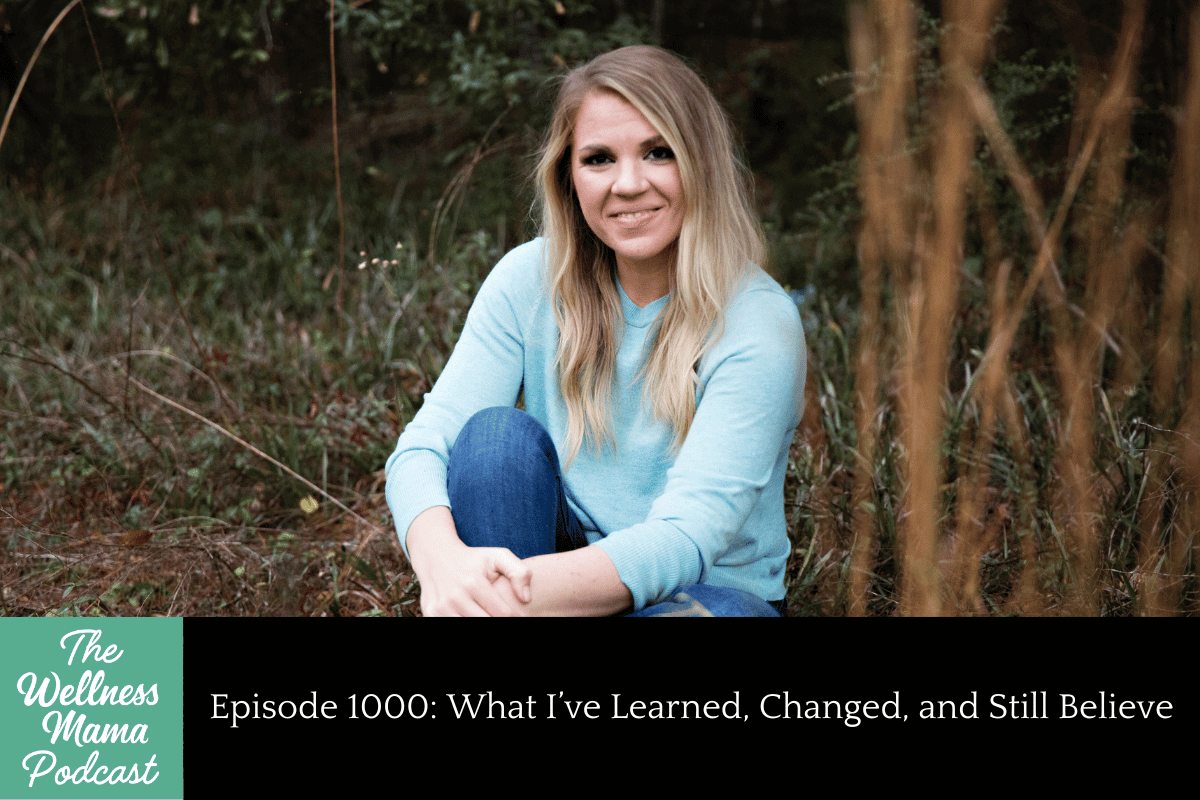
Katie: ?Hello. Welcome to episode 1000 of the Wellness Mama Podcast. It is incredible and hard to believe that I have been here now for a thousand episodes. I know some of you have been here since the very beginning and it’s been so wonderful to get to hear from you over all of those years since 2014. And in this episode, I wanted to get a little bit more personal and kind of walk through the last 10 years, 10 plus years, the last 1000 episodes, and really delve into what I’ve learned, what’s changed, what I still believe. And what’s coming next for this podcast for Wellness Mama.
And I would love your feedback at the end, so please stay tuned for that part. So as a recap, this, we have now had 1000 episodes together. Over, from my best guess and estimate, over 51,000 minutes of podcasts together.
I’ve gotten to speak to hundreds of amazing experts. And this podcast has been listened to now almost 100 million times, which is absolutely mind blowing to me. Like I said, it started in 2014 and it certainly evolved over the years. Some of you, your names, your comments I recognize from years ago, from 2014 when the podcast started, or all the way back to 2006 and 2009 when Wellness Mama first started as well. So it’s been a long time. I feel like I am a drastically different person than I was when it began. I would guess you are too, and I’d actually love to hear a reintroduction to you as well. But if you’re new here, my name is Katie. Online I am known as Wellness Mama.
My favorite job title is Mom and I hear that word about a thousand times a day with all of my kids. I’m an accidental chicken wrangler, a professional experimenter of all things health and wellness. Someone who willingly walked across Legos barefoot and got a world record with some fellow moms in the process.
And over the past thousand episodes, I have gotten the pleasure of interviewing some of what I consider the smartest and most incredible people in the world. I’ve tested everything from butter coffee, to cold plunges, enema to peptides, and everything in between. I’ve always been the willing Guinea pig, and I’ve usually shared my experience, the good, the bad, and the ugly.
And I’ve changed my mind on more than a few things along the way, and some of you have gotten to go on that journey with me as well and see those changes. I would love to hear what you’ve changed your mind on in the last 10 years. Some big ones for me I’ll delve into today. And I started this podcast to indulge my own curiosity and answer my own questions about health, about parenting, and about just living better.
And along the way, you guys have gotten to become part of this wild and wonderful journey. So whether you’ve been here since episode one, or this is your very first time listening, welcome back to the kitchen table of curiosity. And thank you so much from the bottom of my heart for being here. As a recap a little bit of how all of this began. It was never my plan in life to actually even get into the health and wellness world.
I went to school for journalism. I always was intensely curious and I loved to write. And when I had my first baby and started having some strange health symptoms, a lot of you have heard this story before. It ignited a passion for research in the health and wellness world specifically. And years ago when I first started, so much less information was available and certainly less mainstream than it is now.
And it has been incredible to watch that grassroots change happen in homes and in our own lives over these last now almost 20 years. My oldest, who was a baby when all of this began is now an adult. And I’ve certainly grown up along the way with him. Wellness Mama has grown up along the way, and now he’s a fully formed adult in the world as well.
My backstory, the short version is that at his six week follow-up appointment after he was born, I read in Time Magazine that for the first time in two centuries the current generation of American children would have a shorter life expectancy than their parents. And that hit me so hard, holding this perfect tiny newborn and wishing the world for him.
And just reading about what his generation would face and what we have seen largely play out in the rise of chronic disease. The rise of all of the big killers, cancer and heart disease, and autoimmunity and diabetes. And still continuing to see those things rise. So I didn’t know how, but I knew I wanted to help contribute to changing that number and changing those statistics.
And at the same time, I was starting to have some strange health symptoms that got dismissed as because normal, because I was a woman or normal, because I was postpartum or all of the other things we often hear. And in fact, it took me years and many doctors and experts to finally start to pull the thread and unravel some of the mystery of what was going on.
And very grateful for some of the incredible experts who helped me in that journey. And I was given the word Hashimoto’s. A lot of you have heard this story, so I won’t go into the whole one here. I can link to my episodes specifically on how I reversed my Hashimoto’s, but I was given the word Hashimoto’s.
I was told that it would be with me for my whole life, that there was nothing I could really do. I could mitigate it. There were some changes, diet and lifestyle that would help kind of minimize the impact, but that the best I could hope for was remission. That it would never be completely gone, and that I would likely take medication for the rest of my life.
I now from firsthand experience know that that is not true. And it’s been an incredible journey to learn that. To learn to trust my body again, to get to really viscerally feel and believe, and have confidence in the body’s incredible ability to heal in that it is wired for that. It’s our natural state. That it’s always sending messages to us and what we call symptoms and problems are often clear communication from our body.
And that when we support it in the ways it’s asking for it, almost all cases, it knows how to thrive. And I’m so grateful in hindsight. I would not trade that journey for the world, even though it certainly had its hard points. For all of the incredible lessons I’ve learned along the way and all of the amazing people I’ve met along the way.
Another thing I’ll delve a little bit more into later, but that has been a big shift along with my healing journey, is the movement away from that, the way I looked at the body and positioned the body and understood the body in more of a place of fear. Towards now one in a place of absolute appreciation and confidence in the body and what it’s capable of doing. And back then, I know I used to use language like that, I had Hashimoto’s, that my body was attacking itself, and slowly learned that my body’s always on my side. It’s always working with everything it’s given to the best of its ability to move toward absolutely thriving.
And I got to learn it’s language. I got to learn what it was asking for. And I got to learn baby steps that over time completely shifted my physical health and even my experience of life in how good I feel. So now that baby I held when I first perceived that spark that led to Wellness Mama is an adult walking around in the world.
I got diagnosed and then healed from Hashimoto’s. I have gotten to learn so much, write thousands of blog posts to now a thousand podcast episodes, and it’s been an absolutely incredible journey. And I wanted to highlight some of the most common recurring advice from the last 1000 episodes before I got into the more personal aspects of what’s changed for me, because certainly learning from these experts, I feel like I’ve gotten a real world advanced degree in health and wellness through these conversations with these incredible people.
And there were certainly recurring themes. And they might not be the one, they certainly weren’t the ones I would’ve expected in the beginning when I was navigating spreadsheets of supplements and living in extremely regimented health protocol every single day in an attempt to get better.
And I also love that while of course there’s a time and a place for supplements, there’s a time and a place for Biohacks, and I’m deeply grateful for practitioners who can walk the journey with us. The most recurring advice is those simple foundational things that I now talk about on here quite often. And the great news is most of these things are completely accessible to all of us.
If you’ve listened for a while, you are probably by now tired of hearing me say that we are each our own primary healthcare provider, and I feel more and more strongly about this as time goes on, because no outside expert can ever have the physical data, the experience of living in our bodies. The intuition and the beautiful harmonic communication with our own body that we have.
And I do think the best outcomes happen if we’re working through something specific when we get to benefit from the expertise and the very specific knowledge of a practitioner. Along with that data, that valuable data from our own bodies. But I continue to just have it reinforced for me over and over that we are each our own primary healthcare provider.
That we are infinitely capable of thriving. That’s the body’s natural state, and that many of the things that most support that process are completely free or very inexpensive and are often about simplifying, not making things more complicated, which is wonderful news. So some of the things that have come up most often in these last thousand episodes are sleep.
And I don’t think anyone will be shocked to hear this one. It is more powerful, I think, than diet, than supplements, than almost any other lever we can pull. With the exception of a couple that I would say rank about the same. But I’ve never, not once in a thousand episodes had one single expert even allude to or suggest that sleep is not vitally important. We know all the things that happen in sleep, or at least a lot of them, we’re still learning, about the body’s repairing mechanisms that come into play and the deeper detox that happens. How active our liver is. How when we get enough deep sleep at the right time, our glymphatic system is supported
And the beautiful hormonal cascade of melatonin and all the hormones that happen at night that are so deeply supportive for the body. And conversely, we also know that interrupted sleep or not getting enough sleep begins that whole cascade into all hormones being affected. Cortisol being out of range, blood sugar changing, even from just one or two days of interrupted sleep. And so much more.
I will say, ’cause I get this question often, I know that as a mom especially, and as parents, there are times of life where perfect sleep is just not available to us, especially when there’s newborns or toddlers or sick children. And the beauty is the body seems to have incredible wisdom here as well. And seemingly for parents, there are a lot of protective measures that come into play, hormonally and biologically that seem to really mitigate the problems that can come from lack of sleep and that we would normally experience if we were just getting that little sleep for another reason. And also that like that doesn’t have to be perfect, especially in those stages of life. The body is resilient and infinitely capable of healing.
And another, the other ones that I would put right up there almost as important as sleep. And one, the first one I will say, I think is as important and directly related to sleep. They can’t be separated and that is light exposure. And this is something I’m gonna talk more about in the future on this podcast. I think it’s one of the most underrated health tools because it’s, it cannot be turned into a product. It can’t be sold and it can’t be patented. So it’s often ignored.
However, there was an early Nobel Peace Prize in the early 1900s related to the benefits of natural light exposure and sunshine for healing. And I actually think it just wasn’t focused on as much because there was no profit in it. I think it’s one of the most incredible health tools we have at our disposal, and my understanding of it has changed and really evolved over the years.
And this is now sleep and light are kind of my primary focus and non-negotiables most days. I think that they of course, go hand in hand. They affect each other very directly and we know this. And I’ll talk more about the light specific piece, but this has also been a recurring piece of advice in different forms from many of the experts over the years, whether it’s exposure to natural light during the day, being aware of our light exposure at night, especially with artificial light. And the way that our body responds with stress signals or safety signals to our light environment. As well as ways that we can modify our light environment to support our body.
I would also put pretty close to those two, minerals. I’ve talked a lot about different nutrients and supplements over the years, and I keep coming back to minerals. And this is also a recurring theme with experts. And in the future, I’m gonna do a whole series on the electromagnetic nature of the body and how minerals and electrolytes come into play here.
Because I think for a lot of people, voltage is key and it’s not something we. I really understand or are taught. My friend JJ says that the body is not a bank account, it’s a chemistry lab. And I like to add to that, that it’s not just a chemistry lab. It’s this incredible electromagnetic power plant that is doing incredible things on so many levels all the time.
And when we understand it from an electrical first component, it shifts the way we think about supporting the body. What kind of very first opened my eyes to this possibility was reading the book called The Body Electric, and then now I’ve gotten to interview some incredible experts and I’ll link to a couple of the podcast about light exposure and about the electrical nature of the body and how this can be really, really powerful way to support the body. A very powerful lever for health as well. And I feel like minerals are a supportive component of this electrical and electromagnetic cascade that happens within our body.
And the easy way to think about this is that if you have just plain water, it’s not very conductive. It’s actually kind of anti conductive, but if you have electrolyte rich water, it can conduct electricity. And since many of the things that happen in our body are through voltage gated ion channels and they’re electrical in nature, really dialing in our minerals is a wonderful way to support our body and give it what it needs.
Another recurring theme that I found when going back through these thousand episodes that I love, because again, it speaks to the simplicity and the idea of subtraction sometimes rather than addition. When it comes to health is the recurring theme that small, consistent baby step changes, beat drastic changes every single time. And I know there are times, especially if there’s something really intense going on in the body that we do make drastic changes, and that of course has its time and its place. But for most of us and for most things, it’s the small baby steps that we can implement and make habits over time that really lead to the most drastic long-term results.
Also, not surprisingly, movement has been a recurring theme as well, though in perhaps different forms than we might think topically. So we all hear about exercise and the types of exercise, the importance of exercise. I’ve had Dr. Gabrielle Lyon on here a lot to talk about muscle being the organ of longevity, and strength training being very important for longevity.
And I very much have seen that in my own life and how good I feel when I lift heavy weights. However, I think when we only think of movement as exercise, we lose some important nuance, which is that humans are meant to be moving a lot more than we are moving in normal life. And just a workout in the gym every day is not enough movement for the other parts of our body. That might help our muscle tone and our strength, which is vitally important. However, there’s much more to movement than just muscle or just our composition of fat in our body.
There are, and I’ll talk more about these in future episodes, but there’s a whole paseo electric element to this in that when we move, especially things like spiral movements or walking or things that lead to kind of resistance on the bone. Like I think walking is the gold standard for this.
We are actually creating electrical cascades that essentially very simplified, but help charge our cellular batteries. Help our mitochondria and support the body in a lot of ways besides just muscle. So just like I think we did a disservice when we started simplifying sunlight down to vitamin D, I think we lose some important nuance and do ourselves a disservice when we distill movement down to exercise. And the great thing is movement can, like I said, include things like simply walking or jumping on a rebounder or play, any kind of game sport, anything that gets us moving. Or I’ve been doing a lot of mobility and fascia supporting things lately. Which also, fascia has a whole electric, electrical component as well.
That’ll be another thing I go into in the future. But electrical communication in fascia is so much faster than even electrical communication in neurons in the brain. It’s nearly instant feedback loop faster than, like I said, like our, than our brains can communicate. And so this is another area that I think when we understand from an electric first perspective, we get a lot more valuable insight and more ability to affect change.
But this going back to movement in general, being underrated medicine. And there’s been some cool quotes along the way from this, I think perhaps Hunter Cook who said “motion is lotion” and just as, this doesn’t always have to be a workout. We don’t always have to put on workout clothes and go lift something heavy.
It can be a walk in the sunshine. And in fact, I think a barefoot walk in the sunshine is an incredible health tool. Another recurring theme, and this shows up in Blue Zone data as well, is that relationships, community and emotional health matter just as much or more than diet. In fact, I would say the Blue Zone data points to the quality of our human connections being a more important factor than diet.
It statistically, is actually as important or more important than whether or not we smoke. And this one we, of course, have seen interruptions in in the last decade. And I think for a lot of people, this really highlighted how important this was when we all were removed from our normal human connections, or at least the ways we were used to them.
A lot of people felt a difference. Mental health, we know took a dip across the board. There’s some really drastic things that can happen there. And so for me, after hearing from all these experts and just from personal experience, community is something I now prioritize and actively build. In this past year, I even opened an in-person wellness center because I think while things like sauna and cold and all of the health modalities are so beneficial, they’re even more beneficial in community. And this is a really strongly correlating factor that shows up in Blue Zone data.
I don’t talk as much about parenting on here, though I’m planning to talk more about it in the future, and I am actually finishing a parenting book that I’m slightly hesitant to release.
However, that might be on the horizon as well. But my parenting approach has certainly shifted and evolved as my kids have grown over the years. And I guess the core that I would pull out here, and I’ve had some great guests on as well. Like Positive Parenting Solutions and others, is that children thrive when parents focus on presence and connection, not perfection.
And when we focus on connection over control. And certainly, like I said, this was an evolution. I definitely have shifted a lot since my first children were little, and this is a category where I wish I could go back and tell my younger self so many things. And I’m grateful for the lessons I’ve gotten to learn along the way, but perhaps more parenting conversations coming soon.
Another recurring theme in lots of different forms, people have called it lots of different things. I call it nature deficit disorder. And I think this is actually a leading driver of a lot of problems, or at least a factor that we can influence that will help resolve a lot of problems, is our connection and exposure to nature in the correct way. I think a lot of things are at least made worse, if not directly related to Nature Deficit Disorder. As humans, we were meant to live much more in harmony with nature than we do in the modern world. Meaning barefeet on the ground, benefiting from the electrons of the earth. Meaning natural light exposure and the hormone cascade that happens from that, far beyond just vitamin D.
The infrared light that is available to us for free anytime the sun is shining. We spend money on all these fancy devices and red lights and saunas, which are amazing. And I have them too. And infrared light is available from the sun when the sun is out, even sunrise and sunset.
And I think, and I’ll talk about this more in the future as well. That infrared light deficiency is perhaps one of the kind of silent and chronic factors that is affecting a lot of people. So it sounds oversimplified. I think a lot can be benefited by us simply spending more time outside in our natural environment that we were meant to live in.
And this can be as simple as you’ve heard me mention before, morning sun exposure. Ideally seeing the sunrise with your bare eyes, no glasses or contacts or windows in the way, and getting that light signaling. And then every time we go outside during the day, it reinforces these circadian signals. It sends our body a clear message of what time of day it is.
It triggers melanopsin receptors and many other things in the eyes and in the skin that lead to our hormone cascade that impacts sleep. We also ge fresh air while being outside. Hopefully, depending on where we live. And all the questions I get related to this to briefly touch on them. That morning sunlight and sunlight throughout the day, still beneficia even if it’s cloudy. You’re still getting much more beneficial light outside than in the brightest indoor room. Still beneficial if it’s raining. Still beneficial if it’s winter. The light is so much more than just the vitamin D or UV that’s hitting our skin. And personally what I do these days is prioritize being outside even for just 10 minutes during the sunrise whenever possible, which is almost always while hydrating.
So like you’ve heard me mention as well, hydration and protein before caffeine, but even just that 10 minutes starts, the hormonal cascade. Sets the biological clock for better sleep at night. And then I try to reinforce that feedback by getting little light exposures throughout the day. I personally also do get midday sun exposure on purpose.
It’s a controversial opinion, but I personally for me, feel that midday exposure to the full spectrum of bright light, without sunburn, is actually one of the most positive things I’ve done for my health. And as I’ve lowered the inflammation in my body and learn slowly to have good, not just sun tolerance, but I would say sun thriving.
I feel a physical difference when I get that bright midday sun. Almost like a euphoria when I get that light on as much of my skin as possible, and I notice a difference when I don’t get it. So even in the winter, I’ll try to be outside in that natural light. Even if it’s only hitting a little bit of my skin.
And in the summer I soak it up as much as I can. I’ve talked about before how I used to burn from a few minutes in the sun and now I don’t sunburn basically at all and my skin seems to thrive. Even my Irish Scottish heritage skin seems to thrive from sun exposure. So you’re probably hear tired of hearing me talk about sun.
It’s something I definitely will talk about more in the future. Including going deep on topics like why I don’t wear sunglasses or sunscreen and what I personally do, but that has been a recurring theme. And I think one that is shifting in kind of the collective mainstream also in the last 10 years.
Another recurring theme is the biological individuality that comes with health. And that there’s no one size fits all. I’ve said this before as well, but every one of these amazing experts I’ve gotten to interview has incredible knowledge, has figured out something vital for them and things that have helped many, many people.
And I feel like with anyone, it’s important to remember, and I say this especially and including me, that when we have figured something out, we figured it out for ourselves. And being curious about that and listening, I think we can learn something from truly everyone we encounter, everything we read. But I tend to think of that as learning from a sense of framework, not a blueprint. So we can learn from their experimentation, we can learn from their general principles. It still requires experimentation for us because it’s not always apples to apples because we are so individual based. Not just on our genes, but on our environment, our exposures.
What’s currently happening in our bodies and the data we get from our own bodies is so much more valuable than what any expert can tell us. And so this is another one. I think like the personalization aspect. We now have so much in data that we have access to in wearables that can tell us insights in our health, in labs like Function, that give us kind of a great snapshot of what’s going on in our body. And to not lose that very important personal feedback and intuition and symptom experience of being in our body and that feedback loop that we get almost instantaneously. And then one that’s occurred in lots of different ways, and then I’ll kind of sum up again that I mentioned briefly, is that food is information for the body, not just fuel.
And like I said, my friend JJ has for years summed this up so beautifully by saying, Your body is not a bank account, it’s a chemistry lab. And like I said, I like to add on that it’s the most sophisticated electromagnetic power plant that we know. And I’m gonna, like I said, elaborate more in that in the future.
And lastly, the theme that I hear a lot from experts, again is that progress is better than perfection. That those baby steps are better than drastic changes. That it does not require anything drastic, but rather that quiet listening, the small changes, the finding a little bit more relaxation and peace and resilience rather than often adding more.
I’d also love to run through things I feel like I got wrong or changed my mind on, or am still evolving over the years. And when I started writing this list, I realized it was gonna be a long one because a lot has changed and certainly I had very strong opinions strongly held for a lot of years.
Now I feel like I have strong opinions, much more loosely held and fewer of them. But there were certainly a lot of soap boxes I stood on and hills I was willing to die on that I have since shifted my opinion on. Long time listeners, you might have heard me mention before that I start each year by making a list of things I am pretty certain I believe to be true.
And then I question those things throughout the year. And this includes things in the health world. And I’ve noticed over the years that this list has gotten shorter each year. That I have a lot less certainty, a lot more questions, and a lot fewer really strongly held beliefs that I think are absolutely true, including in the health and wellness world.
And it’s been fun to actually learn and get to admit that I’m wrong about a lot of these things. And some of you guys have been with me through all of these journeys. I’d love to hear what shifted for you also in your health journey or what you’ve changed your mind on. A big one for me is food dogmas.
When I came more from a place of fear, that seemed to inform how I thought about food a lot, and I had a lot more fear related to foods, and I’m grateful for the experience of it. But there were times in my autoimmune journey, and especially doing autoimmune protocols where I was eating very, very few foods, which I don’t think was sustainable.
And I think there’s a time and a place personally for those protocols, but they’re not meant to be long-term sustainable solutions. And at the time I didn’t realize that. I just knew, I felt mildly better from restriction and I moved into a more and more and more restrictive model. Which over time I had to sort of unlearn and sort of rehab my body to be able to listen to what it was saying for one. And also to realize that for me, healing was not about feeling good in a very narrow range of restricted inputs, but being adaptable and resilient with a wider range of inputs.
And having both metabolic flexibility, lifestyle flexibility, without having this drastic impact on my health. So I’ve been through the gamut. Some of you guys have been through it with me on stricter Paleo, AIP, Keto, across the board, and now I would say I have a lot more nuance and flexibility.
And a lot more for me personally, connection with my body in real time and listening to what it needs versus what a protocol tells me. And this also what I would say is one of my biggest shifts I mentioned briefly, was movement away from a more fear-based understanding of the body and fear-based place of decision making, to a place of confidence in the body’s ability to heal. Of our harmony with nature.
And with the fact that our body is always on our side. Dr. Cassie Huckabee, who I also had on this podcast, I love her episode, she says, your life is your medicine. And she talks a lot about how your body is always on your side. And I feel like the more I have learned to shift my inner dialogue to that, to pay attention to what my body’s saying, it’s had tremendous impact on my health.
And that wasn’t where I came from in the beginning. Early on I was much more in the research and cognitive and data backed. And I do think those things are still have their place, of course. But I think the best data we get is from our own bodies and our own experimentation. Like I said, my belief list gets shorter each year and my questions list gets longer and I love this.
It’s been quite the journey and even when it comes to health, there are very few things I would even attempt to label as universal principles for human nature other than the ones I already kind of touched on. And that’s been a big shift for me ’cause I have written posts in the past about how grains are killing you slowly. Or how we all need magnesium. And while that may be true that a lot of people still need magnesium, and that does tie into the electromagnetic side I was mentioning. I realized there’s a lot, a lot fewer universal things than there used to be for me. And that the ones that make the list are those ones that I’ve already touched on briefly, like sleep and light and nature.
Certainly have also evolved my parenting approach and homeschooling approach, which I touched on and I know many of you have waited for a long time for Unnstitute. I hope to get that out very soon. That has just been in such a rapid evolution, even as I was creating it, because it has evolved and grown with my kids. And the crux of the whole framework is not a curriculum.
I think that’s one big thing that shifted for me is I don’t personally believe that any child benefits from a cookie cutter curriculum because they’re each so different. And that a more personalized approach that is less dogmatic and less about the bookwork and less about what they should learn and more about curiosity and love of learning and how to learn makes a drastic difference.
I also counterintuitively do not completely limit screen time by any means in my house. And that shifted over the years. I certainly, when kids are really little, I don’t do screens for the first few years at all. However, as we all know, as adults, screens are ubiquitous. They’re everywhere. They’re part of our lives.
Our phones are for better or worse connected to us. And this is something our kids are very likely going to navigate their adult lives with. So I don’t, I didn’t feel like all or nothing approach was going to serve them and learning how to navigate that. So taking a much more conscious approach to screen time.
And recognizing that I myself can’t model having no screen time either. And so attempting to have a healthy relationship with that myself and then be able to model that for my kids as well. Certainly my thoughts on supplements have changed over the years. I do still think they have a time and a place. I take a lot fewer than I used to. So I’m more of a supplement minimalist these days and much more strategic I feel than when I was just trying to take anything and everything I could that might help me. And basically this also has shifted to coming more from a voltage informed place than from a treating a symptom with almost like a pharmaceutical mindset.
But through supplements instead of pharmaceuticals. And for me the the voltage first approach has really shifted how I think of supplements and what I take. And I still do take some. And I might do a follow up episode on what I’m actually doing personally now at some point in the future. But I just take a lot less than I used to and I don’t actually feel they’re necessary.
I’ve had for a long time, and you guys might have heard me mention this, I take weekends off so I don’t take anything all the time. I think that’s an important factor for me and I also just don’t stress about it. If I miss supplements, I’m not worried at all. I sometimes go for a couple weeks without taking them.
And just kind of try to tune in and listen to my body. I have shifted some, and this is ever evolving, like I said, about movement and exercise and what’s beneficial there. And moving away from punishing workouts. I used to try to work out really hard to punish my body into being the size I wanted it to be.
And now I’m much more focused on nervous system and capacity and fascia and mobility. I still lift weights also. But I have been in more of an experimentation with play and dance and fascia and walking and spiral movements and things that I did not use to include at all. Also I would say some of the biggest shifts that I have had and changed my mind on a lot is my approach to motherhood.
And I believe many of us get to go through this journey as we become parents and then go through all of the years with our children. And unpattering the things that we ambiently picked up, or patterns we had from our own childhood, and becoming aware of them. And conscious of them. And then getting to choose which ones we feel like are loving and we wanna keep, and which ones we wanna shift or take a different approach than perhaps what was modeled for us with. And in this sense my kids have been absolutely my greatest teachers and my approach to parenting has shifted a lot over the years. I feel, and I hope it’s shifted a lot away from more of a control model to more of a connection model.
I will say there’s very little like discipline related things that have to happen in my house these days and that there’s a lot more connection than there used to be. I feel like this has been very fulfilling in my family and something I may talk about more in the future as well as the book I mentioned.
Certainly a lot comes with writing a parenting book and I’ve avoided that for a long time because I didn’t want the pressure on my kids. And I found a way to finally share that simply from my own direct experience and inner experience without having a dogmatic approach. More of a curiosity based approach there as well, and without sharing my kids or any of their personal details.
And on that note, that’s actually one thing I have been relatively consistent on and that hasn’t changed. So I’ll mention here, even though it’s a little controversial, I feel like this, this is actually maybe growing in popularity a little bit. But I have not posted my kids on social media publicly, certainly on this platform.
What has shifted a little bit is when they were little, I sometimes posted them on my private social media profiles for family, and now I have moved away from that even. And very firmly feel it will be their decision if or when they ever choose to engage with the online and digital world through having an online presence.
This is not something I feel like is across the board or that I suggest or feel like I’m trying to impress upon any other family. My personal approach is that I don’t feel like even though I’m their mom, that I want to make the decision for them if they are on the internet or not. Once things are on the internet, it’s very hard to take them off the internet. And I want them to get to choose if or when or how they ever have an online profile or footprint.
I also do think it’s interesting to step back and evaluate things from the perspective of what we share. We assume, I think often that the internet and social media is a much more private and safe environment than it is, and we share so much of our kids’ lives. Or we can before they’re old enough to consent or even understand.
And that does live on the internet kind of forever. And I, I feel like we would not go in public and if a stranger asked us like, oh, can I take a picture of your baby? What’s your baby’s full name? What date was your baby born? We would feel really strange about giving that information to someone we didn’t know, yet putting it on the internet is essentially that. And again, this isn’t something I’m trying to convince other people on, it’s just something that feels very important for me. Is kind of protecting my kids from that digital environment until a time where they might or might not choose to engage with it, but letting that be their decision.
And I will say, my two oldest do have some forms of social media now. We’ve had conversations around how they navigate that, but it has been their decision, not mine. And I don’t have pictures of them throughout their childhood online. Though I have many, many of those on my personal files that I will treasure forever.
Another one I’ve touched on and I wanted to summarize here ’cause this has changed a lot for me, is that health is not about doing more, but about aligning with nature and simplicity. My super type A mindset in the past, I definitely had a do more approach for a long time. And actually ironically in hindsight, created nervous system stress by all the things I was trying to do to be healthy, and things shifted a lot.
I’ve talked about my journey through releasing trauma, through dealing with the emotions and through simplifying. And how my health even shifted when I did those things, even though I was eating more. I didn’t even do any form of formal exercise for years when I was healing. I gave my nervous system really deep rest.
I did a lot of walking, swimming, gentle, gentle things only, and slept a ton and let my body restore, and it knew exactly what to do when it was given those tools. Another area I’ve touched on a couple times, but to recap, is that I moved from much more of a biochemical or physiological lens of health to a more electrical and electromagnetic lens.
Taking into account things like light, mitochondria, fascia, minerals. I’ve gotten to do some amazing interviews with people about this. I’ll link to the ones from Dr. Courtney Hunt. I did a great light deep dive masterclass episode that was a couple of hours long. But that has been absolutely paradigm shifting for me and made a drastic difference in my health, and it’s something I do prioritize.
In fact, when I finish recording this episode, I will be going outside in the sun with as much skin showing as possible. And my non-negotiables have become so different. It used to be things like avoiding gluten or eating a very specific diet or taking supplements or all the much more dogmatic approaches.
And now it’s things like light, sleep, minerals, hydration, peace and connection, and starting with those.
So I don’t wanna get too long-winded ’cause I wanted this to just be a fun recap, but looking ahead to the next thousand episodes and beyond, this is where I would love to get your feedback and hear directly from you what you would like to see. Because this is a community. I think community is vitally important and I would love to know what you’re most interested in and curious about and what would serve you the most to have experts come on and talk about. Some possibilities that I would love your feedback on would be releasing things like a book called Be Love, which has been about the inner journey and the mindset that I have gone through. A book on unparenting, as I call it. I’m considering doing a lot more YouTube and video if that’s something that would be beneficial or helpful for people. I’ve not ever been much of a video watcher, so I’ve always kind of resisted that.
Though I’m aware a lot of people love to learn from video, so love your feedback on that. And I also opened an in-person wellness space like I mentioned, because I think community is so important. So if you happen to be in the local area where I live, for those of you who know where that is, I would love to see you in there.
And if not, no matter where you live, I highly recommend and would love to hear about ways that people are curating and building conscious communities wherever you are especially if there’s a fun element of wellness in it. Whether you’re doing things outside, whether you’re sauning together, whether you’re getting together for potluck and making nutritious food, and then playing outside, whatever it may be.
I think this is truly one of the best things we can do for our health is to nurture community. And I would love to continue to do that in my own area, but also to hear how you’re doing it in yours. And as always, I deeply value your feedback. If you want to leave a comment on this podcast, if you want to direct message me on Instagram, I would love to hear what you would like to see in the next thousand episodes of this podcast.
But for those of you who have joined, whether it’s the first time or you’ve been here since the beginning for today, I’m so, so grateful that you have shared part of this journey with me. It has been truly a pleasure and one of the deepest joys of my life to get to connect with you through this community. Through the wonderful technology that lets us unite through the digital world. And to get to learn from not just experts, but from so many of you as we’ve been on this journey together. And through your questions and through you challenging me on things I’ve written in the past. Some of my greatest lessons have come from those old dogmatic posts that I wrote and being boldly challenged by comments, and I’m so grateful for that.
And so I’m grateful for you for listening, for being here, for sharing your time with me. I would love for this to be a collaborative journey going forward as well. So please leave feedback and if you have a moment, I would be deeply grateful if you would leave an honest rating or review wherever you listen to podcasts as that helps people to find and listen to the podcast. Helps other families, to connect as well and helps support the mission of Wellness Mama.
And I look forward to the next 10 years and the next thousand episodes with you. Thank you for sharing your time, your energy, and your attention with me today. I don’t take that lightly. I’m so grateful that you did, and I hope that you will join me again on the next 1000 episodes of the Wellness Mama Podcast.




Leave a Reply