


Spirulina Benefits: 7 Reasons to Try It (& 1 Major Caution)

Katie Wells Avatar

Reading Time: 6 minutes

This post contains affiliate links.

Read my affiliate policy.

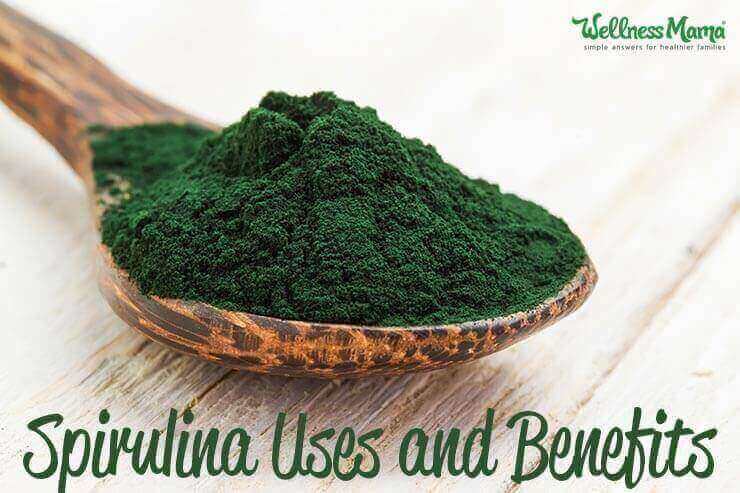
Spirulina Uses and Benefits
Wellness Mama » Blog » Natural Home » Spirulina Benefits: 7 Reasons to Try It (& 1 Major Caution)

I don’t like using the term superfood, though it could certainly be applied to Spirulina (and is sometimes used for coconut oil). Surprisingly, you may know this amazing compound by its common name…

Pond scum:

This nutrient rich substance is actually a cyanobacteria and it boasts its fair share of health promoting properties. It is rich in chlorophyll, and like plants, gets its energy from the sun. It does have many benefits, (though contrary to some health claims, I’ve seen no evidence that it cures cancer or HIV).

What is Spirulina?

Spirulina is a natural “algae” (cyanbacteria) powder that is incredibly high in protein and a good source of antioxidants, B-vitamins and other nutrients. When harvested correctly from non-contaminated ponds and bodies of water, it is one of the most potent nutrient sources available.

It is largely made up of protein and essential amino acids, and is typically recommended to vegetarians due to its high natural iron content.

The high concentration of protein and iron also makes it ideal during pregnancy, after surgery, or anytime the immune system needs a boost.

Benefits of Spirulina

Though it does taste like pond scum, Spirulina has some great health-boosting qualities:

1. Most Nutrient Dense Food On the Planet

The concentration of protein and vitamins in Spirulina has led many to classify it as the “most nutrient dense food on the planet.” Compared to other foods gram for gram, it lives up to this reputation and is a great source of:

  • Protein: It is considered a complete source of high-quality protein and is often compared to eggs for the amount of protein per gram. The protein in Spirulina is highly usable and has a net protein utilization rate of between 50-61%
  • Vitamin B1: Also called Thiamin, this vitamin is necessary for the digestion of fats and proteins. It is often taken for increased energy, eye health, brain function and for improving nerve functioning.
  • Iron: Spirulina is a favorite food for vegetarians and vegans because it is one of the best plant sources of iron. Even for those who consume meat, it has a highly absorbable form of iron that is gentle on the digestive system.
  • Calcium: Spirulina is also incredibly high in calcium with over 26 times the calcium in milk.

It also contains (per Tablespoon):
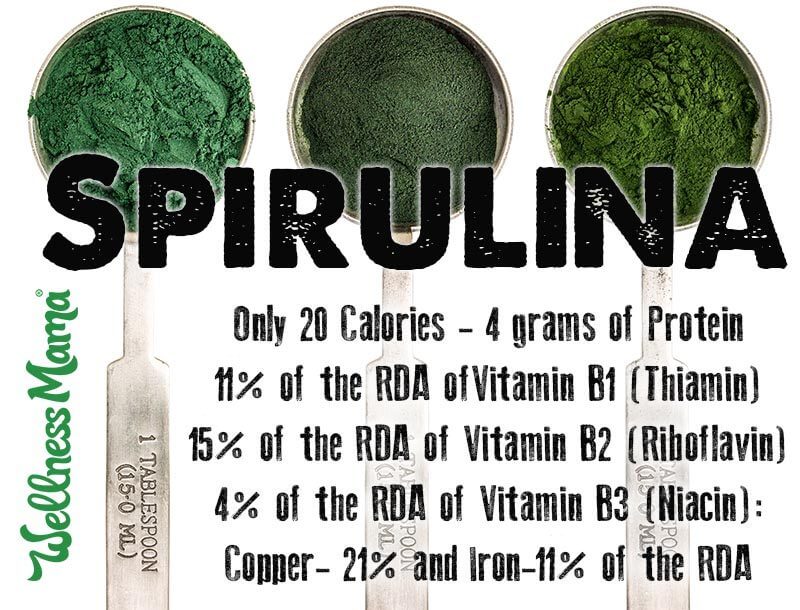
Spirulina nutrition benefits

Spirulina is a great source of other nutrients including (according to Wikipedia): “It contains vitamins B-1(thiamine), B-2 (riboflavin), B-3(nicotinamide), B-6 (pyridoxine), B-9 (folic acid), vitamin C, vitamin D, vitamin A and vitamin E. It is also a source of potassium, calcium, chromium, copper, iron, magnesium,  manganese, phosphorus,  selenium, sodium and zinc. Spirulina contains many pigments which may be beneficial and bioavailable”.

Important Note: Contrary to many claims, Spirulina is not a good source of Vitamin B12 for humans. While it does contain a form of B12, it is pseudovitamin B12 which is not absorbable or effective in humans according to studies.

2. Contains Gamma Linolenic Acid (GLA) & Omega-3s
Spirulina contains Gamma Linolenic Acid andOmega-3s

Spirulina is 65% protein and amino acids including the essential fatty acid gamma linolenic acid (GLA) which has gotten a lot of attention for its anti-inflammatory properties, especially when taken with other quality Omega-3 supplements.

GLA is difficult to find in a food source and normally has to be created by the body. Spirulina is one of the few foods with a natural GLA content.

I suspect that the benefits of GLA in Spirulina are even more than what the studies have found since these studies often use vegetable oils for their GLA source, and the other inflammatory compounds in vegetable oils can interfere with the anti-inflammatory ability.

Besides GLA, Spirulina also contains Omega 3-,6 and 9s and is especially high in Omega-3s.

3. May Help Balance Blood Sugar

Studies show that spirulina may be especially helpful in balancing blood sugar, and may even be as effective as diabetes medication in some instances. Other studies show that it not only lowers blood sugar but may also lower HbA1c, which is a long term marker of blood sugar levels.

4. Powerful Antioxidants

Antioxidants are powerful substances that protect our cells from damage. Thanks to decades of research, many of us understand the importance of consuming enough antioxidants from natural sources, and spirulina is a great choice.

The antioxidant that makes spirulina unique is called phycocyanin, which is a potent anti-inflammatory.

5. May Help Those with Allergies

Some research has suggested that Spirulina may be helpful for those with allergies and allergic reactions. (source)

This is likely because it reduces inflammation that leads to nasal congestion and other issues. In studies, those who took spirulina noticed a reduction in nasal congestion, itching, and sneezing.

6. Helps Remove Heavy Metals

Spirulina can bind with heavy metals in the body and help remove them.

It is also extremely high in Chlorophyll, which helps remove toxins from the blood and boost the immune system. In fact, one study found that 500 milligrams of spirulina daily combined with zinc supplementation was enough to reduce arsenic toxicity by almost half!

Emerging evidence also suggests that it binds with radioactive isotopes and may be useful for radioactivity exposure or radiation therapy.

7. Muscle and Endurance Benefits

Spirulina is known to increase fat burning during exercise. Its high antioxidant content makes it beneficial in reducing exercise induced oxidation which leads to muscle fatigue and inability to gain muscle.

In fact studies found that it:
health benefits of spirulina powder

Cautions on Spirulina

Those with phenylketonuria (PKU) should consult with a doctor before taking, as it does contain that amino acid. Those on any type of anti-coagulation medicine should consult with a doctor before beginning (or stopping) taking Spirulina. Some people with autoimmune disease do not do well with this supplement. If you are pregnant, nursing or have any medical condition, check with your doctor first as it is often not recommended for pregnant or nursing women.

Downsides of Spirulina

As I mentioned above, this beneficial algae is gram for gram one of the most nutritious foods on the planet. It is also probably one of the most expensive when compared gram for gram. Many articles about its benefits focus show the nutrition data per ounce. The problem is that one ounce contains about 28 grams and is MUCH higher than normal (or safe) daily intake would be.

It costs up to 30x as much as dairy or meat protein per gram and is not a viable primary protein source for this reason.

Is Spirulina the Same as Chlorella?

Short answer: No, but they share some similarities.

Both are types of algae but there are some key differences:

  • Structure: Chlorella is a single-cell algae with a nucleus, while Spirulina is a multi-celled plant with no nucleus. For this reason, chlorella is much smaller and acts differently in the body.
  • Color: Spirulina is a cyanobacteria, a blue-green type of algae, while Chlorella is a green algae.
  • Amount of Nucleic Acids: Both are a good source of nucleic acids, though Chlorella has almost twice as much per gram. Nucleic acids are important factors for DNA and RNA in the body.
  • Digestibility: Chlorella has to go through a process to break its cell walls before it is bioavailable and usable by the body.
  • Chlorophyll Content: Chlorella is higher in Chlorophyll, with almost double the amount.
  • Iron, Protein and GLA: Chlorella is not a great source of Iron, protein and beneficial Gamma-Linolenic Acid (GLA).
  • Heavy Metals: Chlorella has unique properties in its cell walls that make it bind to heavy metals and other contaminants

How to Take Spirulina (& What I Use)

I use a couple of different sources of spirulina that all checked out when I did my research.

  • Spirulina Powder – The least expensive but has a a strong flavor
  • Spirulina Capsule – Small, portable tablets called “EnergyBits.” Very easy to take and no unpleasant taste. Use the code “wellnessmama” at this link for 20% off.

For more on why spirulina and chorella are so beneficial for health, check out this Wellness Mama podcast interview with EnergyBits creator Catharine Arnston.

This article was medically reviewed by Dr. Scott Soerries, MD, Family Physician and Medical Director of SteadyMD. As always, this is not personal medical advice and we recommend that you talk with your doctor.

Ever tried spirulina? What did you think of the taste? Will you try it now? Share below!
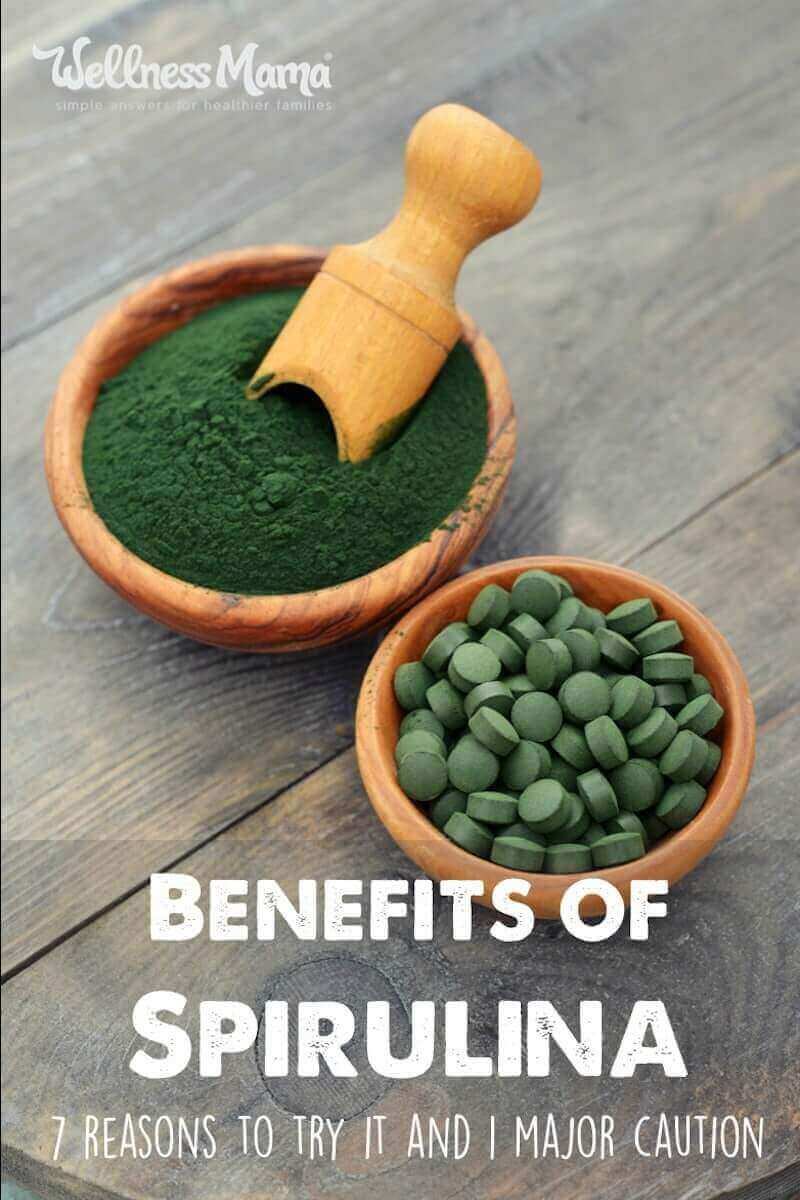
Spirulina is a superfood plant source of protein, minerals, vitamins, and antioxidants. Benefits include fighting anemia, good for blood and heart and more!
Sources
  • University of Maryland Medical Center Report on Spirulina
  • P. D. Karkos, S. C. Leong, C. D. Karkos, N. Sivaji, and D. A. Assimakopoulos, “Spirulina in Clinical Practice: Evidence-
  • Based Human Applications,” Evidence-Based Complementary and Alternative Medicine, vol. 2011, Article ID 531053, 4 pages, 2011. doi:10.1093/ecam/nen058
  • The Medical Research of Spirulina – Cyanotech Corporation
  • Park, Hee Jung;Lee, Yun Jung;Ryu, Han Kyoung;Kim, Mi Hyun;Chung, Hye Won;Kim, Wha Young, “A randomized double blind, placebo controlled study to establish the effects of spirulina in elderly Koreans,” Annals of nutrition & metabolism. 2008.

Become a VIP member!

Get access to my VIP newsletter with health tips, special deals, my free ebook on Seven Small Easy Habits and so much more!

Easy Habits ebook on ipad
Katie Wells Avatar

About Katie Wells

Katie Wells, CTNC, MCHC, Founder of Wellness Mama and Co-founder of Wellnesse, has a background in research, journalism, and nutrition. As a mom of six, she turned to research and took health into her own hands to find answers to her health problems. WellnessMama.com is the culmination of her thousands of hours of research and all posts are medically reviewed and verified by the Wellness Mama research team. Katie is also the author of the bestselling books The Wellness Mama Cookbook and The Wellness Mama 5-Step Lifestyle Detox.

Comments

471 responses to “Spirulina Benefits: 7 Reasons to Try It (& 1 Major Caution)”

  1. Nola Avatar

    hey!! I’ve been having spirulina since I was a baby and the way I have it is ibpn my milkshake !!!!!
    its actually very yummy !
    Here is my recipe

    1 banana
    1 cup of berries (mixed)
    1 cup of yogert
    milk ( to get ur texture)
    1 tablespoon of spirulina powder

    BLEND
    ENJOY
    !!!!!!!!!!!!!

  2. Julia Avatar

    I’m confused by the links. I wanted to purchase based on your recommendation. WHen I click your link, I get this site which doesn’t appear to be afiliated with Mountain Rose Herbs and it doesn’t seem that they are selling that brand’s product: https://thrivemarket.com/p/nutrex-hawaii-hawaiian-spirulina

    When I checked the Mountain Rose Herb site, I found this page: https://www.mountainroseherbs.com/products/spirulina-powder/profile

    Can you verify which one you are referring to and correct your links if needed?

    1. Katie - Wellness Mama Avatar

      Both are good. Several people were asking for an option with faster shipping than Mountain Rose Herbs, so I listed the other one as well, but either option is great.

      1. Rajat Avatar

        I read somewhere that the Nutrex Hawaiin powder is not organic. Have you, by any chance, aware of this?

        Cheers

  3. Tina Avatar

    When taking both spirulina and fermented cod liver oil, could the high amount of vitamin A be harmful?

  4. Patrick Avatar
    Patrick

    As someone who is just starting out I’ve been experimenting a little … here is an idea that I tried today that I haven’t seen anyone mention yet… adding spirulina and wheatgrass to homemade tuna salad. My tuna salad uses lots of pepers (cayenne, red, banna, plain black) and whatever pickles my kids haven’t eaten :-). Even though the salad turned an awesome green color, I couldn’t taste either the spirulina or the wheatgrass.
    Hope this helps someone when looking for new ideas.
    Cheers,

  5. Kolleen Dohermann Avatar
    Kolleen Dohermann

    I add a tablespoon to my smoothie and i feel like a lot gets wasted. I find the powder on the blender blade, on the walls of the blender. I want it all !!! Is there anyway to dissolve it then mix? I don’t want to make a big production of it, I just want all the health benefits.

    1. Wellness Mama Avatar

      Hm… You might try blending the smoothie a little first, then once it is pretty wet stir in the powder. I don’t know if that counts as making a production, though.

      1. Elizabeth Avatar

        I find that adding powders to blender container in the right order helps. First is is liquids, then nutritional superfood powders, then protein powders, then last add frozen or fresh fruits and/or ice cubes. This seems to ensure that the powders don’t end up stuck to the lid. You could also try swishing the powders around in the juice (after adding to the blender container in the proper order) by hand before adding the solid fruits, veggies or ice. This seems to be what works best for me.

  6. Johanna Avatar
    Johanna

    Is Pure Planet a good brand? Why may it not be good for those with autoimmune diseases? What about migraines?

  7. mariska Avatar
    mariska

    I agree with most that it tastes like pond water. My solution is to add a little bit of pink salt to my smoothies to offset the taste (also works with bitter greens like kale etc).

  8. christa Avatar

    Good Afternoon All –

    I am enjoying the thread. I guess I would like to know how do you know what powders (maca, Spirulina or others). Do you rotate or is there a way to know which is best?

    Thank you,
    Chris

  9. Yvette Avatar

    Along with adding spirulina to my veggie and fruit smoothies, I throw in some fresh mint which totally masks the flavor that I don’t particularly like. I think one can get “use to” the flavor, but it just isn’t happening for me; thus, the fresh mint allows me to consume spirulina everyday. My husband, who cannot stand the taste of spirulina, has no idea there is spirulina in his smoothie when I add mint. He just doesn’t understand why when he makes his smoothie, it’s not a dark green-lol! I’ve also had it on popcorn, and while it obviously doesn’t taste like butter, it isn’t bad. I’ve even had it sprinkled on French fries, and that was pretty good when I dipped them in mayo. I know, I know, French fries, mayo, not necessarily health food. But these are my small steps to becoming healthier. We live on Maui, and we can get the Hawaiian spirulina at Costco. So maybe it’s at Costco on the mainland? If not, maybe from Costco website? Mahalo for your site!

  10. Anna Arguello Avatar
    Anna Arguello

    I need to make a chewable iron rich gummies for my toddler. Do you think spirulina would be a good source and if it is, should I use the liquid or powder for the gummy vitamin recipe?

  11. Audrey Avatar

    What about spirulina protein powders? Are there any cons to using the powder as a meal replacement vs putting spirulina in an actual smoothie. I have been using the GNC Superfoods Spiru-Meal with pretty good results.

  12. debbie Avatar

    I used spirulina in my son’s bday cake and frosting and it wasn’t so bad. He wanted a blue cake with blue frosting and I read that it can be used as a natural food coloring. I didn’t put a ton in and I did eventually add a few drops of food coloring, but it wasn’t so bad of a taste and it was slightly blue (even though it is more of a green color in itself).

  13. Ed Avatar

    I have a very physically demanding job. What is the most effective way to take spirulina: 1 tsp/4g of spirulina once a day (e.g. in the morning before I head for work) or 2 x 500mg tablets/capsules four times a day? Or doesn’t it matter how I take it?

    1. Catherine Jadot Avatar
      Catherine Jadot

      I would prepare snack to eat during the day. Every time you feel tired, just grab one and you’ll be ready to go.

  14. Anastasia Avatar
    Anastasia

    Tastes bad? I guess I have a weird taste, because I love it! And I enjoy licking off the leftover clumps that are stuck to the spoon after mixing 🙂

    1. Catherine Jadot Avatar
      Catherine Jadot

      mmmh, still have a hard time with powdered spirulina. No problemo with the fresh though… 🙂

  15. Jojo Avatar

    My favourite way to take spirulina is in a smoothie.
    I use frozen banana, whatever kind of milk I have on hand, a bit of peanut butter, and sometimes turmeric.
    Sometimes throw in other frozen fruits.

  16. J Kent Avatar

    This supplement changed my life! I am no longer exhausted, I have been sleeping better, my mind is sharper and my overall health during the winter months has improved. I believe it is the use of this supplement that has made the difference as it was the only thing I changed about my routine. I take the pill form as I don’t think I could stomach the taste if I were to drink it.

  17. CJ Avatar

    For the last year I have had high labs on my calcium. I’m 58 female my md says for me not to take calcium. Should probably check with her before I take it. How much calcium is in it?

  18. Melody Avatar

    Is it really safe while breastfeeding? WebMD says to avoid because possibly unsafe (if contaminated) and that basically not enough is known to approve of during this time. I am breastfeeding and have been using in smoothies, but I am wary with the conflicting information out there.

  19. Elizabeth Avatar
    Elizabeth

    I have Lupus, fibro, and sjogrens. Would this stuff help me any? Or do I need to be careful? Tia

    1. Sheila Avatar

      Try the autoimmune protocol diet. It’s an offshoot of paleo and what I have read so far is very positive in regards to reducing inflammation and calming the immune system. It’s not something that will work overnight, but given time, you may experience some symptom relief.

Leave a Reply

Your email address will not be published. Required fields are marked *