


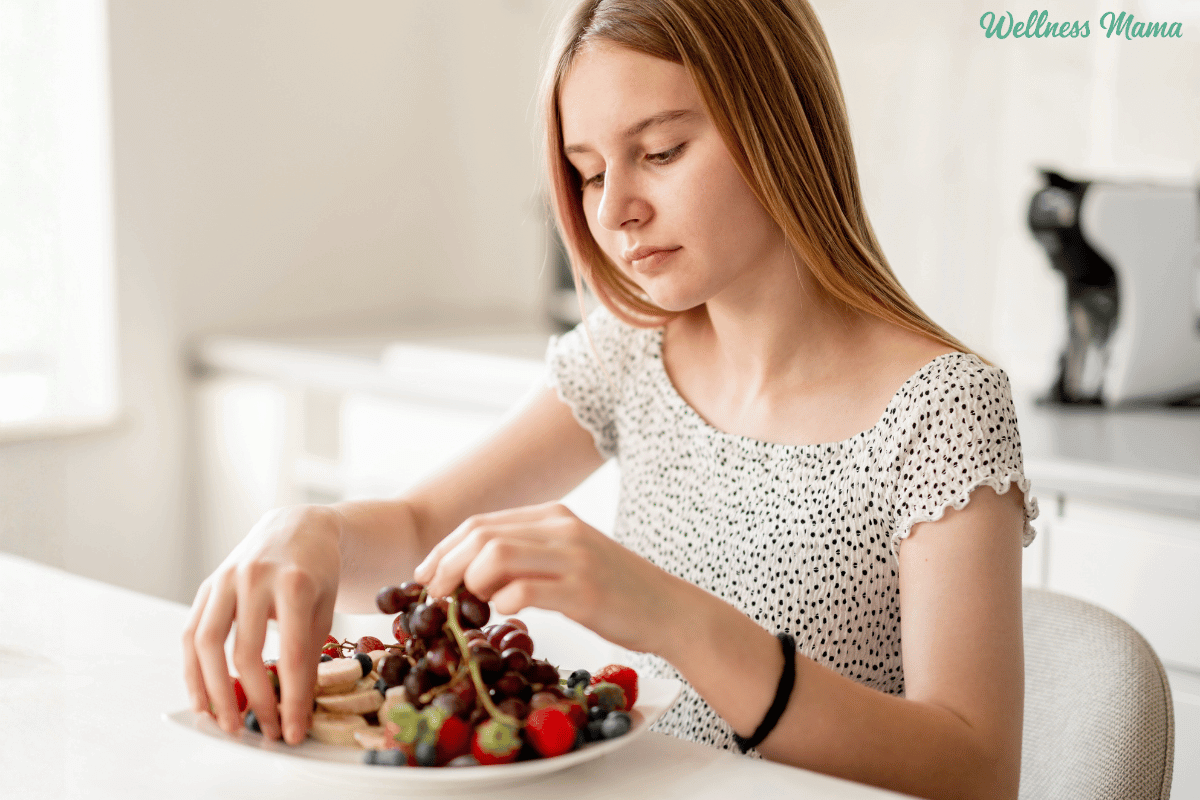
Parents ask me about food more than almost anything else. After all, I’m the natural health lady, so of course my kids are always drinking kale smoothies (not really). When health dogmas and real life collide, at the end of the day what do I feed my kids? And more importantly, how do I help them make healthy eating choices?
Food can feel like high-stakes parenting, and it’s easy to worry that one wrong move will set kids up for unhealthy habits. You might be surprised to learn that I actually don’t micromanage what my kids eat.
Over years of parenting, research, and personal trial and error, I’ve learned that tightly managing food often backfires. Instead, I focus on providing nourishing options, modeling good habits, and trusting my kids to listen to their bodies. This approach isn’t about throwing out all structure, but building autonomy and a healthier relationship with food.
Why Food Control Often Backfires
One of the biggest shifts in my thinking came from understanding how restriction affects desire. There’s a growing body of research showing that when we tightly control food, especially foods labeled as “junk” or “bad,” it can actually make us want them more.
A study in Appetite found that children who had restricted access to certain foods were more likely to overeat those foods when they became available. In contrast, children who weren’t restricted tended to eat less of those foods. Plus, they were more in tune with their hunger cues.
If you’ve ever dieted, you may have noticed the same thing. The more forbidden a food becomes, the more power it holds.
Psychologically, this makes sense. Restriction creates tension. It frames food as something to be resisted rather than understood. Over time, that tension can override internal signals like hunger and fullness, replacing them with external rules and emotional responses.
There’s also evidence that pressuring kids to eat certain foods, like insisting they finish vegetables, can have long-term consequences. Research from the Journal of Nutrition Education found that children who were pressured to eat vegetables were actually less likely to eat them later in life. What starts as a well-intentioned push for health can quietly backfire.
Children Are Born With Self-Regulation Skills
One of the most fascinating pieces of research in this area focuses on self-regulation, especially in young children. Studies published in the New England Journal of Medicine observed that toddlers naturally adjust their calorie intake over time. If they eat more at one meal, they often eat less at later meals. If they undereat one day, they compensate the next.
In other words, children are born knowing how to regulate intake. That is, if we don’t override that system.
When food choices are heavily managed or restricted, children can lose touch with these internal cues. Instead of asking, Am I hungry? Am I full? they learn to ask, Is this allowed? Will I get in trouble? Over time, external control replaces internal awareness.
This matters not just for physical health, but for their long-term relationship with food. The ability to notice hunger, fullness, cravings, and satisfaction is a skill we can carry into adulthood. Once it’s lost, it takes intentional work to rebuild.
The Problem With “Good” and “Bad” Food Labels
Another subtle but powerful factor is how we talk about food. When foods are labeled as “good” or “bad,” morality gets attached to eating. Eating something “bad” can lead to guilt or shame, while eating something “good” can feel like a moral win.
There’s evidence that this moral framing may contribute to disordered eating patterns later in life. A review in the International Journal of Eating Disorders found links between controlling eating and a higher risk of disordered eating in adults.
I’ve seen this play out personally. Growing up, certain foods were framed as off-limits or unhealthy, largely due to budget constraints. When I gained independence as a teenager, those foods felt irresistible. Not because they made me feel good, but because they had been forbidden. It took years to separate actual enjoyment and physical response from psychological attraction.
Helping Kids Understand Food Choices
On the flip side, when I first started trying to eat healthy I had some harsh things to say about certain foods. And while I still don’t think highly processed foods need to be in anyone’s kitchen, I’m more focused on the positive now. Instead, I’m focusing on helping my kids (and other adults) understand what foods do in the body.
With my kids, I try to avoid ranking foods. Instead of labeling something as “bad,” we talk about what it does in the body. Protein helps build and repair tissue. Minerals support electrical signaling. Carbohydrates provide energy and hormone support. This kind of information gives kids context without attaching judgment.
Autonomy as a Core Parenting Principle
At the heart of this approach is a broader belief. My children are infinite autonomous human beings, each with their own paths. My role isn’t to control them, but to guide them toward becoming capable, healthy adults who trust themselves.
Food is one of the earliest and most tangible ways children experience autonomy. What they put into their bodies matters, not just nutritionally, but psychologically. Respecting their agency in this area reinforces the deeper message that they’re allowed (and encouraged) to listen to their body.
This doesn’t mean a lack of structure. It means choosing structure that supports autonomy rather than undermines it.
What This Looks Like in Practice
Having principles and standards is one thing, but actually putting them into practice is another. So what does this actually look like in our home?
Food Isn’t a Reward or a Punishment
I don’t use food as leverage. There’s no “eat this to earn dessert” or “skip dinner and eat it for breakfast.” These systems can disconnect eating from hunger and turn food into a currency.
When kids choose to eat nutrient-dense foods on their own, that choice carries more weight than when it’s coerced. Over time, voluntary choices are more likely to stick.
I Provide, They Decide
I don’t stock the pantry with ultra-processed foods, but I also don’t micromanage what they eat or how much. The house is filled with whole foods, proteins, fruits, vegetables, and leftovers they can get on their own as needed.
I cook one family meal and that’s what’s offered as the option. My kids are free to eat it… or not. If they’re still hungry later, they can make eggs, fruit, or leftovers. I’m not a short-order cook, but I’m also not a food enforcer.
Modeling Over Rules
I quickly learned as a mom that our children learn far more from what we do than what we say. When they see me eat a wide variety of foods, their curiosity naturally grows. Foods they once avoided often become familiar over time, without pressure.
When my kids were babies and trying new foods that they thought looked suspicious, I ate it in front of them. This helped them decide it was ok for them too.
Teaching Without Controlling
When kids are interested, I explain how food works in the body. Not lectures, just conversations. We talk about why minerals matter, how protein supports muscles, and what electrolytes do. When they’re open to learning they’ll soak it in like a sponge.
Knowledge empowers choice. When kids understand why certain foods feel better, they’re more likely to choose them.
Eating Outside the Home
When my kids are at restaurants or friends’ houses, I don’t comment on their food choices. I don’t restrict or even ask. Occasional exposure to foods I wouldn’t serve at home isn’t harmful, especially in the context of an otherwise nutrient-dense diet.
Resilience matters more than perfection. In most cases, the dose makes the poison. I feel like this helps take the pressure off when they might get a little bit of something (like vegetable oil) at a friend’s house.
Why This Approach Works Long-Term
Research supports a balance known as authoritative parenting, a combination of structure and autonomy. A 2020 review found this approach led to healthier eating patterns than rigid, authoritarian control.
By stepping back as the external regulator, kids strengthen their internal regulation. They learn responsibility, trust, and body awareness. And they do it without food battles.
Addressing Common Concerns
I’m sure many of you reading this are going to have some questions and concerns about my method. And honestly, I’m not even trying to tell you that you should approach eating the same way I do. This is just what I’ve found works for my kids and why we do it. But here are some of the top FAQs I hear from moms when I share my approach.
“Won’t they just eat sugar all day?”
In my experience, the novelty wears off, especially when foods aren’t forbidden. Children may test boundaries initially, but self-regulation can reemerge surprisingly quickly. In fact, some studies show that kids who had fewer food restrictions ate fewer cookies when given the chance compared to kids with tigher food rules.
“What about nutrients?”
This is where parental responsibility still matters. Providing nutrient-dense options, variety, and education creates a strong foundation. From there, kids often make balanced choices. If all they have to eat at home are healthier options, then that’s what they’ll have to choose from.
“Doesn’t this create chaos?”
Quite the opposite. Without power struggles, meals are calmer. Structure remains, but tension fades.
Final Thoughts on Kids and Food Choices
Strict control often backfires, especially when it comes to food. Instead, trust, modeling, and connection tend to win over time.
My goal isn’t to raise kids who clean their plates or avoid every “unhealthy” food. Honestly my views on what’s healthy and what isn’t (like grains) have changed over time. Instead, my goal is to raise adults who trust their bodies, understand nourishment, and feel confident making choices long after I’m no longer there to guide them.
When children are respected, informed, and given real autonomy, they often rise to the occasion. I’ve seen this play out with my own kids and I’m continually surprised by how capable and creative they are when given the opportunity.
How do you handle food in your home? Do you have any food rules or ways to encourage healthy eating? Let us know in the comments!


Leave a Reply