


The Real Problem with Grains

Katie Wells Avatar

Reading Time: 8 minutes

This post contains affiliate links.

Read my affiliate policy.

The real problem with grains
Wellness Mama » Blog » Health » The Real Problem with Grains

Grains are a controversial food in modern society, but the real problem with grains may not be what you think! On the one hand, you have experts who claim that we aren’t meant to eat them based on the stance that grains are a modern addition to the food supply and people have consumed them for only the last 10,000 years or so. Others claim that grains are the foundation of our food supply and have been for thousands of years.

So, Who Is Right?

Turns out that both sides might be, but with some important caveats. This means it isn’t a simple answer, mostly because we may not actually be talking about the same food!

What’s In a Grain?

Grains are simply the hard, edible seeds of grass-like plants. There are many varieties and the most common are wheat, corn, oats, and rice. They are one of the most-consumed foods worldwide and the primary source of nutrition and energy for many populations around the world.

Grains are made up of three main parts:

  1. Bran – the hard outer layer or shell
  2. Germ –  the core of the seed that provides nutrients when it sprouts and grows
  3. Endosperm – the starchy food source for the growth of the seed
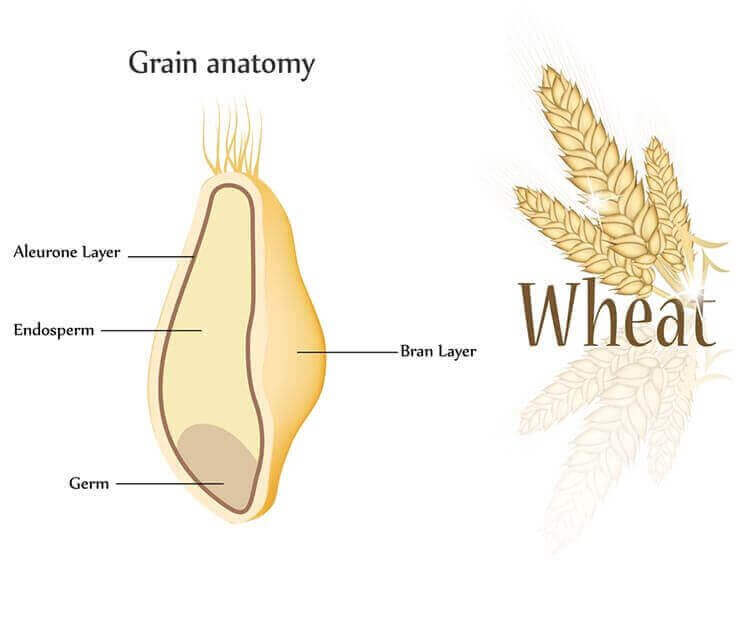
Anatomy of a cereal grain

By definition, a “whole grain” contains all parts of the seed, while refined grains often have the bran or germ removed, leaving just the highly starchy endosperm. Whole grains can be a source of nutrients like B-vitamins, magnesium, and others, but in refined grains most of these beneficial parts are removed.

Many manufacturers enrich processed grains with synthetic forms of nutrients like folic acid (instead of the natural form of folate), iron, and B-vitamins to try to make up for the nutrients removed during processing.

Why Avoid Grains? (Answer: They Aren’t What They Used to Be)

It’s a fact: modern grains aren’t the same as they used to be a few hundred years ago, or even a few decades ago! And the grains we consume in the U.S. aren’t the same as the grains eaten in other countries … especially when it comes to wheat.

A few major developments started the problem with grains:

1. New ways of processing led to wider availability (and decreased nutrients).

With the dawn of the modern mill in the mid 19th century, grain evolved. Before this time, grains and wheat were ground in whole form, often with stones, and the flour still contained all the components of the whole grain. It was now possible to separate the parts of the whole grain and use just the starchy endosperm to create an inexpensive and very finely ground white flour (similar to most flour used today).

Without the bran and germ, these new refined flours lasted longer on the shelf but contained much lower levels of nutrients. So much lower, in fact, that in the 1940s manufacturers started to “enrich” wheat and other flours with synthetic nutrients.

Along with the reduced cost of flour from the newer and more efficient method of refining, availability of flour soared and almost everyone could now afford it as a regular staple. This, of course, led to more people consuming flour.

This wouldn’t have been as big of a problem on its own, until …

2. Agronomists developed new types of wheat to increase yield.

In the 1960s agronomists developed new cultivars of wheat in order to increase the amount of wheat possible to grow per acre. This modern wheat is a type of dwarf wheat that, unfortunately, is much less nutritious and comes with a list of potential problems.

A centuries-long study has tracked the results of this change. Since 1843, researchers in England have been conducting research called the “Broadbalk Winter Wheat Experiment.” They tracked many variables related to wheat cultivation, including fertilizer use, crop rotation, and nutrient content.

Unfortunately, nutrient content took a dive. Mark Sisson explains in his fascinating article “The Problem with Modern Wheat“:

Between 1843 and the mid 1960s, the mineral content, including zinc, magnesium, iron, and copper, of harvested wheat grain in the experiment stayed constant. But after that point, zinc, magnesium, iron, and copper concentrations began to decrease – a shift that “coincided with the introduction of semi-dwarf, high-yielding cultivars” into the Broadbalk experiment. Another study found that the “ancient” wheats – emmer, spelt, and einkorn – had higher concentrations of selenium, an extremely important mineral, than modern wheats. Further compounding the mineral issue is the fact that phytic acid content remains unaffected in dwarf wheat. Thus, the phytate:mineral ratio is higher, which will make the already reduced levels of minerals in dwarf wheat even more unavailable to its consumers.

In other words, while these modern varieties are easier and faster to grow, they don’t contain the same levels of nutrients but have the same levels of phytic acid, creating an imbalance that can lead to nutrient deficiencies.

3. Grains are hard to digest without soaking, sprouting, and other traditional preparations.

Aside from the fact that the grains and flours we consume are fundamentally different from the ones our grandparents and great-grandparents consumed, we also prepare them much differently and this may also help explain the increasing rates of allergies and intolerance problems with grains.

I explain in depth in this article how in almost all cultures people traditionally prepared grains by different methods like soaking, sprouting and fermenting (think sourdough bread). These methods make the nutrients in grains more available to the human body and reduce the phytates that can bind to minerals in the body. Many studies support the nutritional benefits of this traditional preparation.

In the name of convenience, we’ve largely stopped using these traditional preparation methods, further reducing the amount of nutrients we can obtain from grains and flours and potentially increasing the amount of mineral-binding phytic acid we consume.

But Why So Many Allergies to Grains and Wheat Especially?

If we just look at the changes in grains from the invention of the modern steel mill and the high-yield dwarf varieties cultivated in the 1960s, it still doesn’t completely match up with or explain the drastic rise of grain-related allergies and intolerances in the last two decades … but there is a missing link that might!

Are Grains and Wheat Toxic?

Other countries don’t seem to have the same problem with grains. Many people report that they are able to eat wheat and other grains without a problem when travelling abroad, even if they react to it in the U.S. In fact, I know several families who while traveling out of the country who consumed more processed grains than they would at home and noticed that certain digestive and skin issues actually improved.

I have family members who can consume certain varieties of grains (like imported organic Einkorn wheat or the ancient grain spelt) without a problem but react horribly to regular wheat or grain products. Why is this? Both contain gluten, so perhaps gluten intolerance isn’t the problem we think it is!

In fact, the answer may be something much simpler and more obvious that isn’t being widely talked about: the cultivation and spraying methods that have changed in the last few decades.

The Real Problem with Wheat

So what’s a mom to do? So many experts in the health world today (many that I’ve interviewed myself on the Wellness Mama podcast) say a resounding “no” to grains and especially gluten-containing grains. JJ Virgin recommends against giving wheat or gluten to kids and Dr. David Perlmutter blames grain in large part of the rising epidemic of MS and other brain conditions.

I agree with the Healthy Home Economist that new pesticides (Roundup or glyphosate, specifically) are largely to blame. The timeline matches up much more closely with the rise in wheat and gluten intolerance in the U.S.

From her article “The Real Reason Wheat Is Toxic Is Not Gluten“:

Pre-harvest application of the herbicide Roundup or other herbicides containing the deadly active ingredient glyphosate to wheat and barley as a desiccant was suggested as early as 1980. It has since become routine over the past 15 years and is used as a drying agent 7-10 days before harvest within the conventional farming community. According to Dr. Stephanie Seneff of MIT who has studied the issue in depth and who I recently saw present on the subject at a nutritional Conference in Indianapolis, desiccating non-organic wheat crops with glyphosate just before harvest came into vogue late in the 1990’s with the result that most of the non-organic wheat in the United States is now contaminated with it.

The fact that glyphosate is banned in many parts of the world may explain why other countries fare better.

In fact, this article and chart explain how increased glyphosate use on wheat crops may be partially to blame for the rising rates of celiac disease, comparing the increased incidence of celiac with increased glyphosate use:
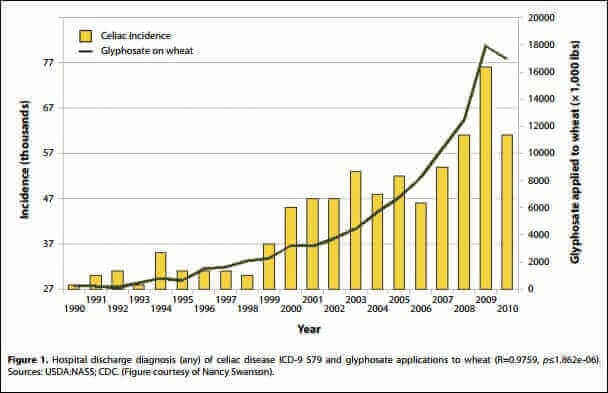
celiac-incidence-as-a-factor-of-glyphosate-application-to-wheat

Of course, I’m hesitant to assume that any of these factors alone is directly responsible for the rising problems we are seeing related to grain consumption in the last few decades, but when you consider that glyphosate may impact gut bacteria in a negative way, it makes sense that this could be contributing to the problem.

Other Reasons for the Problem with Grains and Wheat

Aside from the above problems with modern grains themselves and the way they are cultivated and processed, I believe there are several other (possibly inadvertent) effects of our grain consumption.

More Grains = Less of Other Foods

We know that statistically we are consuming more grain products in general (both whole grain and refined grains) and that corn and wheat are two of the top 5 most consumed foods in the United States. We also know that we are statistically consuming less fat that we have in previous decades, and fewer vegetables.

Since refined grains can spike insulin levels and are a highly processed carbohydrate, our increased consumption may be partially to blame for the rising rates of diabetes and obesity (though of course other factors come into play here as well).

Grains like wheat are found in the vast majority of all processed foods, which makes sense because they are inexpensive, shelf stable, and easy to manufacture. Unfortunately, we are consuming these foods in higher amounts at the expense of foods like vegetables, healthy proteins, and beneficial fats.

Fewer Nutrients

More grains and less of other foods means that we are also statistically consuming fewer of the nutrients found in foods like fresh produce, ethically sourced proteins and healthy fats. As we already know that modern grains have a diminished nutrient content, it is no wonder that it is becoming so difficult to consume enough nutrients from food alone.

Many experts suggest that micronutrient deficiency may be a large contributor to many types of modern disease as we simple aren’t able to obtain enough micronutrients from our food supply. As grains are a large part of the modern food supply but a low source of nutrients, they are contributing to this problem.

So Should We Consume Modern Grains?: The Bottom Line

The problem with grains isn’t as clear-cut as it sometimes seems. It isn’t just about the gluten, or the processing, or the modern cultivation, but a complex combination of many factors. There isn’t a clear-cut answer to that question and it truly does vary on an individual level based on gut health, the type of grain, and how it was prepared.

My Take on Grains

For years, I was completely anti-grain and didn’t eat them at all, especially while healing a thyroid issue. After many years of consuming processed grains when I was younger, I felt great avoiding grains entirely and saw no reason to eat them as I was consuming more nutrients and more vegetables without grains in my diet. This was a guiding principle of my cookbook as well, which I kept entirely grain free and dairy optional.

These days, I do eat white rice on occasion (here’s why) and serve it and other organic and properly prepared grains to my family at times.

What I Do:

  • I still avoid most grains, especially those that contain gluten, the majority of the time.
  • If I do consume grains, I opt for white rice or properly prepared whole grains such as organic Einkorn (soaked, fermented, sprouted, etc.).
  • I don’t make grains a staple of my diet. I do occasionally consume them but make sure that the core of our family’s diet is a wide variety of vegetables and fruits, healthy proteins, and beneficial fats.
  • Whenever possible, I use vegetables in place of grains. Love grains or hate them, vegetables typically contain many more nutrients. I make simple substitutes like using cabbage for noodles in spaghetti or sweet potatoes instead of noodles in lasagna. Not only are these substitutes more nutritious, but they also taste better (in my opinion).
  • I often bake with grain-free flours like coconut flour or almond flour, which are higher in protein and fiber and experiment with cassava flour and plantain flour (sources of resistant starch).
  • When I travel internationally, I try grains in other countries out of curiosity to see how I react. So far, so good … the research continues!

I realize that for many people completely avoiding grains is neither desirable or practical, and it certainly may not be necessary for everyone. At the same time, I continue to feel strongly about avoiding processed modern grains that have been refined, modified, and highly sprayed as they offer no nutritional value and may have a severe health impact over time.

What do you think? Do you consume modern grains? Why or why not?

Sources

Become a VIP member!

Get access to my VIP newsletter with health tips, special deals, my free ebook on Seven Small Easy Habits and so much more!

Easy Habits ebook on ipad
Katie Wells Avatar

About Katie Wells

Katie Wells, CTNC, MCHC, Founder of Wellness Mama and Co-founder of Wellnesse, has a background in research, journalism, and nutrition. As a mom of six, she turned to research and took health into her own hands to find answers to her health problems. WellnessMama.com is the culmination of her thousands of hours of research and all posts are medically reviewed and verified by the Wellness Mama research team. Katie is also the author of the bestselling books The Wellness Mama Cookbook and The Wellness Mama 5-Step Lifestyle Detox.

Comments

976 responses to “The Real Problem with Grains”

  1. Jamie Avatar

    Hi Katie

    Thanks for the information, very informative. I have had your site bookmarked for 6 months now
    I am a pescatarian, but i am always tweaking my diet and educating my family as i learn more of improvement.
    Great research you provided. thanks again, and much success.

  2. Magnolia Avatar
    Magnolia

    Sorry, this doesn’t fly with me at all. In the Mediterranean region where people eat lots of bread, pasta, and rice, obesity is almost non-existent and heart attack rates are are a fraction of what they are in the US. European men have no problems with fertility, testosterone levels, or genital size. In fact Italian, Spanish and Portuguese men are noted for their machismo and their extra large genital endowment So the problem in the US is NOT grains, it’s the huge portions Americans eat and the processed foods and fast foods we consume. We don’t savor our meals and eat small portions of fresh, homemade, unprocessed foods. There isn’t a town or city in this country where you can go 1 or 2 blocks without seeing a plethora of fast food and junk—from the “golden arches” to all the pizzerias and Chinese takeout places, etc.

    Most of the wingnuts who villify grains are basing their claims on one book-“The Wheat Belly Diet” by William Davis (who needs to lose a few pounds himself. Nutritonists worth their salt should know better.

      1. Fred Avatar

        I think it has a lot more to do with the way the grains are processed now. People in the Mediterranean used to make their own bread and pasta and now buy it dry from the store.

  3. mae Avatar

    Grain are not killing us, our bodies was design to eat grains, healthy whole grains which contain all three parts of the kernel. not the process ones that they are offering us today where they remove the germ and the bran . Gen 1:29
    God said, “I have given you every plant with seeds on the face of the earth and every tree that has fruit with seeds. This will be your food.”
    1. every tree bearing seed
    Examples: apples, avocados, grapefruit, pecans, papaya, cherries, olives
    2. every plant bearing seed
    Examples: tomatoes, beans, lentils, wheat, berries, squash, corn, rye
    What is killing us is our high fat, process food diet .

  4. Karen Avatar

    What about sprouted grains? Are these safe to consume? You touched on the difference but didn’t elaborate. Thanks.

  5. Shannon Avatar

    I don’t agree with your article. Where did you get these facts? I would love to read the articles you got this information from.

    https://wholegrainscouncil.org/whole-grains-101

    ANTIOXIDANTS, VITAMINS AND MINERALS
    Consumers are increasingly aware that fruits and vegetables contain disease-fighting phytochemicals and antioxidants, but they do not realize whole grains are often an even better source of these key nutrients.

    Moreover, whole grains have some valuable antioxidants not found in fruits and vegetables, as well as B vitamins, vitamin E, magnesium, iron and fiber.

    HEALTH BENEFITS OF WHOLE GRAINS
    The medical evidence is clear that whole grains reduce risks of heart disease, stroke, cancer, diabetes and obesity. Few foods can offer such diverse benefits.

    People who eat whole grains regularly have a lower risk of obesity, as measured by their body mass index and waist-to-hip ratios. They also have lower cholesterol levels.

    Because of the phytochemicals and antioxidants, people who eat three daily servings of whole grains have been shown to reduce their risk of heart disease by 25-36%, stroke by 37%, Type II diabetes by 21-27%, digestive system cancers by 21-43%, and hormone-related cancers by 10-40%.

    where on the other hand you state “We have found that grains can deplete nutrients, cause weight gain and infertility, but don’t they still have nutrients? Unfortunately, grains do not have the nutritional profile that all the granola-pushing commercials of late make them out to have. It makes much more sense to get your nutrients from foods like vegetables, fruits, proteins and healthy fats, which offer much higher nutrient profiles without the drawbacks.”

    What I have learned in my Bio Life Science class this Spring 2014 is staying away from grains is DANGEROUS. Sure it blocks some vitamins and minerals from being absorbed but it also strips away the toxins that manipulates our DNA causing cancers and such. Advising people to stay away from grains is wrong. One of the comments even mentioned her hair falling out after she rid grains from her diet.
    If people are trying to loose weight then advise them to be smart about the grains you’re eating and how often you’re eating them… not to cut them completely out of your diet.
    ALSO our bodies can synthesize most vitamins and minerals and are not essential to the body for they act more as coenzymes (help the actual enzymes) to speed along the metabolic process.
    So if you’re trying to loose weight, cut back on the grains and become more educated with what kind of grains do what and why. ALWAYS ASK WHY. But please DO NOT cut grains completely out of your diet.

    I would also like to point out you simply can’t draw connections between correlations because there are other things that increased other than grain consumption:
    “In the last 130 years of increased grain consumption, chronic disease rates have skyrocketed, fertility has fallen and the average weight of the population has steadily risen. The more consumption of grains rose, the more fertility rates fell. Research from the University of Missouri, the average sperm count of American males has dropped 50% since the 1930s. To add insult to impotence, testicle size tends to have an inverse relationship with grain consumption.”

    So please, if you have evidence against this I would love to read about it and take into consideration. If not I highly suggest you take down this article.

    1. Katie - Wellness Mama Avatar

      Do you find a conflict of interest at all that your information comes from the whole grains council? I’ll be posting a guide with all of my resources (and more) soon… I understand where you are coming from though. I learned all of the same information in school and had to research and find the truth through my own research. I’d also love to see your evidence that avoiding grains is dangerous, as there is nothing in grains that isn’t present in higher amounts in vegetables and meat.

  6. Jennifer Avatar

    Wellness Mama:

    Nice article and intriguing points! Perhaps we are living in another backwards society, but please site your sources. I’m genuinely curious about the points articulated, but I’d like to know where I can find scientific findings that support your points. Isn’t it generally understood that one should do such things?

    1. “Interestingly, scientific and historical research show that not only have humans not always eaten grains, but the human body is not designed to function well on grains at all!”

    2. “Since the dawn of agricultural practices, archeological evidence shows a gradual but steady decline in human strength.”

    3. “Studies have shown, and I have seen in my own work with clients, that a no-grain diet can lower cholesterol, lower blood pressure, reduce inflammation, promote weight loss, alleviate dermatitis or acne, end digestive disturbances like heart disease, increase fertility and dramatically improve energy levels.”

    … for starters. Many thanks in advance!!

  7. Celeste Avatar

    Thank you for your website! I was raised exceptionally healthy by my middle eastern mom. Lots of veggies, fruits, nuts and very little bread or pasta. In fact, my mom looked at a PB&J like a candy bar, and never fed us that.
    Fast forward to my college days, and early adult life where I could choose to eat Lucky Charms for dinner, which occasionally I did. I still over veggies, and uber healthy foods. I was not the cool kid. But at 26 I began having night sweats, and by 29 was diagnosed with Lupus.
    Last year, I read all about the ways “healthy whole grains” turn to sugar in our bodies and how our “new” grains are actually not the grains our grandparents ate & decided to ask my doctor to do a complete physical & lab work up. Iwas “perfect” according to her. My HDL was 79, my Tri’s were 20. My bp was low, and my bmi was in the healthy range at 19. The only blip was very low vitamin D. I asked for a follow up on gluten sensitivity & it came back negative. Great, but I felt like crap. Everyday.

    While at Disney World, surrounded by very obese, slow walking kids and adults, eating more processed crap than should be legal, I decided to kick out gluten.
    4 days in, I cried. I felt like someone had turned on a light switch in my brain. I woke up at 43, with the energy I had when I was about 16, I ‘m serious. My aches and pains slowly went away. I felt so amazing. My eyes sparkled and people noticed.
    Medical tests have not caught up with the changing landscape of frankenstein-esqe foods, and my only proof was taking it out. Americans are overly trusting of the “whole grains” labels that have been added to everything- yogurts, “nutrition bars” that are really candy bars with vitamin powders added.

    Several peer reviewed medical journals have been written and documented about gluten and psychiatric patients, prisons and the links to the gluten in their diets. We were not designed to eat grain all day long. Veggies, fruits, nuts, fish, lean meats.
    If it comes from a box or a window, it is not real food.

  8. steven Avatar

    Just eat vegetables. They pass any and every test. Grains and meat create controversy but no reasonable person can go on a diet that doesn’t allow bell peppers, garlic, and apples et al.

  9. mike h Avatar

    Hi Mama, just have to say how fantastic this website is and how people like yourself are helping people reclaim their lives and move away from the dangerous mainstream madness.

    I have read a lot of comments on this board and it still amazes me how so many people are constantly asking for a study for this and another study for that which if done would be done in a lab environment. The real scientists is the average Joe who decides to try eliminating wheat and finds out that it works for them and then shares their experiences. Blogs like these are invaluable as they connect real people.

    Instead of asking for a study why don’t you have the guts to just try it yourself. There are many who have and are reaping the benefits. Asking for studies just gives people an excuse not to try it and others to blur and confuse the reality that it really works.

    Thanks for the awesome website.

    Mike H

    1. Ashley N. Avatar

      Indeed! Couldn’t have said it better. Trying things for ourselves is the best experiment – asking for studies can be helpful on some topics but sometimes it’s just a cop-out so we don’t have to do the work ourselves.

      When my La Leche League leader said gluten could be passed through breast milk to my newborn, my world turned upside-down. My older daughter’s pediatrician had told me it didn’t, but I always suspected she was wrong. Eventually my milk had dried up with her, partly because of everything I was trying to avoid eating for her benefit. Fast-forward to my next child, who puked after many feedings. And I know the difference between puking and just spitting up!

      When I carefully monitored my diet and narrowed it down to gluten (caused the puking), and dairy and soy (caused diarrhea) and eliminated them from my diet, Baby did great. Then I cut it out if her sister’s diet too, and she started sleeping better, screaming less, and learning new words more quickly. Then I realized I felt better too! Your blog was just what I needed to jump from gluten-free to grain-free, and I’m feeling more full after meals and brighter already. My anxiety has gone down, I’m getting things done and feeling less overwhelmed – even with the added task if finding new recipes and experimenting with new foods.

      Thanks for all you do!

  10. Kristin Avatar

    Hi! I LOVE your site. I have been gluten free for the last 4 years, as it seemed to be a migraine trigger for me, and about 2 years ago I started taking Effexor( an anti depressant) for a profolactive for the migraines. It was a miserable drug and I got off of it after 6 months. My body seems to have never recovered. I gained 30 lbs, 20 of which I can’t shake. A couple of months ago I started to getting severe flushing, hives and hot face after eating. I narrowed it down to eggs. Long story short I was essentially grain free for 2 weeks as gluten free bread products use egg to compensate for the gluten. I felt really good those 2 weeks, so my ND told me to try gluten again. I had no stomach issues but got cystic acne and began to get the flushing and hives again, so I stopped gluten. For the two weeks following I continue to get flushing and hives after eating. I’m pretty sure its histamine intolerance. The info on this is really frustrating and completely contradictory, as its a pretty new diagnosis. I tried the reccomended diet for 3 days and was eating about 500 calories a day, I felt terrible. I am considering doing the GAPS diet, but it seems too restrictive, and a lot of work. What are your thoughts on just giving up grains? do you think that is enough to heal my gut? Sorry for the long winded post…I’m at my wits end!!!

  11. Mary Avatar

    How does this work for a vegan? Pasta, bread, quinoa, and potatoes are used widely in a vegan diet. My husband has to be vegan for cholesterol and can’t have dairy or meat….so that doesn’t give him many options except starvation.

  12. Ron Avatar

    A lot is said about following a Biblical diet. Grains were a big part of meals then. Bread was served at lest once a day. Don’t know of any other use for it then, except a supplement to the grass for the ‘fatted calf’. Its the excess use of any food that becomes unhealthy. ‘Course, it would take a humongous amount of veggies to be bad, if that’s possible. Too much fruit shows up as the green apple quick step………lol

  13. Ana Avatar

    Love this website and have found going gluten free to be well worth the stares and questions.

    I’m wondering about millet, oats, and some of the other grains you mentioned. I eat oatmeal occasionally, but only buy the gluten free, Bob’s mill brand. Are these safe? I thought that oats did not contain any gluten naturally but are usually contaminated during processing.

  14. Lana Avatar

    Ahhh I’m so overwhelmed by all this information. I’ve been reading comments for nearly an hour now and I’m more confused than ever. I simply want to make the best decisions for my families health. I have 4 daughters, under the age of 7, and we’ve been living on mostly grains. I grew up with ZERO knowledge of nutrition. Like most children of the 90’s I grew up eating mostly grains and dairy. The idea of making the switch seems monumentally impossible. My children are addicted to carbs. Any advice would be greatly appreciate wellness mama! I would also like to note that I followed your advice on getting rid of GBS naturally and it worked! ???? thanks!

  15. Jan Gardner Avatar
    Jan Gardner

    Good article, I came to decision to stop eating grains, am gluten intolerant. I have been eating only Rice flour, but still get inflammation directly attributed to after having eaten Rice flour. As of 2/5/2014 I am off all grains. Some things we just know is the right thing to do, this is one of them for me. I will write again in of my success to share with others. Nice how whats most needed suddenly appears. Be well all

  16. christina Avatar
    christina

    I have been circling the grain thing for years, have not even worked up the courage to do a trial run…truth is a love so many grains in so many ways the idea seems almost impossible so i bank it for awhile and go off researching else but I keep circling back. I am curious though rereading this article for the 10th time why you added potatoes to the mix here , I know they have a lot of carbs but as far as I know they are not a grain and I just happen to love potatoes too and did not catch this the no grain means no potato thing before

    1. Katie - Wellness Mama Avatar

      Potatoes don’t have the same gluten problems that many grains do, but they still do have lectins, which can be problematic. If you’re on the fence though, definitely try giving up the grains first.

  17. Ann Avatar

    Chuck a donut? I could kiss ya! The years I’ve spent suffering or trying to figure it out have been tough. I knew it partially before, but these facts seal the deal. This makes total sense. I’ve had allergy testing, failed on my elimination diets. An acupuncturist, a nutritionist, general practitioners, health books, supplements, on and on and on! Yes! It’s the grains at the bottom of the period. You presented the right facts in a great way. You’ve got the phytic acid, the insulin spikes, the leaky gut and the agricultural development. Thank-you so much!! The undertaking of it is a challenge. It’s a relief to know what you’re dealing with, but then to deal with it is very tough. With the burden of thinking about it every time I eat or dare to eat the all too convenient, and abundant grain. Putting up recipes is also appreciated, I still have yet to check them out yet. Man it’s hard every time you realize you have to make a huge change like this, but it’s a gem of info. Thanks again

  18. stephanie Avatar
    stephanie

    I’ve been on GAPS for a while now and feel good from it but have found alot of people saying that they have developed thyroid issues from being off carbs, and I’ve done research that says we need some carbs apart from veggies such as grains to support our thyriod? So much conflicting info, does anyone have an answer?

  19. jenny Avatar

    Wow! I couldn’t get through all the comments but it sure seems to be a contentious issue. I say do what works for you. I am gluten free and refined sugar free but eat pretty much anything else that isn’t overly processed. I am 51 but look (I’m told) 10 years younger and feel amazing. I’m at my lowest adult weight ever but am healthy and strong. If wheat and sugar agreed with my system I’d probably eat them but fortunately for my skin and my weight, they don’t.

Leave a Reply

Your email address will not be published. Required fields are marked *