Read Transcript
Child: Welcome to my mommy’s podcast!
Katie: This episode is brought to you by NativePath and in particular, something I have been experimenting with and really, really loving lately. And here’s what you need to understand. A lot of us think calcium is important for our health, especially for our bones. But is this actually true? Bad news. It turns out maybe not, or at least there’s more nuance here.
One of the largest bone health studies ever conducted followed thousands of women taking calcium and oral vitamin D daily, and the results were surprising, but not in the way you would think. They saw no significant reduction in their risk of fractures, and they saw no improved bone density. So all those calcium pills might not be doing what we think, and it turns out they might actually be counterproductive.
But here’s where it gets interesting. A brand new study found that women who did one thing every morning consistently for six months gained 7% bone density, which is massive. This is the same amount of bone mass the average person loses over the course of five years after a certain age. So what did they do?
It was not a medication or even a workout. It came down to one simple thing added to their morning routine. And that’s why a lot of people, especially people over 50, are making this one simple change and seeing massive results. I’m sure you’re probably curious what it is, and it’s a particular protein from one of my favorite brands called NativePath.
And they’re offering all of you up to 45% off of this, plus free shipping and a free gift. Right now you can visit savewithnativepath.com/wellnessmama to find out what it is and how to implement it and save up to 45%. So again, that special site for 45% off is savewithnativepath.com/wellnessmama And see why people are adding this to the routine with amazing results.
This podcast is brought to you by LMNT, and this is a company you might’ve heard me talk about before, and I really love their products because proper hydration leads to better sleep. It sharpens focus, it improves energy, and so much more. But hydration is not about just drinking water because being optimally hydrated, a state called euhydration is about optimizing your body’s fluid ratios. And this fluid balance depends on many factors, including the intake and excretion of electrolytes, which many people don’t get the right amounts of. Electrolytes are charged minerals that conduct electricity to power your nervous system. I talk a lot about nervous system on this podcast.
They also regulate hydration status by balancing fluids inside and outside of our cells. LMNT was created with a science-backed electrolyte ratio of 100 milligrams of sodium, 200 milligrams of potassium, and 60 milligrams of magnesium with no sugar. Since electrolytes are a key component of hydration, here’s what happens when we get our electrolytes dialed in.
We have more steady energy, improved cognitive function, suffer fewer headaches and muscle cramps, we can perform better for longer, and especially the support fasting or low carb diet because when we stop eating carbs like during a fast, the absence of insulin allows the kidneys to release sodium.
So replacing that lost sodium with electrolytes can help you feel good on a fast. Since LMNT is zero sugar, it also doesn’t break up fast. Electrolytes are also important for maintaining blood pressure, regulating digestion and proper fluid balance. Keeping skin hydrated, which is a big one that I feel like often gets missed and so much more.
I feel like proper electrolytes is a missing piece for a lot of people and I love LMNTs new canned drinks, which are sparkling water with all the same ratios and minerals I just talked about, and they are delicious. You can check it out and learn more at drinklmnt.com/wellnessmama. And at that link you will receive a free sample pack with any order.
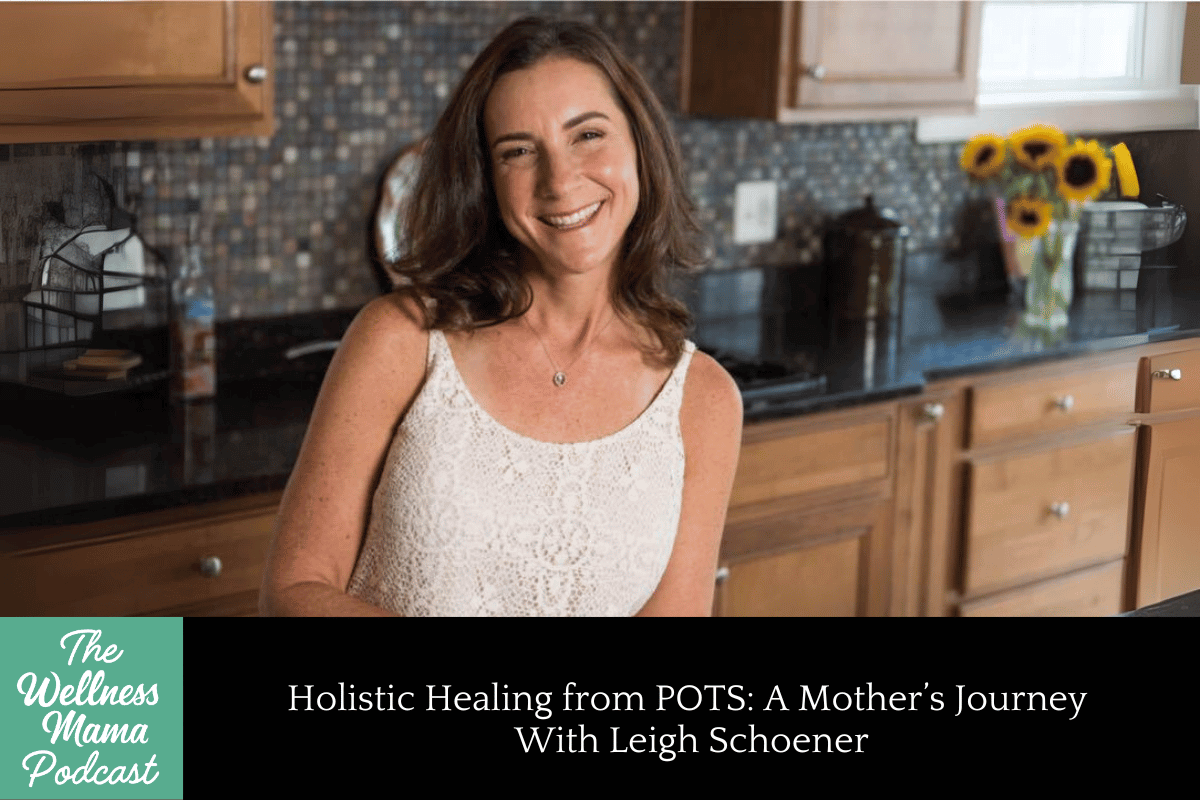
Katie: Hello and welcome to the Wellness Mama Podcast. I’m Katie from wellnessmama.com, and I am back today with Leigh Schoener to talk about her incredible journey between her and her daughter with holistic healing from POTS and the miraculous recovery that her daughter had and the strategies they utilize.
Leigh is also the owner of Leigh Debra Wellness, LLC, where she works with a lot of families as an integrative nutrition and health coach. She especially likes supporting families with teens and young adults, and she has a lot of strategies that fall within this. She gets very detailed in this episode about her daughter’s journey, which she shares with permission and the many strategies that work specifically with POTS and that may be helpful in many types of chronic conditions.
Let’s jump in and learn. Leigh, welcome back. Thank you for being here again.
Leigh: Thank you for having me back. I’m excited to be here.
Katie: Well, if you missed it, we had an amazing first episode that was very wide ranging in how to support teens and their mental health from a very holistic perspective and a first principles perspective. It was amazing, and I’ll link to that in the show notes. And in this one, I would love to dive into a new topic, which is the topic of POTS, which I know will apply very acutely to a specific part of the audience listening.
And also that there will be things in the story of that and what worked for you that will probably broadly apply to a lot of people. I know this one is very personal and close to home for you, and for that reason is very much a passion. So to introduce us to the topic, if you’re willing, please share your own personal journey with us and at least some of the things you learned along the way.
Leigh: Absolutely. Thank you Katie, for giving me this opportunity to share about our own personal story with POTS and my daughter. First of all, POTS stands for Postural Orthostatic Tachycardia Syndrome. It’s a mouthful. And it is a dysfunction of the autonomic nervous system. At the very basics of it it is when your body is not pumping your blood correctly, I’m not gonna get all sciencey. And the heart ends up working very, very hard to keep the blood pumping in the body. And so people with POTS, their heart rate can get very, very high.
And it usually, but not always, is when you go from a resting position and then when you stand up, the heartbeat normally would go up maybe like 15, maybe 20 beats. And when you have POTS dysfunction of the autonomic nervous system, it can go up 60, 70 beats. If it goes up over, I think the baseline and it might have changed, 40, that is when we start looking into, could this be POTS? POTS is a very intricate syndrome. It often goes mis and undiagnosed. And I say intricate too because it affects individuals in different ways and affects the body in different ways.
So you imagine the body is not pumping the blood correctly throughout the body. So not only is it affecting the heart, it’s affecting all the organs, including the gut, which the gut is a pretty typical organ to be affected by pots. And it affects the brain because our blood isn’t flow flowing up to the brain correctly. It’s kind of just staying down more in the extremities, in the legs and the feet and in the hands. And so that’s why the heart is working much harder to be able to get the blood to the brain. And so a lot of, I’m gonna say kids right now, but of course it’s adults.
But for our purposes, I’m gonna say kids, ’cause we’re gonna be talking about kids and teenagers with POTS. Dizziness, lightheadedness, brain fog, focus that those are a lot of symptoms, like I said, stomach, chronic pain because the blood isn’t flowing through the body correctly to be able to support muscles and joints.
And so a lot of kids have chronic pain as well. And there’s a lot more that goes into it as well. We’ll link a video that explains POTS a little bit more. It is under the umbrella of Dysautonomia as well. And then I’ll share a little bit about our personal stories.
So my daughter who is now 22, I do wanna pause and just say that my daughter has given me permission to share her story. She is thankfully thriving and doing well, which is amazing. And she wants to be able to give people hope. And so she has given me permission to be able to talk about our story. So my daughter was diagnosed when she was in eighth grade. She had had a concussion and she was in therapy for concussion.
We have an amazing clinic here in Northern Virginia. And she went for three months and through the therapy she was improving on everything that got affected by the concussion except for one area. And that was her heart rate variability. And so they said, we think this could be something underlying.
We want you to go see this doctor who happens to be here in Northern Virginia who specializes in POTS. And I was like, okay. And so I went home and of course I looked it up right away and I just sat back and thought, oh my goodness. It gave us pieces of a puzzle, even before I got to the doctor, gave me pieces of a puzzle that were kind of floating around out there about different symptoms that my daughter had been having really since about age nine. I can even somewhat go back to age four and pinpoint some of the symptoms. But really since age nine mostly. And I pretty much knew that this is what she had even before we got an official diagnosis.
And I do wanna back up a little bit and say my daughter was always very, very healthy. She did have a lot of ear infections when she was young, but otherwise very healthy, very happy, kind of an old wise soul.
And so a lot of these things that then we realized kind of just kind of got hidden a little bit. Anyway, flash forward to when she got diagnosed. We went to see the doctor. He did what’s called a tilt table test. Basically you go from rest and then the table just keeps tilting until your standing and they monitor a lot of different things.
And her, one of which is the heart rate. And her heart rate flew up. And so through other aspects of testing as well, she did get an official diagnosis of POTS. And then looking back, like I said, when she was age nine, she, which is where her health journey really started. She was a swimmer and she never really had trouble swimming. And then all of a sudden she had trouble finishing a lap.
And so long, I’m not, I’m not gonna go all into it, but long story short, she got diagnosed with exercise induced asthma. And this was after seeing, pediatric pulmonologist and pediatric cardiologist. No one ever mentioned POTS at the time. So that’s when she was nine and then got diagnosed in eighth grade. The other thing at age nine that she came down with a few months after getting diagnosed with exercise induced asthma, was she woke up one day with chronic foot pain. And like just out of the blue came into my room, middle of the night.
So I took her to the emergency room she was in so much pain. We had gone ice skating that day and I thought she must have done something to her foot. She also was horseback riding. That was her sport at the time. And so we go and they could not find anything. No broken anything, no fracture, nothing. And so they said you need to go see an orthopedist. So we go to the orthopedist and they also really couldn’t find anything, but for a lack of not finding anything, they decided to put her in a boot at the time because she literally couldn’t walk. It was either a boot or cast at the time. I believe it was a boot with crutches. And so here she is, fourth grade, having this chronic foot pain.
Go back two weeks later and they tested again and everything seemed fine, but she still had pain. And so thankfully that orthopedic ran blood work, which is pretty unheard of for like orthopedic to think, let’s try to make other connections. And she did have strep in her blood. And so that kind of is going, I’m gonna go back to that part, but it’s important to say kind of that part of the story when she was nine. So she gets diagnosed with POTS, eighth grade and also with a condition called Ehlers-Danlos, hypermobility.
And so they did, I believe it’s a nine point test, different parts of the body. And she was diagnosed with this hypermobility. And that kind of then connected back. So you’re talking four years worth of never getting answers of her chronic pain. She had on and off chronic pain for, well, really on for those four years. In and out of boots, in and out of crutches. Different therapies, different doctors, pain management, children’s hospital.
Never once got an answer. And once she was diagnosed with the POTS and the Ehlers-Danlos, we then connected her chronic foot pain to both of those conditions because they really go kinda hand in hand. So Ehlers-Danlos is hypermobility, just kind of loosey goosey. And then you connect that to blood not flowing correctly or flowing well, that it gets pulled really kind of in the body.
And so they go hand in hand together. And so for lack of never getting another diagnosis, we finally connected that to POTS and Ehlers-Danlos. So that was in eighth grade and it started to affect her socially. She was a very, very social kid, loved school, very, very good in school, and we could start to see it start to affect her socially through the summer of eighth grade. And then in ninth grade is when her condition is what I call at the, she was at the height of her condition looking back
We tried medication through the doctor. I do wanna say this doctor at the time was one of the only in the country, happened to be here in Northern Virginia. So we felt very blessed to be under his care and that finally someone was able to put this together. We did try medication at first. Even me, who always says like, try holistic first, try nutrition, just natural approach first, but I just wanted her to feel well. And so we decided to try this first and then maybe go back to that. Well, after about a month, the medication was making her not feel well, and she was having some negative side effects, so we decided to try a different one.
So we took a little bit of time off and then tried a new one. And only two weeks, maybe even a week to two weeks, she did not feel well. So I said, all right, then we’re gonna just take all my knowledge that I know of integrative nutrition health coach, and I mean, I’ve been passionate about natural health and wellness, so since I, myself was in my early twenties, and so I have a lot of knowledge. And as her mom just decided, this is what we’re gonna do. And I will say that it was really Lauren’s mindset at this moment that drove us to make this decision that she decided she did not, this wasn’t gonna define her.
She wasn’t going to be I am POTS, or I am Ehlers-Danlos, or I am chronic pain. She herself is the one who taught me about that because she decided she didn’t want this to define her life. So little baby steps at a time, we kind of came up with now what we call Lauren’s protocol. And it really worked and helped her through, well, backing up a little bit in ninth grade is when she was at the height. She missed a lot of school. It was very hard for her to get out of bed. When you have POTS, you’re very, very tired because your body is working as if you’re running a marathon.
That’s how fast your heart could be racing. And so she’d either make it to school or then wanna come home from school. And so she, through that was really through ninth grade. Now and our protocol kind of started in the beginning of ninth grade. She, I was encouraging her to do just a very short walk in the morning before she went to school. That was my very first idea of what we’re gonna do, besides nutrition, we’ll get to that. And so she was very open to it. We took like a two minute walk with our dogs. It was not easy. I want parents to know who have children with POTS. I hear you. It was not easy to do. But we got her out of bed, she went for a two minute walk.
That two minute walk turned into five minutes. Eventually it turned into even a half hour and she asked me if we could do a longer walk, which meant her not having time to catch the bus and I would have to drive her to school. And so that’s what we started to do. It was absolutely amazing and kind of the first sign of very much, a lot of encouragement. But what moving the body in the morning, getting the blood pumping into the body, did to help her. Where alot of times kids with POTS, they just can’t get out of bed and we kind of stay stuck there a little bit.
Again, I want any mom, dad that are listening to this. I hear you. I was there. I know how hard and difficult it is, but again, it was Lauren’s mindset that drove us. So that was kind of the very, very start. And then we can get into other aspects of what we did for her protocol naturally.
Katie: I love that. I feel like that was already a masterclass and I love that you started by also sharing that you have her permission to share that story. That’s something I’m also, I’ve never posted my kids pictures on the internet without their permission and I feel like especially in such a digital world, it’s important that they get to have some input in those decisions.
So I love that you have that mindset as well. And I feel like I already learned so much. This wasn’t something I’m super familiar with and it makes so much sense the way you explain it. So I would love to go deeper on what were some of the specific things you implemented from there. And it sounds like her mindset shift actually was the catalyst for so much.
And I think that broadly applies to anything that we might be going through as parents or with our children. And so I love that that was kind of the catalyst for you.
Leigh: Yes, definitely it, it’s her will and resilience just still to this day, like I said, she’s almost 22 now. Still just, I learned so much from her through that about life and wellness. And wellness is what we focused on. We made a decision to not focus, not give a name, a personality to the illness side.
It doesn’t mean it’s not real, it doesn’t mean it’s not there. It is all real. It is very, very important that teenagers or kids that are diagnosed with any chronic health condition be validated that this is real. Unfortunately, through my daughter’s medical experience, especially with the chronic foot pain, she was gaslit. She was you know, we left many doctor appointments, both of us crying, and that is not okay. That has to change in the medical world.
So it is very, very important that we acknowledge our kids when they are having something chronic happening. And so, yes, so that began with that mindset of focusing on wellness. What can we do to make you feel well, to create wellness and knowing that this is real, this is really how you feel? So I started off by sharing about the exercise piece and that ended up growing into longer walks with our dogs. Sometimes Lauren would even go by herself. This is still her freshman year. And she absolutely loved that routine. It was a special time for us too. We also focused tremendously on nutrition.
So I did also work with a functional practitioner, because I felt it was important that as much as this is my field of work, I also wanted to be there as her mom. I didn’t always have to be the one doing this. So we worked with a nurse practitioner who takes more of a functional, nutritional, holistic approach.
And so it was really great to have her in our village. And that’s something else that I really encourage parents who have children with any chronic health condition is that it really does take a village. You don’t have to do this alone. And for me that was important because I wanted to be there as mom as well.
And I will say, our pediatric cardiologist who had given her the original diagnosis was very supportive of us doing a holistic nutritional approach. He actually encouraged it and said he wishes more people would integrate that even if they’re taking the medication. It’s both that’s really important. And that’s why I love sharing about this, to give families hope no matter which direction they choose to go. So nutritionally we worked on removing some foods that we felt were very inflammatory to the body. In my coaching practice, I don’t love going to removing foods if we don’t have to. But there are two food groups that I think that when you do have a chronic health condition or any emotional, anything emotional going on in the body, it is important to just see how the body does.
So we removed gluten and she already was dairy free. So those are top two food categories that really can cause inflammation in the gut can affect the health of the microbiome. And so since she was already dairy free, that was pretty easy. And she, and we did it when she was ready, we kind of introduced it, she wasn’t totally ready. And that’s something I really encourage parents with anything nutritional wise. Use the education around it and empowerment with your children, and then let them decide when they’re ready. They will tell you. And that is exactly what my daughter did. And so we did remove gluten as part of our protocol.
And for a few years she, she didn’t keep it going. She’s not gluten-free right now. I would say she’s gluten light, but that doesn’t mean she’s not gonna get back to it. As a teenager and then especially in college, it can be more challenging, especially in college when you don’t have your mom cooking for you, but she embraced it. She actually started to learn how to bake her own gluten-free recipes. And she even started a little gluten-free bakery in the neighborhood, like just through online. And so she really embraced it and she felt the difference. She really did feel the difference, especiallye with her breathing and her chest.
So when the heart is racing, of course it affects your breathing. She felt a difference focus wise as well. She felt she was able to focus better once we removed the gluten. And removing the gluten means adding in a lot of really good food, adding in the rainbow of food and getting them to taste those tastes because so many kids really are just so used to more of the processed box foods. Removing more sugars from the, from her nutrition as well, focusing on those good clean foods.
We did supplement too. There were some areas that she was low, so we did some supplementation. Magnesium was one, vitamin D is another. And just a good whole food based multivitamin also really helped her. So that was nutritionally. A lot of other things too, but I’m gonna kind of hit on the different points just briefly. So we talked a little bit about exercise, we talked about nutrition. Back to the exercise. I will say too that she started to go beyond the walking and she started to go to the gym, our local gym, and she started lifting light weights as well. And she also found some Pilates videos online, and that really helped her too. It is very much, it’s kind of like a first line of lifestyle encouraged that kids with POTS do exercise. But like I said earlier, it’s so hard.
Usually you start with more of a recumbent type of exercise, a recumbent bike, swimming. But for Lauren, this worked. The walking and being outside in nature also I believe played a huge role, in healing. What happened with Lauren is she ended up taking her sophomore year off from her traditional school. She asked us if, she practically begged us to be able to not go back to traditional school. She wanted to just do online school. This is kind of before the pandemic, and we really heard about online schools. She found one herself and set up an appointment and we listened to her and decided that that was best for her sophomore year. And that’s when we really dove into all of these protocols. So she was doing her own self-paced learning, which worked for her. And so she was able to go to the gym and kind of put that in in the middle of the day.
And it kind of helped her get through her schooling and be able to focus more. We talked a little bit about mindset, but I’ll hit a little bit more on that. So mindset was really important. Like I said, that’s kind of what drove this, but mindfulness a lso was part of it. Sobeing outside, being in nature just kind of being in tune with the circadian rhythm of the body.
She did a lot of journaling at the time, and even listening to meditations. And that also played an important role. She also did, through her physician’s office, biofeedback. And so she learned what I like to call intentional breathing. I don’t call it deep breathing, it’s more intentional breathing.
She learned different breathing techniques. She learned to be in tune with her breath as well. And I always say the breath is the most underutilized healing modality that we have from birth to adulthood. I mean, it is right there with us at all times. It can be silent, it’s free, and it’s right there.
And it is just the most empowering part of health that we could do for ourselves. So once she learned these intentional breathing techniques, that also really helped with the symptoms of POTS, it really helped with the gut health. It helped with her brain health. The brain fog, helped calm the heart rate to get into a stable heart rate. So that was a little bit of mindfulness.
Sleep was another very important component. Aand I kind of chuckle because now that she is in college, of course she doesn’t follow, I’m gonna be real here. She doesn’t follow all these protocols, like we did back then. But she will still say that it helped her tremendously through her healing process. And she knows she always has it within her. So sleep, at the time that we were doing it. She became very regimented with her sleep patterns. So her sleep routine before bed. Even in the morning, what she did in the morning influenced her through the day and then influenced for sleep. But she went to sleep at the same time most nights, you know, weekends a little different
But most nights she used essential oils. She diffused essential oils. She put essential oils on topically, that was able to really calm the mind. We know that essential oils play a very important role in natural health and wellness. You know, just inhaling it through the olfactory system and it goes into the brain and then the whole gut brain connection calms the body down. She did journaling, she did gratitude journals before bed.
And so different routines. She took magnesium, that was one of the supplements she did as well. So sleep was vital to work on a really good routine. And talking about her now, she recently shared with me, she recently got the Oura ring.
She used to use the Apple watch, but she got the Oura ring just very recently. And she told me that the Oura ring is reminding her, because she really has not had the best sleep patterns recently, but it’s reminding her of all the things that we worked on because she’s being encouraged to get back to those good habits of her sleep. So I’m really proud of her for going back. And that’s kind of what’s so empowering about using all of these natural modalities, is it becomes empowering to the child. And then even if they’re kind of going through different phases of life, it’s always there. It’s always there within them.
So we talked about exercise, we talked about nutrition, sleep, mindfulness, and oh, personal belief.
Just again, kind of full circle that. She really believed that, like, honestly believed this was not going to define her for life. And that was the foundational aspect to all of this. But that takes some work sometimes. It takes for, for her, it came more naturally. For other kids that I’ve worked with it takes working with them to be able to switch their thoughts and actually even working with a parent to go from that focusing on illness to focusing on wellness. Just switching those thoughts tells our body to react and show up differently. and I can share too, just a little bit of how she’s doing now. If you’d like, just kind of flash forward.
Katie: Yeah. I love that story and I love that you highlighted some of those free and simple tools that I agree with you are some of the most underutilized health modalities. Which are things like breath, which is we know the master control switch of the nervous system and sunlight and walking. I think we underestimate the power of those things because they’re simple and free.
And I also have seen firsthand how they can be so incredibly, incredibly transformative when we do those consistently. I also love that you shared her mindset journey throughout it. I think that’s a journey many of us get to go on in a parallel way with whatever we may be navigating. And it sounds like she is wise beyond her years.
I would love to hear how she’s doing now and also where people can find you because I know you also help people navigating various health journeys as well.
Leigh: Yes. Thank you. So, yeah, she’s doing well. She actually did return to traditional school for her junior year of high school. So that sophomore year, taking that year off and really focusing on her health and wellness really became pivotal to them being able to move forward. Like, I, one thing I didn’t hit on is that it really had affected her socially. And then after we really embraced these protocols, she started to become social again, which was so wonderful to see. And something I teach people that people don’t often think about, that just being social and having that community can activate the vagus nerve. The vagus nerve connects the brain to the gut and that does get very affected with POTS.
And so that alone, like that social piece alone, I think was healing in itself. And so anyway, she returned back to school her junior year only for the pandemic to hit in the spring of her junior year. So she actually only got to go for those short few months to school. And then of course, was sent home for the pandemic.
So she never really got to have that full on high school experience, and it’s amazing how far she’s come and resilient from that. So then she went off to college and she freshman year she went to school that was eight hours away. But she wanted to go, she wanted to go away, start clean, kind of start fresh. Some of her symptoms from POTS did flare back up. We believe that the mold in the dorm definitely impacted that.
But thankfully because we worked so hard on this protocol, she was able to lean in on that at the time. And I think that’s so important that we’re not saying that Lauren’s been cured, we’re saying that she’s healed, she’s in a healing process and she’s able to lean in on all of these things. So that was freshman year. She ended up not loving where she went freshman year. So she transferred to a school in state that’s about four hours away that has become a home away from home. She’s a senior getting ready to graduate in two months, which I cannot believe. But she absolutely loves her college experience.
She is living and thriving a full college experience. And again, does she get flare-ups? Yes, but does she know how to cope and manage? Yes, she has all of her tools with her. She even studied abroad for the fall semester of her junior year. Which if you asked me back in eighth grade, ninth grade, 10th grade, would my daughter, A, go to college, wasn’t sure if she would make, I knew intellectually she could, but physically, B, be able to go to Switzerland and Africa to be able to study abroad. It is just incredible to me. So she’s thriving.
She also, like I said, gave me permission to be here because she wants to give hope to other kids that have POTS and other kids that have chronic health condition. I’m hoping that parents that are listening to this, even if their kids don’t have POTS, maybe they have something else, that they’re able to feel empowered and given permission that it’s okay to lean in on natural approaches. Even if you’re choosing to do other approaches as well. To use Lauren’s story to give that hope.
And, I just so appreciate being able to be here and to be able to do that. You asked how people can find me. I’m online at Leigh Debra Wellness. I do, am passionate about working with families with any health condition or just desire better health in the kind of tween to 22 year age, age range. Especially those young adults getting ready to go off into the real world as well. And I work with parents. I work with parents and kids. If they’re over 18, sometimes it’s, it’s just the young adult.
But, just reach out to me. I’m also just open to having a conversation and being able to give you some more information. I always offer a complimentary wellness discovery session where we just talk and you will always walk away with actionable steps immediately. I also am going to have a guide for your audience. I have one, more for just teenage health and wellness in general. And then I have a guide specifically for families who have children with POTS that goes a little bit more in depth of some of the protocols that we took and some actions that you can take right away with your family and with your child.
Katie: Amazing. Well, that truly was a masterclass. I took a lot of notes and I will make sure those links are in the show notes for any of you listening on the go so you can find Leigh and keep learning. Leigh, this has been such a joy. I’m so glad we got to connect face to face and share our conversation. Thank you so much for being here and for the work that you do.
Leigh: Thank you so much for having me. It’s just been a joy. I, like I said on my other episode, I have listened to you since you started and have learned so much from you, and it is just an honor to be here with your community and thank you so much for having me.
Katie: And thank you as always for listening and sharing your most valuable resources, your time, your energy, and your attention with us today. We’re both so grateful that you did, and I hope that you’ll join me again on the next episode of The Wellness Mama Podcast.




Leave a Reply