Read Transcript
Child: Welcome to my mommy’s podcast!
Katie: This episode is brought to you by Hiya Health, which I have a now extended and renewed interest in, especially with having a baby around who will be starting solid foods pretty soon. Because here’s something that’s kept me up at night as a parent, and I’ve talked about before. Our kids are the first generation growing up on not just ultra-processed foods, but foods that don’t have the same nutrient content that they used to due to soil changes and so many other factors.
In fact, we’re just beginning to understand the extent of this problem. And this is why Hiya exists and why I’m glad that they do, which is to give parents a real solution in a market that is flooded with kids’ vitamins that are actually contributing to the ultra-processed foods. They have candy-like appeal, but not actual nutrition.
In fact, some children’s vitamins on the market contain up to seven grams of sugar per serving and are stuffed with additives and petroleum-based dyes that I go to great lengths to avoid in my kids’ diet. So Hiya took the opposite approach with zero sugar, zero gummy additives, just clean nutrition. And the great part is kids actually love them.
My younger kids are a huge fan. I have tried them, and the flavor is actually great, although obviously I don’t take them daily. But what makes them different is how thoughtfully they are designed, formulated to meet very specific nutritional gaps that modern kids face. And they worked alongside pediatrician and nutrition specialists to make a chewable multivitamin that packs a blend of twelve organic fruits and vegetables and fills the common nutrient gaps that kids face.
They’re also non-GMO, vegan, dairy-free, allergy-free, gelatin-free, nut-free. They really have thought of everything to make these ideal for kids. And they are NSF certified and receive Clean Label Project’s Highest Purity Award. So when it comes to something I feel safe giving my kids, they are definitely on the list.
It’s designed for kids two and up. They ship straight to your door. And I love that they send you a reusable bottle and stickers with your first order. So this helps you keep up with the refills, and they send refills every month as well. I am a big fan of these as well. And Hiya just launched something new.
If your kids are active and growing, you can add a clean protein powder with minerals designed just for kids to be exactly what they need. Their new Kids Daily Growth Plus Protein is a game-changer. It’s more than a protein shake. It’s a purity awarded clean protein powder with added minerals and healthy fats that can mix right into water or smoothies and support muscle development and cognition and fuel everything else they’ve got going on.
So, we worked out a special deal with Hiya. You can receive 50% off your first order on any of their products. To claim this deal, you must go to hiyahealth.com/wellnessmama. This deal is not available on their regular website. So again, that’s H-I-Y-A-H-E-A-L-T-H.com/wellnessmama, and get your kids the full body support they deserve.
Today’s episode is brought to you by LMNT, which is my go-to electrolyte drink for staying hydrated and feeling my best every day. I have used this for years, and unlike many sports drinks which are loaded with sugar, LMNT delivers a science-backed blend of electrolytes with the sodium your body actually needs, especially if, like me, you live in a hot climate, sauna regularly, or work out regularly. Whether you are working out, walking the dog, traveling, or simply trying to keep your minerals and your energy levels up, LMNT makes this simple and delicious. I keep their canned ones in my fridge all the time now, and their convenient salt packets are perfect for tossing in your purse, your gym bag, or your carry-on, so you are never without electrolytes when you need them.
My kids are also a huge fan, especially of their new pink lemonade. What I especially love about LMNT that they have so many flavors now, so it’s easier to drink throughout the day. If mixing isn’t your thing, they also now have what I love, their new sparkling canned beverages that give you the same electrolyte benefits but in a ready-to-drink format. And those are a favorite among people who visit my wellness center as well. Adding LMNT to your daily routine is one of the easiest ways to support hydration and help your body perform at its best. I also find very helpful if you’re a breastfeeding mom.
So if you’re looking for a simple upgrade to your wellness routine, give LMNT a try and experience it for yourself. They have some delicious new flavors like lemonade iced tea and pink lemonade, and they always have their happiness guarantee. Go to drinklmnt.com/wellnessmama for a special offer.
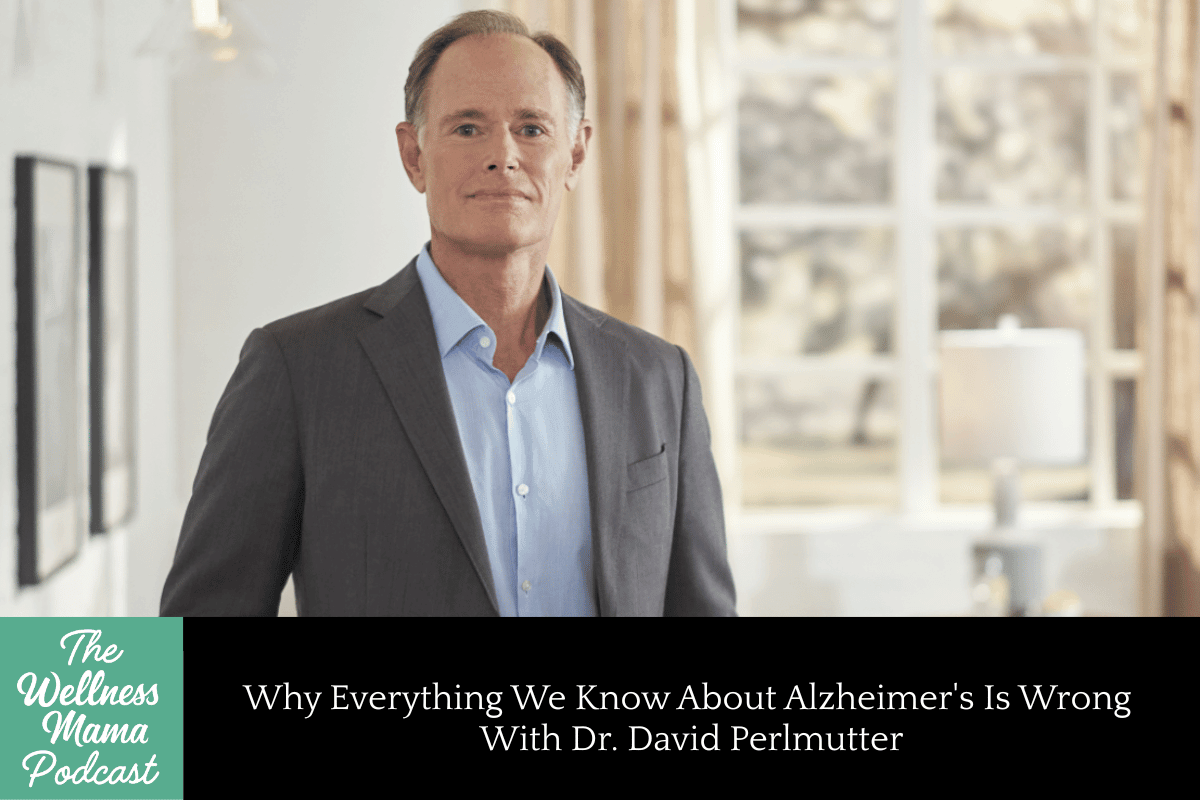
Katie: Hello and welcome to the Wellness Mama podcast. I’m Katie from wellnessmama.com, and I am here today with return guest Dr. David Perlmutter, who is an absolute wealth of knowledge. I always love learning from him. And in this episode, he provides some incredible foundational education around how everything we know about brain health could be wrong and what we need to understand why our brain could be on fire and we don’t even know it, and what actually comes into play for Alzheimer’s.
And if you’re not familiar with him, Dr. Perlmutter is a board-certified neurologist, six-time New York Times bestselling author, and he focuses on the intersection of neurology, nutrition, and brain health. He’s a fellow of the American College of Nutrition. He serves on the board of directors of the editorial board of the Journal of Alzheimer’s Disease.
He has written extensively on this. And in the book we talk about today, Brain Defenders, he focuses on the pivotal role of microglia, which are the brain’s immune cells, in protecting, repairing, and even reprogramming the brain for lifelong resilience. I will link to that and many of his resources in the show notes, but I feel like he helps really provide a deeper context on how the brain’s immune guardians, called the microglia, impact our long, long-term brain health and how we have so much power within our lifestyle choices to really improve brain function even as we age. Let’s join him and learn now.?Dr. Perlmutter, welcome back. It is always an honor to get to chat with you. Thank you for being here.
David: Well, Katie, good to see you again as well. It’s, we’ve been doing this for a little while, so I’m glad to be back.
Katie: We have been doing this for a while, and I am really excited to get to really deep dive in this conversation because you’re always so phenomenal at teaching, and I feel like you’re sharing a new viewpoint.
I got a little bit of a preview of it that is super relevant to a lot of people. I know very top of mind for my parents who are in their 70s, and something I even think about and wanting to be proactive about. And of course, you are the one of the world’s leading experts when it comes to brain health to begin with.
But I feel like this is a whole new arena that a lot of people don’t know about, and we’re gonna get to go deep on that. But before we do, y- I feel like you yourself walk the walk. Like you’ve been to Antarctica, you play music, you fish. You aren’t what maybe people think of as a typical, like, neuroscientist.
You, a very active, adventurous lifestyle, and I feel like that’s kind of a cool segue into some of the things we’re gonna get to touch on today. But maybe, like, just tap on what, what does living adventurously and new challenges and new exposures, what does that do for our brain?
David: Well, let, I don’t do, I have to be honest, I don’t do these things because I, you know, this is brain therapy for me.
I do these things ’cause, you know, I love to live this kind of life, an adventurous life and the, it is true though that having a sense of awe, for example, we wrote about that way back in a book called Brain Wash, is really good for your brain health. It’s good for your body. It’s good for activating your parasympathetic nervous system.
But I feel very grateful that I can be active. I’m in my 70s as well, 71. And I think it’s, yeah, the downside is it’s good for me. It’s good for a person to be able to, you know, participate in these experiences. But I think that, you know, getting back to why we’re together today, I think one of the biggest issues that threatens brain health is something we call sedentarity.
In other words, being sedentary, not doing stuff. And, you know, the world is really set up for us to be sedentary these days. We have, we can be stimulated by watching TV or spending way too much time on our computers, and life can be cush. And you know, it’s this issue of stressing ourselves a bit physically, cognitively, et cetera, that ultimately is good for us.
And, you know, vis-a-vis what I’ve been writing about lately, which is how all of these incredible factors that we know about, whether it’s the physical activity that we get, the quality and quantity of our sleep, the certainly the, the types of foods that we consume and the level of stress in our likes, in our lives, our social interaction, all of these things can be looked at now through a very newly discovered lens that for me is hugely exciting and at the same time very empowering, and that is how do each of these levers play out as it affects the brain’s immune system.
So, you know, we’ve been talking for years and about the importance of our brain cells, the neurons, and that’s really been where all the focus has been over the years. You know, what can we do to preserve the health and functionality of our brain cells, the neurons? And now the spotlight has been redirected to the brain’s immune cells.
And once we start to embrace the idea that the immune cells are really holding the cards in terms of determining whether your brain’s gonna be along for the ride or it’s gonna decay and leave you short-handed, it really is very empowering because all the things I just mentioned and so many more play out through how they affect our immune cells in the brain being either supportive or destructive, and that’s really the focus o- of my new book, Brain Defenders.
Katie: That’s what I’m so excited to learn from you on today. And just to double-click what you said, I love how you tied in being active and why a sedentary lifestyle can be so damaging to our brain, to our bodies. I consider myself infinitely grateful that my parents live nearby, and that my dad is always helping me with projects in the yard, and now it’s, I’ll get to tell him that there’s extra benefit to that as well for him as well.
I consider myself so grateful that he’s willing to. But you, for people who don’t know, I would guess most people know who you are, but you have written six New York Time bestsellers from my research, including Grain Brain, which we’ve talked about before. It sold over a million copies. And I read that you consider Brain Defenders the most urgent and important thing you’ve ever written, and I think I agree with you after getting to preview it.
But, I really wanna double-click and deep dive into that. Like, why is that so important, especially right now? And you mentioned the brain’s immune system, which I feel like might be a new concept for some people. So I’d love to start there and then build kind of a broad foundation for all the things we’re gonna talk about today.
David: Well, the reason I’m so excited, here, here’s what, here’s the book, here’s the cover. The reason I’m so excited, and the website, by the way, is oddly enough braindefenders.com, who knew? Is because when we look, when I look at everything I’ve done for 40 years in neurology and in medicine, everything converges on how it affects the immune system, whether it’s what I wrote about in Grain Brain with respect to carbohydrates, Brain Maker with respect to the gut microbiome.
All of the issues that I’ve been describing for so many years were interesting in and of themselves, but they all come together and unify mechanistically in terms of how they play out by affecting the brain’s immune system, what we call the microglial cells. The microglial cells are sensitive to a high ultra-processed food diet, higher levels of carbohydrates, inflammation, changes in the gut bacteria.
All converge on the brain’s immune system and either create a scenario where the brain is gonna really be preserved and functional and resistant to decline as we see with Alzheimer’s, or, based upon our metabolic health and our inappropriate dietary choices and, as mentioned, our sedentarity, lack of good restorative sleep, the immune system will shift and become destructive.
So let me unpack this just a little bit more ’cause it’ll set some groundwork for our conversation. We can think of the brain’s immune cells, they represent about 20% of the cells in the brain, we call them again the microglial cells, as existing in two forms. The M2 supportive microglial cell that nurtures the health of the neuron, that supports the growth of new connections called synapses, that actually shores up the blood-brain barrier and keeps inflammation in check, versus the M1 or evil twin microglial cell.
Same type of cell, but it can shift to becoming the evil twin based upon inputs that we control. We want to keep our microglial cells in their M2 loving, nurturing, wellness mama support kind of configuration. But they can shift, again, as mentioned, to becoming this evil twin based upon factors over which we have control, like metabolic changes, elevated blood sugar, insulin resistance, increased inflammation, infection, trauma, lack of restorative sleep.
All of these things can morph those supportive M2 microglia into setting the stage for brain decline, brain destruction. And then really the empowering part of our time together today is that we can control that. You know, they’re, one of the biggest factors that shifts these microglial cells away from being supportive is our age.
But I think we’re getting to a point now where we understand that age, I think, is something we need to kind of rethink. It’s not our chronological age that really matters, it’s our biological age. You know, how, how has our body aged through the years, and then how does that play out in terms of our microglia?
And we now know there are wonderful techniques to help- helping slow down our rate of biological aging. But the big levers to pull, as mentioned, are diet, sleep, exercise, socialization, getting out in nature. All of these things really help keep our microglial cells supportive and being our brain defenders.
And that’s what it’s all about. And again, getting back to your question, it’s what I’ve been talking about for so many years, but we never really understood why. You know mainstream medicine, for example, in Alzheimer’s has focused on this idea that Alzheimer’s is caused by beta amyloid, this chem- this protein that accumulates in the brain, that has been resoundedly rejected in the past year or two.
In fact, in just the past several weeks, a huge study came out that we’ll talk about later that really has, I think, put the nail in the coffin that beta amyloid, this accumulation of protein, for some reason, who knows why it accumulates in the brain, causes Alzheimer’s, and we can only get rid of it, then problem solved.
That has recently been proven to be just completely false. So- Why I’m so excited about it mostly is because this new view as to what makes a good brain go bad has really provided some incredible tools for the entire world to know about, to protect their own brains, really giving you back the ability to be the architect of your brain’s destiny, to take agency over whether your brain’s going to age appropriately or it’s going to age more quickly and you’re gonna be, you know, at the mercy of some named disease, call it Alzheimer’s, Parkinson’s, PSP, frontotemporal dementia, or one of the neurodegenerative conditions. It doesn’t have to happen.
Katie: I love that about your message in this book. It’s s- such a message of hope and agency ’cause you give people such a clear path for understanding, and it makes sense to me. As you just said, we used to have this belief that it was the beta amyloid plaques, and I know I had read quite a few things that seemed to blame beta amyloid plaques for everything going on in the brain.
And as you explain, understanding that at a more fundamental level and knowing that’s not the singular cause as we thought gives a whole different perspective and foundation for how we would address brain health. And it would seem like that would mean these new, like, FDA-approved drugs targeting just the beta amyloid plaques but not addressing the underlying problem could be not just ineffective, but potentially dangerous, right?
David: Well, not potentially dangerous. They are dangerous. So a- i- interestingly, about three weeks ago, so three weeks prior to our conversation today, a Cochrane analysis came out. It’s like, this is the gold standard of, trying to understand a question in, in healthcare and medicine. Cochrane analysis looks at all the available evidence and comes up with a conclusion.
They looked at 17 trials of these drugs that target beta amyloid, which I will say are approved by the FDA here in America to treat Alzheimer’s disease, and what they found was that the drugs had no benefit in terms of slowing the disease and were, as you say, not without risk. The term the Cochrane analysis, and this is an analysis of 17 well-constructed studies that encompass th- 20,342 individuals, each study about 18 months long, and the results were that the effectiveness of these drugs, in the words of the Cochrane analysis, was trivial.
And yet 25% to 28% of the people involved in these studies developed either microhemorrhages into their brains- Or brain swelling or both. That can’t be good. The comment made in some of the research was, “Well, we don’t really know if there’s any long-term issue related to brain hemorrhaging and brain swelling.”
You know, I kinda think that those necessarily aren’t good things to have going on in your brain. But nonetheless, the drugs didn’t slow the decline of Alzheimer’s disease in patients really at all. And that, I think, does a couple of things, for all of us. First, the drugs did rid the brain of beta amyloid significantly, so it tells us then that getting rid of the amyloid doesn’t solve the problem, meaning that amyloid isn’t the cause.
If amyloid were the cause of Alzheimer’s disease, then getting rid of it should have an impact, and it did not. So that’s really very powerful. And, you know, we look at that in the face of other studies. There was an interesting study published in 2024 by Dr., Rudolph Tanzi at Harvard and Dr. Dean Ornish, where they did a lifestyle intervention on 51 patients over a 20-week period of time, and this involved changing their diets, changing their stress levels, changing their level of physical activity, raise, you know, increasing it.
Because, what we normally see is that, you know, in people in their 65, 70-year-old age range decline, but that’s not who they targeted. They targeted patients who had Alzheimer’s disease already diagnosed, like the trials using the amyloid drugs. All they did was lifestyle intervention. And did they slow the decline in these Alzheimer’s patients?
No, they did not. They actually stopped the decline, and in fact, not only did they stop the decline, but in 70% of the people in this trial, Alzheimer’s disease not only was reversed, but actually led, the treatment led to an improvement, not just stabilization or s- slowing the decline, but led to an improvement in cognitive function.
What- say what you will. I mean, cowabunga, caramba, say whatever you will. It’s huge news because there’s no downside of what their intervention was. Nobody developed hemorrhages in their brain and swelling. All they did was get more metabolically intact, lose some weight, became more physically active, had better cardiovascular function, and their brain function improved in patients with existing Alzheimer’s.
Not even using a drug, just lifestyle change. So it’s hugely supportive of this notion that lifestyle is incredibly impactful in changing the brain’s destiny, not just in Alzheimer’s patients, but we can talk about other research for non-demented individuals as well. There’s a wonderful study we’ll talk about in a moment.
But the point is, it’s not a drug. It’s not a billion-dollar brass ring that somebody’s gonna own and, you know, try to convince us that’s how we should treat Alzheimer’s. And yet, to this day, this is how Alzheimer’s is treated, in America, is you’re diagnosed, you end up in an infusion therapy center, two times a month at a cost of $40,000 a year, putting your brain at risk for hemorrhage and swelling for a drug that does not work.
And it almost sounds like I’m making this up. It’s incredible, isn’t it? But this was just published three weeks ago, and again, a Cochrane analysis, so, and this is after my manuscript had been submitted for the publication of the new book. So it’s not gonna be in there, but it sure is validating.
Katie: Wow, that really is staggering and incredible, and I can only imagine those people who received lifestyle intervention, of course, probably had positive side effects because we hear all about the problems with metabolic dysfunction and how so many people have that and how, of course, it affects your muscles and your cardiovascular function and so many other things as well.
So it makes complete sense to me that that would have a ripple of positive side effects in the body. And in researching for this episode, you talk about how it’s not just like you’ve said, the beta amyloid plaques or the things we commonly attribute Alzheimer’s to, but as a disease of misdirected immunity.
And as you were explaining this, it makes sense to me if the beta amyloid plaques are not the problem and they’re just a symptom of the problem or, more likely our body’s very valid response to what’s going on trying to protect us ’cause our body’s always on our side. If we just remove the Band-Aid, we’re not addressing the underlying issue.
It makes sense that could make things worse. But I would love for you to kind of walk us through that shift of like going deeper on the immune side of this ’cause I feel like most people have probably never even heard of this framework.
David: And I agree with you 100% that most people have never heard of this.
But I will also tell you that this is front and center in terms of neuroscience right now as we have this conversation. In fact, the role of the microglial cell in brain degeneration was the number one topic for the year 2025 in Science Technology magazine. In ’26, they published this issue, and they cited these microglial cells as being, you know, the key.
It’s what we’ve wanted to know for an awful long time. And to be sure, you know, long beyond the- Well beyond the lifestyle inputs that we’re talking about today and others, and we can talk about some of the technology, there’s deep pharmaceutical research and technological research dedicated to exploring how can we modify the behavior of these microglial cells such that we create a better internal environment in the brain for healing, for improvement, and for resistance to decline.
That’s where it’s at right now around the world. So, you know, scientists are looking at how can we keep the microglial cells supportive? How can we target receptors on their surfaces using, what are called TREM2 agonists, for example, to keep them in their M2 supportive configuration? How can we transplant into the human brain modified microglial cells that re- retain their ability to be supportive?
How can we target their metabolism? Because the shift from helpful to harmful is accompanied by a change in the cell’s metabolism away from getting energy from the mitochondria to getting energy through another pathway called glycolysis. And that goes both ways. When we threaten mitochondrial function by our lifestyle choices or exposure to toxins, then those cells will shift, away from being M2 supportive to being M1 destructive.
And at the same time, when we nurture mitochondrial function, then we can shift those microglial cells back to being supportive. How do we nurture mitochondrial function? You know this better than anybody. We do things like exercise, caloric restriction, time-restricted eating, fasting, certain nutritional supplements, coenzyme Q10, urolithin A.
You know, all the things that people talk about that can increase the ability we have to get rid of defective mitochondria and grow new mitochondria, bio- mitochondrial biogenesis, that’s how they work. That’s why they’re associated with better brain health because they target mitochondria, not just in the neuron, but in the brain’s immune cells.
And I think a really powerful point that I’d like to make for all of your viewers is that if controlling whether our brain immune cells are on our side or are threatening is determined by their metabolism, here’s the home run keys to the kingdom. The metabolism of these cells, which determines whether they’re friend or foe, mirrors your body metabolism, right?
So if you know all the things that you should be doing for your body’s metabolism. Now you should realize that yes, those things are gonna have traction in terms of your brain’s immune cells, and help you be, again, the architect of your brain’s destiny, i.e., keep your body weight down, keep your blood sugar in check, make sure you’re insulin sensitive, do things to reduce inflammation, make sure your microbiome is where it needs to be.
Exercise, get the right amount of sleep that’s restorative, limit stress, increase your socialization. All of those things that keep your body’s metabolism improved have an, a play out in terms of keeping your immune system and your brain where it needs to be, so you’re at lower risk for developing the things that you dread the most in terms of brain degeneration.
Katie: I love that. That’s an important note. I just took notes on the brain’s metabolism mirrors the body’s metabolism, and I can only imagine that being aware of both of those, of course, is gonna have downstream positive effects for all the markers of aging and inflammation and disease as we understand it today.
And you talk about the gut-brain immune axis and how this all connects, and I love how it seems like in health everything does eventually at some way circle back to the gut. And we have probably all heard how important gut health is, but maybe people haven’t heard of it in relation to brain health specifically.
And I feel like from that lens forward, I can guess at some of the really important levers that we can pull that are within our own daily control that make a noticeable difference. I would probably guess sleep is very high up on that list. But I would love for you to walk us through, like within someone’s daily life, within their environment, within things that are within their immediate control, what are some of the biggest levers from this understanding of the immune side of brain health that we can focus on first?
David: Well, first let me, c- just, finalize th- what I was just saying to you. And that is, so if microglial metabolism mirrors body metabolism, and it’s a perfect answer for what you just asked as well, it’s important to understand that the metabolic changes that we experience which set the stage for Alzheimer’s, for example, begin in our 30s and in our 40s.
So that it’s not good enough to be thinking about what we’re talking about today, you know, the, the tenets of Brain Defenders, when you’re suddenly noticing that your cognitive function is declining or you’re having movement issues and you might have early Parkinson’s, that, you know, as Kennedy, John Kennedy said, “The time to fix the roof is when the sun is shining.”
And that means that our metabolic health in many people begins to deteriorate in our 30s and in our 40s, you know, certainly even in adolescence. So these ideas of reining in our metabolic health are concepts that people really need to, inculcate into their, into their minds earlier in life than waiting until you’re becoming forgetful of your grandchildren’s names or Wi-Fi codes and all the things, right?
By then, you’re already well along this continuum, and reversing that is certainly doable, but more difficult. I would like this messaging to get out to younger people such that they realize that in a blink of an eye, you’re gonna be my age. You’re gonna be your parents’ age. It happens very quickly, and you are gonna be either very grateful for the changes that you made in your 30s or 40s or wish that you had.
And so my hope is for the former, not the latter. But these cells, these microglial cells, and when I say M2 supportive, M1 destructive, to be clear and, so I’m not called out on that the number of phenotypes or different forms of these microglial cells transitioning from one from being supportive to being destructive is infinite.
It’s not like they go from– It’s not like it’s binary going from M2 to M1. You know, there’s all sorts of transitional forms. But, the point is that our microglial cells are hugely sensitive to our metabolism and inflammation. So let’s talk about sleep, for example. It’s really quite clear that even one night of non-restorative sleep does two important things.
It increases the level of inflammatory chemicals in our bodies as well as cortisol, which we can talk about in a moment. But even that level of inflammatory chemicals stimulates those microglial cells to shift away from being supportive, and we become insulin resistant that following day with one, just one night of non-restorative sleep.
Think about that. Think about that in the context of people who generally don’t get enough quality sleep. How would you know? Well, you might know because you’re tossing and turning all night, but that’s not as common as it is for people to not know, that they were up three times, didn’t fully awaken, or they didn’t get enough deep sleep, they didn’t get enough REM sleep, or their total sleep time was five hours and 23 minutes.
How would you know? Meaning we need to be, getting more information. And these days, I’m not gonna say there’s no excuse, but the wearables are widely available, whether it’s the Apple Watch or the Whoop or the Oura Ring or whatever it may be. We can learn about how well we are sleeping, both from a quality and a quantity pers- quantized perspective.
How long are we sleeping? How much- REM sleep? Are we getting deep sleep? How is our heart rate variability during, during our sleep, et cetera. These are metrics that we can get. But even if you’re not metricizing or wearing a wearable, people should be aware that they need to go to sleep at a reasonable hour and shoot for that magic seven and a half to eight hours of sleep.
If you find that you wake up at 6:30 in the morning, great. Adjust the time that you go to bed appropriately so you’re gonna get at least a good eight hours of sleep each night. But if you find that you’re a- awakening several times during the night or wake up too early and can’t go back to sleep then, or have difficulty falling asleep, that’s what’s most common, then figure it out.
We put in the book, you know, all of the tools that a person might need to improve his or her sleep. You know, having the caffeine curfew, having no caffeine after 2:00 in the afternoon. That works for me, works for many, many people. Adjusting the time that you exercise during the day. Is it early? Is it late?
What works best for you? Have your dinner earlier. Don’t be watching, you know, Netflix, binging on things too late at night or spending time on the computer because you want to be productive in the evening. Little things. Make the room colder, make it darker. If your partner snores, get a white noise machine.
There’s a lot we can do. I think that, of the big three, sleep, exercise and diet, I think sleep is hugely important but not valued as much. Because people see sleep, unfortunately as downtime, that, you know, things aren’t really happening in your body and that’s, that’s, really, incredibly, myopic.
You know, we spend more time sleeping than we spend exercising, and eating combined, right? I mean, you should sleep eight hours. You’re not gonna eat and exercise for eight hours a day. I guess some people could or some people do. But that said you know, you’re spending a third of your life involved in this process, so it’s obviously really important.
So, you know, plenty is said, on Wellness Mama podcast about diet, you know, on and on about diet. And, you know, by and large, the messaging is a diet to keep your blood sugar under control that reduces inflammation, supplies adequate amounts of good fat, protein, and is colorful. That’s it. That’s the home run.
You can call your diet what you want, you know, the MIND diet, the Mediterranean diet, the Green Plus Mediterranean, paleo, primal, keto, whatever you wanna call it. For me, it has to check those benchmarks that I just mentioned. Let’s make it a lot simpler, right? And then we come to exercise, and exercise is absolutely a tonic for your brain.
When you exercise, you’re tapping into your body’s pharmacy that makes the very chemicals that nurture your brain health and keep your microglia in their M2 supportive configuration. That’s something to think about next time you jump on a treadmill or you tell yourself, “I’m not gonna do that today ’cause I just don’t feel like it.”
That’s powerful motivation. You know, yeah, some people carry the APOE4 allele, and they’re concerned, and they’ll- that helps to motivate them to exercise. Some people have a loved one or a family member or a close relative, et cetera, or friend that has, experienced this in him or herself or has, you know, a close person to them that’s gone through Alzheimer’s, and that becomes a impetus for people to wanna be more diligent about making these choices.
For me, it’s been my career, and my father died of Alzheimer’s, so believe me, I get it. And I fully embrace the notion that it’s a preventable disease by and large. And even with people who carry the APOE4 allele and have been told, “Oh, you know, you’re quite likely to get Alzheimer’s. You better prepare for that,” I just feel that’s so unfair, cruel, myopic, and not empowering because we now know otherwise.
We now know that people who carry the so-called Alzheimer’s gene, and, you know, many of the viewers of our time together today know that they may or may not have APOE4 because they’ve had genotyping. That’s so common these days. But there’s so much that can be done. I will tell you of an interesting study, I alluded to it earlier, and it was published in the Journal of the American Medical Association last year, and it’s called the POINTER study.
So if people wanna look it up, it’s really easy to find, and it’s open access. You don’t have to subscribe to JAMA. Called the POINTER study in JAMA, Journal of the American Medical Association. This is a two-year study of 20,111 individuals, and it divided these individuals into two groups. One group got very aggressive counseling, hand-holding, coaching, whatever you wanna call it.
During the two-year study, 36 times they met with a counselor, and some of it was virtual, to guide them through diet and exercise and other aspects of their lifestyles for stress minimization, et cetera. And I wanna make it clear that the individuals in this trial were in, I think average age was 68 s- up to their mid-70s, non-demented, didn’t have or ever have a stroke, but were metabolically not where we would like people to be.
Had some cardiovascular disease, some insulin resistance, some had low-grade diabetes, et cetera. Perfect population to target. During a two-year period of time, we would expect cognitive decline in these people, but they had this aggressive intervention in one gr- one arm of the study, 36 interventions with counselors.
The other arm of the study basically gave them the information and didn’t give them the coaching, didn’t hold their hands, didn’t supervise them. They had instead of 36 meetings over two years, they had, they had six meetings, so, three a year. And here’s what the study showed. We would have expected these people to have declined.
They did not. They actually improved in their cognitive function, not with drugs, not with any unique technology, simply with lifestyle intervention in the group that got the 36, visits with the coach. But here’s the part of the study that people aren’t talking about that I think is incredibly important, and that is that even the group that only had three times a year of coaching improved as well.
They should have declined with all their metabolic, stuff going on and their age, but they didn’t decline. They didn’t even stabilize. They actually improved. Even the group that just said, “Here, here’s the information. We’ll talk you through it a couple times a year and hope for the best.” That’s remarkable, and here’s the most remarkable part about the whole thing, that this study included people carrying the APOE4 allele, carrying the so-called Alzheimer’s gene.
They improved in their cognitive function. These are elderly individuals over a two-year course of lifestyle change. So I say this to all of the people who carry APOE4. Google search the, Pointer study in the Journal of the American Medical Association, and you will sleep better tonight because it’s incredible information.
It’s really empowering, and it absolutely is completely supportive of making the lifestyle changes that can shift your immune system to being back on your side.
Katie: I always love that about your messages, that you always give the practical steps and the hope for that this is changeable. It’s not just your genetic destiny and out of your control.
And to echo what you said on sleep, I agree. I hear from many people who think of that as kind of like wasted time, and over the years I’ve learned to think of it in the complete opposite, of like it’s our… It’s an incredibly cellularly active time. It’s the restorative time of our day. And the beauty of it is if the things we do to improve our sleep quality are largely hands-off once we do them, and then they pay compounding dividends because we get better sleep over time.
And you mentioned, like, avoid eating after sunset. I think that one is underrated and absolutely phenomenal if people are able to do it. And then the lower lights and avoiding screens at night. I always tell people if you have kids, this is especially helpful because my kids are like, “I hate the campfire lights.
They make me sleepy.” And I love that because it helps my kids go to bed early too.
David: You are sneaky.
Katie: A little bit of a tangent. I know you said even one interrupted night of sleep can be, detrimental to the brain, and I would guess some of the people listening, inc- me included, are postpartum right now and are dealing with a baby, and there are, of course, seasons of life where we are woken up.
I would also guess since women have had babies throughout all of time, we probably have some hormones that are a little bit protected there, or at the very least, that damage can be reversed once we are sleeping again. I don’t know if there’s any data related to that, but is there anything we can do during those phases?
David: I’m thrilled that you would ask that question. And there is evidence, there is data, that can help us understand what’s going on. How can we protect your brain, a- against having your microglia turn their backs on you, when you are postpartum? And here is the answer for that.
On the M2 microglial cells are receptors that keep them in their M2 supportive, loving, nurturing configuration, and these receptors are stimulated by something called oxytocin. So here you are breastfeeding, oxytocin levels are higher, stimulating your microglial cells. So it gives you a bit of a pushback against the downside of being interrupted multiple times during the night and not getting restorative sleep.
So, you know, whoever designed the system and however that came to be, I don’t wanna go there, but isn’t that remarkable? And it also explains something else I think that’s really very important. We all know the data that came originally from the Blue Zone studies, that we’ve now, you know, seen validation of, that more socialization as opposed to isolation, more socialization seems to be good for the brain in terms of Alzheimer’s or dementia risk.
Why so? Again, more socialization, increases oxytocin levels in your body, the love hormone. So you are nurturing yet an- through another pathway, and cortisol levels go down, the ability of your microglia to stay in their supportive role. So there is the answer, yet another argument in favor of breastfeeding that’s good for mothers, and certainly good for infants as well.
Katie: I love that, and it seems like would tie in with grandparents getting time with their grandkids and how we know that improves health outcomes as well. There’s probably oxytocin built in there as well.
David: I hear that, I hear that data. I, I’m hoping that’s the case ’cause I, and I suspect it’s going to be the case for me in a couple of months when I become a grandfather. I’m very thrilled about that. So yes.
Katie: Congratulations. Oh, that’s amazing. Yeah. I wanna make sure we circle to one topic we have talked about before, ’cause I always get questions, I’m sure not as many as you on this, but cholesterol and statins. You’ve been very outspoken on this in the past, and I’m curious if there’s any science, emerging science related to this, especially with the microglial function, and what people should know or be asking their doctors, especially before just kind of jumping on board with the statin.
David: It remains a bit of an unanswered question. We don’t, we do know that the internal environment of the brain, if it has higher levels of cholesterol, free cholesterol, it does seem to be one of the triggers that forces the M2 microglial to shift to M1. That’s been invoked, to help explain why APOE4 individuals might have risk for Alzheimer’s increase because of the shift to M1 microglia.
It doesn’t necessarily mean, though, that taking a statin drug is going to, going to offset that. I you know, I think that overall, there can be mechanistically arguments made on either side with respect to being good or bad for brain health. I think it’s reasonable to consider that a very high cholesterol, and specifically LDL, might be threatening for the brain, at least through the mechanism of the idea that higher LDL leads to higher potential levels of oxidized LDL.
And oxidized LDL tends to be threatening to the lining of blood vessels, including blood vessels that make their way to the brain. That isn’t necessarily a good thing because it’s pro-inflammatory. We know that the, something called the glycocalyx, which is the microstructural lining of blood vessels, and it, which actually forms part of what is called the blood-brain barrier, can be affected by higher levels of oxidized LDL.
You know, the, the other thing to consider is vis-a-vis our conversation with respect to the central role of mitochondria, that these, statin medications, by virtue of their mechanism, which is they inhibit a particular enzyme called HMG CoA reductase, turns out that that’s the same enzyme that’s involved in the manufacturing within the body of something called coenzyme Q10, a very necessary factor for adequate mitochondrial function.
Inhibiting the enzyme to lower cholesterol will inhibit the same enzyme which makes CoQ10, therefore taking a statin might be threatening to mitochondria in that CoQ10 is less available. So it may well be that a simple offset if somebody is in fact needing a statin drug, to add CoQ10 to their regimen.
I would absolutely be taking much higher levels of CoQ10, if I were taking a statin medication. So it’s a bit of an unresolved issue as it relates to the brain and I think to some degree even as it relates to the heart. I think we saw quite a bit of pushback, past decade or so on the true value in terms of reducing heart disease risk of taking a statin drug.
I think more and more science has indicated that in particular contexts that statins are somewhat valuable, in fact, as it relates to heart disease. But I think the newer drugs like the P, PKS- PCSK9 inhibitors, are really showing their value as it relates to m- modulating cholesterol and LDL.
And, you know, for some people, taking drugs like Repatha, might need a, an additional kick from another drug to help lower their cholesterol. And, you know, you have the choice of using a statin drug, but you also have the choice of using drugs that inhibit cholesterol absorption like Zetia. So I think there’s value in considering cholesterol.
I don’t think that statin medications have been proven to be a- associated positively or negatively, in a clear way with respect to Alzheimer’s risk.
Katie: And as you’ve said before too, that’s obviously also an area where lifestyle interventions and dietary changes can make a big impact, so obviously, like again, the positive side effects ripple again through that.
I know we’re probably gonna get questions from this new understanding of the immune side of brain health, and there of course I talk a lot about the things we can do in our personal environment and home to reduce exposure to things through cleaning products, personal care products, and our diet. But what about the things people may not be able to control their exposure to in their environment outside their home or things like pesticides in their environment or in their work environment, or things like air pollution, mold toxins?
Like what are the ones we really need to focus on? What are kind of the bigger levers there, and what do we do about the ones we can’t control?
David: Well, if there’s stuff we can’t control, we do our best to avoid, right? But I’m very glad you brought that up because I think our world is becoming more and more threatening in terms of our chemical exposure, and I think we’re certainly becoming much more aware of these PM2.5 particles in the air that we breathe.
So, I mean, we spend an awful lot of time, most of us in this world of being health conscious, looking at the water we drink. What is the purity of the water we drink? How are we purifying it at home? Do we drink out of plastic versus glass bottles? These are good considerations. Do we have RO at home, and if we do, then do we make sure we’re getting adequate minerals?
These are wonderful considerations. Drinking out of, you know, a stainless steel water bottle or glass as opposed to plastic, very important. But we don’t seem to pay as much attention to the quality of air that we breathe, and we’re now getting a lot more data in terms of how threatening that is to the body and to the brain.
That exposure to the particulate matter, in particular, I didn’t mean to do that, is particularly threatening to the brain. These PM2.5s come to us, via wildfires, via burning incense in the home, being, living near a highway, for example. Or there are plenty of PM2.5s that are a part of car exhaust and certainly from the rubber of the tires, making contact with friction on the roadways, with studies indicating that the closer you live to a major highway your, the greater is your risk of Alzheimer’s.
Who knew? These particles are inflammatory, not only because they are particulate and irritating, but they contain various constituents that are help- we, we call them plasticizers, that tend, turn out to be some of the very common endocrine disruptors, and they’re delivered to our bodies in these particles.
So I think we can fix that. We can alter our indoor environments with high-quality, air purifiers, air purifiers that have what are called HEPA 14 filters. That’s the best you can get right now, HEPA 14. We have in our bedroom what’s called a Lichen Air, L-I-C-H-E-N Air, HEPA 14 air filter, and I just did a video on social media about how, what it’s like to change the filter.
So I did this, made a video changing the filter, and I could not believe what was on the old filters that I replaced with new filters, and the comment I made was, “These could have, this could have ended up in my lungs.” And it’s not just in your lungs, but ultimately it’s in your brain. So- Air filtration I think is huge, and being careful of your indoor environment.
Air fresheners, they don’t freshen your air, they cover up odors with potentially toxic chemicals. Incense loads the air with scented PM2.5 particles. Scented candles are to be avoided. You know, using a gas stove without proper ventilation is absolutely threatening. And we can do it in our work environments as well, so I would strongly suggest people consider what’s going on in your work environment.
And, you know, between home, the car, and work, we spend 90 f- plus percent of our time indoors, where our air absolutely matters, so people need to pay attention to that. And I’ll repeat something that people are all aware of, I mean, it’s almost like doing a stand-up comedy routine about getting into the ride sharing car, whether it’s, whatever it is, Uber or Lyft, and the, the little Christmas tree, pine tree hanging from the rear view mirror that is scented.
It drives me crazy. So, and no matter where I am, no matter how cold or warm it is outside, I open my window and hope for the best in whatever city I’m in. But, ah, I just, why do you gotta do that? That’s a threat to your health, and I’m not, you know, I’m not, not trying to be overly, neurotic about it, but that breathing that scented air is not doing any good.
Katie: I will link to some resources on at least cleaning up that environment in your home, ’cause I’ve done some posts about that. I’m also curious about, I see stuff circulating on some kind of more fringe ideas of things that people say can help brain health, and so I would love your, like, kind of just high level yes or no on things like olfactory enrichment, gamma light therapy, hyperbaric oxygen. That one’s talked about quite a lot. Are these-
David: So, so far, yes, yes, and yes. Keep going.
Katie: Oh, amazing. Well, those were gonna be my big three that I brought up. Also I know things like there’s some evidence about light cues and getting enough natural light throughout the day can be important signaling for the brain.
You’ve of course mentioned movement, and I only see that one talked about a little bit. I think it should be talked about a lot. But what about these more kind of fringe biohacking type things that people use for brain health? Is there evidence to back these up, and what would your top picks be?
David: So the, the fringe I think would be the olfactory stimulation.
I had a, I did, an, a UCSD, professor who developed, a pr- a way of doing that and the research and had demonstrated, in good science that … So he developed a device that changes scent in your environment throughout the course of the night. You know, I, I’m not sure that there couldn’t be a potential downside because of the volatile organics that you’re exposed to, but, he was able to demonstrate improved cognitive function by stimulating people with various types of scents.
And, I think it’s something we should be thinking about, so it was an interesting podcast. The next thing you mentioned I think was gamma light. That’s powerful. So that research is done, led off by Dr. Li-Huei Tsai at MIT, who is really one of the pioneers at using 40 hertz light and sound stimulation to restore the n- normal sinusoidal background rhythm of the brain called gamma synchronization or gamma modulation is the technique, gamma modulation.
That’s associated with reverting microglial cells back to M2 supportive brain defenders. Think about that. And their, you know, phase two human trials are, were pretty outstanding. So it, that company’s called Cog- Cognito. And there’s a company called OptoCeutics that makes a 40 hertz light available, withou- out of a research protocol.
I have one on my desk, not at this desk, but my other, my working desk. So there’s some great evidence there that these are fringe. Yeah, I get that. Are they biohacks? I guess whatever that definition means, you bet. But, you know, I am very taken by the data and no risk. What was the third thing you mentioned that was, fringy?
Katie: Hyperbaric oxygen. I know that one’s-
David: Oh, yeah…
Katie: -gotten kind of controversy.
David: That’s not, that’s not fringe in my world. That’s, you know, hyperbarics has been done for neurologic issues for five decades with wonderful published research, by leaders like Dr. Shai Efrati, Efrati from Israel demonstrating, you know, post-stroke, dramatic re- improvements, cognitive improvements in people with dementia, and nowadays targeting patients with long COVID brain symptomatology, which is a large population.
And what does hyperbarics do? It improves brain blood supply and augments or improves mitochondrial function. So, I can’t– I would say that that goes well beyond fringe and being biohacking. I mean, this is controlled interventional trials at scale using, you know, these multi-place chambers where 14 people can be treated at the same time, a multidimensional with physical therapy, cognitive therapy, psychological therapy, occupational therapy, being done synchronously.
So, this is real research, a- you know, well beyond the fringe.
Katie: Amazing. And I know there’s obviously so much in the book that we can’t cover, so I’m gonna make sure that’s linked in the show notes. I’m giving it to my parents. I think it’s super, super helpful and important. If someone listening wants to know what their actual risk is right now, what biomarkers actually can help them evaluate their risk factors, and you mentioned the APOE4, I know that one gets a lot of talk within the brain health community.
Does having that change the plan? Is there, like, a different path they need to walk if they have that?
David: First, let me say if you want to determine if you’re at risk for Alzheimer’s, ask yourself the following question: Do you have a vowel in your name? And if you do, then you are at risk. So what I’m saying is everyone’s at risk.
Your risk of being an Alzheimer’s patient if you live to be age 85 years chronologically is around 40 to perhaps even 50%, the flip of a coin. So everyone’s at risk. Now, how do we determine if you’re at increased risk? Let’s not go to genetics right off the bat. Let’s throw a larger net here and look at the broad strokes.
If you have elevated blood sugar, not even in the type 2 diabetes range yet, if you, you know, are pre-diabetic, if your blood sugar’s 120, if your fasting insulin is elevated, if your waist to hip ratio is elevated, if you, you know, drink more than one or two drinks a day, two drinks a day, your risk of- If you’ve had head trauma, family history, elevated homocysteine, now we’re getting into some blood work.
If you carry the APOE4 allele, of course. But, you know, a- again, what I just said is everyone’s at risk. The number one risk factor is our chronological age, not carrying APOE4 or being diabetic. So think about that. That’s something we hope we can pursue as a, as a big number as it relates to our chronical- chronological age.
We wanna be- live to be hopefully in our mid-80s, 90s, or maybe even longer than that. And so, that puts everybody, I hate to say, on notice, but I think should raise our level of dedication to a brain health and prevention of disease program, as of our interaction today because we’re all at great risk, and some more than others.
And, you know, to be specific about your, your question there at the end about APOE4, remember what I said about, the, the POINTER study, again published in JAMA, that lifestyle intervention offers a very powerful offset to the genetic, not determinant, the genetic predisposition that a person might carry by carrying APOE4 or carrying presenilin 1 or, you know, others of the genetic risk factors that people are becoming aware of.
Katie: And I know you give a lot of really practical blueprints in the book itself, so I definitely encourage people to check it out. But if you had to sort of distill the message of Brain Defenders down to a single sentence to leave us with and any parting advice, what would you say? Kind of what’s the elevator summary of Brain Defenders?
David: Embrace the idea that you are your brain’s architect. You are choosing, you are choosing to determine your brain’s destiny. It’s, you know, the ball is in your f- in, in your, on your side of the court.
Katie: I love that. Well, Dr. David, it’s always an absolute joy to learn from you. I’m so grateful for your time.
I know that you are incredibly busy, and I’m so grateful that you took the time with us today. Congrats on your grandchild on the way, and thank you for all that you’ve shared.
David: Katie, thank you for this opportunity. I appreciate it and really good to see you as well. Thank you.
Katie: And I will link to the book, and you have so many resources available. Those will all be in the show notes if you guys are listening on the go. As always, thank you for listening and for sharing your time with us. We’re both so grateful that you did, and I hope that you will join me again on the next episode of the Wellness Mama podcast.




Leave a Reply