Read Transcript
Child: Welcome to my mommy’s podcast!
Katie: This episode is sponsored by BON CHARGE, and I love so many of their products from their red light face mask to their sauna blankets and everything in between. They focus on high-end wellness tech, and if you’re interested in how light can help you, which I talk a lot about, BON CHARGE has so much to offer.
Studies have found that specific red light frequencies can help reduce fine lines and wrinkles when used at the correct brightness and strengths. And some products don’t get these correct. The frequencies of red and near infrared light stimulate cellular activity at a mitochondrial level, which I talk a lot about on this podcast.
This can create better energy efficiency in a given location of the body. For instance, red light on your face gives more cellular energy for biological processes. This can help to decelerate the signs of aging and lead to firmer, plumper skin. So the long-term results you can see when using an LED mask over time are things like, reduction in the appearance of fine lines, reduction in the appearance of wrinkles, reduction in under eye bags, firmer skin, tighter skin, reduction in signs of aging, scar fading, plumper looking skin, reduction in visibility of blemishes, and visibly clearer looking skin.
I’m always a fan of getting natural light from outdoors, but for people who are wanting to kind of tackle the aging process head on, this is in a way to kind of give your body some extra benefit from these specific wavelengths of light.
The safe, non-invasive beauty treatment is going to be around for a while, and for a good reason given the results people are seeing. If you wanna check out the BON CHARGE Red Light Face mask, and all of their products, you can go to https://boncharge.com/wellnessmama and use the code wellnessmama for 20% off.
This episode is brought to you by BIOptimizers, and I love this company. And specifically today I wanna talk about one of the favorite things that they make, which is called Masszymes. So let’s be real. We all kind of start this part of the year saying, we’re going to eat cleaner, train harder, feel lighter.
But it’s not just what we eat and what we do, it’s what we absorb. And if our digestion is sluggish, the body just can’t keep up. And this is why I love Masszymes all year, but especially this time of year because it’s a simple digestive ritual that’s made a huge difference for me. It’s loaded with 18 enzymes, including four times more protease than top competitors, to help us break down dietary protein, carbs, and fats efficiently.
And I’ve shared before, I’ve done a whole episode on enzymes and how this was really, really impactful for me personally. But this means that we get better nutrient absorption, less bloating, and more real energy from the food we’re already eating. I’m also a big fan of nutrient loading and really maximizing that in our food too.
And enzymes help us get the maximal benefit from this. It’s this hardworking, yet smooth enzyme blend, and it’s been a favorite of mine for years, and a customer favorite for over 20 years. It’s a ritual that your stomach will thank you for anecdotally. I feel like I really don’t get sick now that I have made these a regular part of my routine.
A lot of people find they don’t have post-meal food hangovers or bloat after taking these, just clean energy to crush goals all year long. For a limited time, you can save up to 26% off their products and bundles during the New Year New You Sale by using my code wellnessmama15 at checkout.
And select bundles are on sale for up to 45% off, so you can get a massive discount there. Visit bioptimizers.com/wellnessmama and use the code wellnessmama15 at checkout. To get the best deal on Masszymes and all BIOptimizers products. So that’s bioptimizers.com/wellnessmama and the code wellnessmama15.
So start 2026 with a stronger gut, more energy, and better digestion.
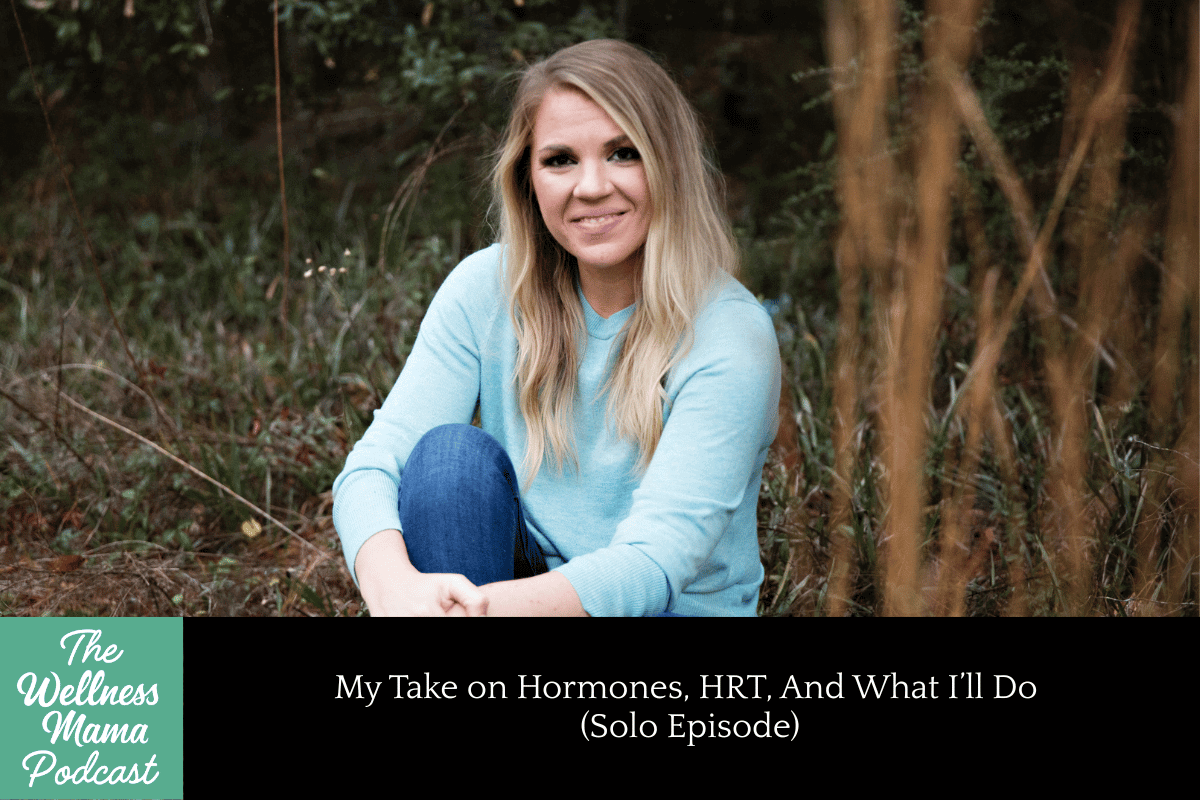
Katie: ?Hello and welcome to the Wellness Mama Podcast. I’m Katie from wellnessmama.com, and this episode is going to tackle a topic that I get a surprising amount of questions on, which is the topic of hormones and more specifically hormone replacement therapy. And what I will likely do and basically what my opinion is on this. And I will say, I’ve had a lot of guests on this podcast who have a lot of varied and different opinions when it comes to hormones. I do think this is especially a very individualized and personalized topic, and seemingly one that’s very top of mind for a lot of people.
So I wanted to share strictly my personal understanding and personal opinion related to this topic, along with what I plan to do and likely will do if or when I encounter those hormone changes and how I will navigate things like hormone replacement therapy. I felt like this is also timely in light of the removal of the black box warning around hormone replacement therapy and the kind of resolution of the controversy around the data of hormone replacement therapy being linked to cancer, which is something many guests on this podcast have tackled in various forms.
And I’ll talk a little bit about that today. But I also wanna just cover this from a high level perspective, from a lifestyle perspective, and share where my personal opinion differs from some of the mainstream narrative, as well as what is similar in my understanding. So before we jump in I will put links to some of the things I talk about in the show notes, specifically a course by Justine Stenger and links to Dr. Courtney Hunt on Instagram, who I feel like both of their work is very helpful and provides a different perspective than the mainstream narrative on this. And I’ve interviewed quite a few hormone experts in various capacities. I’ll link to some of those episodes as well. Before we jump in, I want to reiterate something important.
As always, nothing I share is ever medical advice, health advice, or even personal advice or advice of any kind. It is simply sharing my own experience, my own research, things I’ve learned along the way. Or ideas that have been helpful to me in my own journey with a goal of offering information and inspiration, never prescription or comparison or pressure.
You are and always will be your own primary healthcare provider, and I encourage you to be curious, to do your own research, to listen to your own body, tune into your deep wisdom and have respect for your body and to question everything, including and especially me. If something resonates, that’s awesome. If it doesn’t, please discard it. Always trust your own intuition and research, and my deepest hope is that these conversations will connect you with your own wisdom and your own next steps. With that said, let’s jump in.
So the topic of hormones is a big conversation. And it comes with a big disclaimer. So like I said, none of this is even remotely medical advice or advice of any kind. I get a lot of questions, a whole lot related to perimenopause, menopause hormone replacement, as well as peripheral topics related to things like PCOS, endometriosis, cycle changes.
So I’m just sharing my own opinion on a very, very complex topic as well as what I plan to do, and I’ll say jumping in, I’ll share more context on my feelings around this later. I am not anti-hormone. I am pro context and pro root cause. So I think that even in the context of hormones, even if they are, and I do think there is a time and a place for them, and even if they’re going to be considered with the help, hopefully, of a very qualified practitioner who understands the nuance, the foundational things are still very important.
Perhaps even more important when we’re talking about hormones. And experts like Justine go into how not understanding the foundational things and then just adding hormones can sort of put fuel on the fire. More on that later. Quick definitions, topics I’m gonna be talking about a little bit today and my understanding are things like perimenopause, which is the phase leading up to menopause when often hormonal changes can begin.
Menopause, which is defined as when there has not been a menstrual cycle for a year. And then post menopause, so anything coming after that time of menopause. And how hormones change during those times. I’ll also be talking about hormone replacement therapy, or I’ll often call that HRT, which can include estrogen, progesterone, testosterone via various different delivery methods, amounts and ratios.
Part of the reason this is such a hot topic right now is the FDA started removing the black box warnings from many menopausal hormone therapies after re-reviewing the data. And this is pretty new. The risk from the early 2000’s WHI study they’re saying now are likely overstated and misinterpreted, especially for younger women using physiologic doses in early menopause.
And they reiterate that it was the synthetic progestin that was used in that and not actually natural bioidentical forms of estrogen or progesterone. I have had guests talk about this and explain this in more detail, but just wanted to offer that for context. But I feel like this shift has reopened the conversation for a lot of women and kind of reignited the question of, for women, if they will take hormones or not.
And why I often get the question, what will I do when I enter that phase? In my understanding, here’s what the new label changes do and don’t mean. I think, in my opinion, that that warning was put on due to some misunderstood or falsified data. The WHI study in the early two thousands had increased concerns about breast cancer, clotting, heart disease, and dementia.
Some sources say none of those were actually statistically validated, increase in risk to begin with, and that they correlate to the synthetic progestin that was used, not the bioidentical hormones that are more available today, but this resulted in a broad, across the board spec, box warning for hormone replacement therapy that millions of women stop taking abruptly because of. What’s changing now is the FDA and HHS are removing or softening these warnings after expert review. And their message now is for many healthy women who start HRT near menopause, risk are lower than once believed, benefits might outweigh the risk and that local and vaginal estrogen will probably be over warned, given minimal systemic absorption.
So what does this mean? It does not mean HRT is risk free. Almost nothing is risk free. It doesn’t mean that everyone should be on hormones for life or that, like I said, like that there’s no risk. It means that the conversation is more nuanced than was presented 20 years ago or over 20 years ago.
And that there’s more than just the fear based narrative. So here’s how I kind of interpret this. I see this as a green light for better conversations, not a blanket safety prescription for hormones. I think there is a lot more, like I said, a lot more nuance than goes into this of just even the question of do low hormones mean hormone replacement?
I think there’s much more to that story. I think it’s a both/and. I think it’s worth looking at the root cause asking other than just shifts with age, which of course do happen, what also is contributing to these hormone shifts? How also will I support my hormones outside of just hormone replacement therapy?
And I think that leads us into some of the foundational things that are broadly helpful and supported by data and research whether or not a woman chooses to do hormone replacement therapy. I think this is an area of informed consent and that there will be a lot of nuance and that the answer can be different for every single woman.
So my hope in this conversation is just to share what I’ve learned to spark some initial research for each of us in our own journey with this. I would say I am somewhat open-minded to using hormones in the future. I don’t need them yet, but only on top of really solid foundations, things I’m already doing, which I’ll talk about today.
I would say my core philosophy around this is gonna be root cause, same with other aspects of health. Many of the lessons I got to learn very hands on when reversing my thyroid concerns. Which is foundational things first, and I’m so grateful for the very acute lessons in that, that I got to learn with my own health.
But I think especially when it comes to hormones, this is something I’ll be thinking a lot about when I start encountering those hormone shifts and wanting to really dial in before I would ever consider hormone replacement therapy. Not that I am close-minded to those but here’s why I’m cautious about jumping straight into hormone replacement therapy and personally would focus on the fundamentals first.
Hormones are powerful signals. They’re not magical substances, and if we aren’t making them, we’re not making enough of them. There might be a reason that is not so simplistic as just we are getting older and it’s important to, in my mind, get curious about this, rather than just silence the signal by replacing the hormone.
And even if replacing the hormone does end up being the right path, understanding any other contributing factors to the root cause gives us a lot of insight into our health and messages from our body about ways we can support it in a more comprehensive way. If the underlying systems, things like, what I’ll be looking at at this point, mitochondria, circadian rhythm, nervous system health, detox, and gut health are dysregulated in my mind adding hormones might actually amplify the chaos in the body and not fix it because it’s only addressing one part. So I don’t think this is ever so clear cut or black and white.
I personally feel this is a very much both and versus an either or, and that the conversation is not at all limited to hormone replacement therapy. There’s a whole lot more that needs to enter the conversation to make an informed decision. In my mind, simply just adding hormones without having a deeper understanding of these other things our body may be requesting is kind of like turning up the volume on a broken radio.
Like if we’re unable to convert certain hormones due to deficiencies, due to stress, due to methylation issues, due to a lack of just basic building blocks that we need due to breakdown of mineral communication within the body, or a lack of body voltage, then we’re just trying to turn off the volume on a broken radio and it’s not gonna work.
So personally, here are some key foundations I would want in place and really solid and verified before I would add hormones on top of that, and you’ve heard me talk about some of these before, I just always will use the chance to reiterate them. The first being light and circadian cues, which I think are actually one of the most powerful signals we can send our body.
And the more I research, the more this is reinforced for me and both Dr. Hunt and Justine Stenger both really reinforce this. I’ll put links to their resources in the show notes as well. But I think this is especially for women, and especially when we’re talking hormones, sleep safety, tremendous cues that we can either use to send hopefully safety signals to our body.
Or if we don’t take these into account, we can inadvertently be putting our body in a state of stress all the time. I think blood sugar and metabolic health enter the conversation in a really important way. During periods of life like perimenopause and menopause, and there’s been a lot more talk about this recently.
The importance of blood sugar regulation, of understanding insulin. Of supporting the body metabolically. I think this is another area that if this is not taken into account, simply adding hormones could potentially be problematic because the body’s having a breakdown in normal metabolic functioning somewhere.
And so rather than supporting that, we’re just kind of adding hormones, but without the ability to use them correctly in the body. I think inflammation and mitochondrial health also really come into play here. This is my mind where Justine especially shines as metabolic understanding and mitochondrial understanding.
And I have learned a lot from her and just even following her on Instagram related to this. But I think if we think of things through a voltage first, mitochondrial first lens, we get a unique perspective on how to support the body, and we would want to, in my opinion, take that into account and make sure mitochondrial health is really dialed in before adding something additional for the body to process like exogenous hormones.
I also go back to a lot the nervous system safety side, and we know that stress kind of breaks down function in many areas within the body, including and especially hormonally. And if we are in a state of stress and nervous system dysregulation and cortisol is out of range, whether it be from mental and emotional stress, whether it be from physical and physiological stress or whatever the cause, is that the body is interpreting danger signals.
And if the body is getting stress signals and feels stressed, we will not function hormonally at our best. The body does not prioritize healing, recovery, fertility, or optimal hormone function when we are in that state of stress, which is beautifully designed because our body is trying to keep us safe.
However, if we want to thrive and not just survive it’s important to address that stress response and whole podcasts that really go deep on each of these individual topics coming soon. I just wanted to touch on them briefly. I also think as we get older in general, and especially when we’re talking about perimenopause and menopause, that mineral and nutrient status of well across the board is vital and worth understanding that we have an increased need for minerals and certain nutrients.
I’m going to do a whole master series on minerals that really dives as deep as I know on my understanding of minerals and how to support the system effectively. This has been an absolute game changer for me. On an absolutely simplified basic level it means if we want our electrical communication optimized, we have to have enough electrolytes, sodium, potassium, magnesium.
If we want our terrain and our cellular voltage communication happening, we need those and trace minerals and fulvic and humic minerals and to not do things that deplete them. And this is also things like really amping up the nutrient density of our food, first and foremost, supplementing when we need to.
But really taking a nutrient first approach, not a macro first approach, but micronutrient first approach to food and making sure we’re getting kind of all of them, including some forgotten nutrients that I will also be doing a podcast about soon. And then it’s also taking into account the true basics like sleep, movement, connection, and purpose.
And I feel like, at least anecdotally, and I’ve seen the beginnings of this a little bit, I think there are some profound shifts related to those areas as we enter various phases of midlife and hormonal change. So my personal opinion, how I think of it and what I plan to likely do, I would like to hold off on hormonal replacement as long as possible.
And as long as any symptoms I have are mild and manageable and my labs look good, and I’m hopeful that with taking into account these foundational things I talked about, that I can navigate that for quite a while without having any extreme symptoms or without labs being out of range. However, I’m not in opposed to bioidentical hormone replacement in physiologic doses. If in working with a qualified practitioner in certain circumstances, if needed. That’s just not gonna be my first line approach personally. If I at some point have symptoms that severely impact my quality of life despite doing the strong foundations and I have all those things dialed in, then at that point I will be open to a carefully designed protocol of bioidentical minimal effective dose hormones in partnership with the clinician. And for me, it’s not a never or an absolutely not, it’s a not yet and a both and, and not without doing the deeper work as well.
I also wanna just touch on a couple people who have been great teachers for me and I think have both clinical and personal perspective beyond what I have on this topic. The first being Dr. Courtney Hunt, who I have gotten to interview and I’ll link to her episodes in the show notes. But for quick context, she is an OB-GYN and a quantum biology nerd who looks at how light mitochondria and DNA interact to impact hormones and health. She’s in her fifties, she’s still ovulating and she’s not on hormones of any kind. So she has an interesting personal perspective on this. She also goes live on Instagram all the time and just teaches and has quite a few low priced courses where she really gets deep in this work.
I will link to all of those in the show notes. But big ideas from her work that have impacted how I see hormones, and I highly recommend at least following her and learning from her for free daily, but from her work, I have learned in a deeper way that our mitochondria are conductors and light is one of the main instructors.
So both she and someone else I’ll talk about in a minute, very big proponents of getting the light piece correct. She’s a big fan of sunrise, sunset, repeat, and how sunrise, daytime natural light and sunset and then minimized artificial blue light at night are vital cues for our circadian rhythm that tell our brain and our ovaries how and when to make hormones.
And she says hormonal symptoms can often be bad light symptoms or bad circadian timing symptoms. And that insomnia, mood swing, cycle irregularity, thyroid health can often go back to this. So some key takeaways on how I apply what I’ve learned from her work is, non-negotiable, getting morning sunlight in my eyeballs, ideally outdoors without there being anything between me and the sun, not glasses, contacts, windows, et cetera.
More on that later as well. Anchoring meals and movement to circadian cues. So she’s big on food timing, using fasting to our advantage and moving at certain times to signal our hormones. She’s also, so is Justine, and so is Dr. Courtney Hunt, big on protecting our nighttime, so dim lights, fewer screens, better sleep hygiene, and considering red and near infra light, infrared light, as a supportive tool, but not a replacement for natural sunlight.
So my take based on her work is that if the womb is trying to wind down and yet our light environment is screaming jet lag 24/7, because we’re just exposed to artificial light constantly. It is not surprising that our hormones feel wild. This is the time of life to be a little extra supportive and nourishing and gentle with ourselves.
And fixing light inputs is step one before I would adjust hormone outputs personally. Another person I wanna talk about, I’ll link to her work as well, is Justine and she talks about the cell danger response and safety signals, which I think is also vital for women in general, and especially at times like perimenopause and menopause, when hormone shifts are an added variable.
She is a cellular health expert known for her work on mitochondrial health cell membrane medicine and cell danger response. I learned a lot from her as well. Really appreciate the nuance and depth of her approach. In plain language, some high level stuff that I’ve learned from her, and she goes way deeper on these topics, but the cell danger response from my understanding is when the cells perceive a threat, which could be from infections, toxins, trauma, stress, and they shift into defense mode, which is actually them protecting us. Again, the body’s always on our side. But in this mode, because they’re protecting us, things like metabolism, methylation, and hormone production can all downregulate, and this is actually by design and on purpose.
It’s not always a deficiency. It’s actually a biological strategy on the part of our bodies. So if the body thinks we’re in a war zone, it is not concerned with fertility and balanced hormones. Those are not the priorities. It’s doing it’s best to keep us alive based on what it perceives in our environment.
So what that means for perimenopause and hormones are, I’m extrapolating based on what I’ve learned from her, is that some symptoms that we blame on estrogen or progesterone might be nervous system related, or the mitochondria stuck in defense mode. So I do think her course is very valuable for that.
And if we just add hormones on top of a body that feels unsafe, we might get strange reactions or side effects. We might deepen the signal instead of fixing it, we might delay the work of addressing the actual underlying root of toxins, trauma or chronic stress by trying to mask it with hormones. So again, I think it’s a both and, and I think her approach offers a whole different paradigm and perspective than we often consider in the mainstream medical knowledge.
So based on understanding things from her, like cell danger response, which again, if you really wanna learn a like medical level understanding of, I’ll link to that in the show notes. But things I focus on before I would consider hormones based on her work would be nervous system regulation practices, really dialing in my breath, sun exposure, cold and heat, vagal work, somatic tools, understanding food as safety, so making sure I’m not sending stress signals by undereating or eating foods that the body perceives as harmful, trying to eat enough protein and healthy fats, not being in chronic restriction and eating seasonally when possible.
Focusing on this is more my piece of interpretation, not that she said this, but more of rest, community pleasure and joy. So giving messages to my body that it’s okay to relax and repair, and then slower kinder protocols rather than aggressive detox and pushing, especially if the body’s in a danger response.
So my take on this is I would want my body out of survival mode before I ask it to dance gracefully through perimenopause and menopause. So even though I’m not in those phase yet, it’s something I’m preparing for by addressing these foundational things. So for me, that means safety signals first, and then if needed in the future I’ll be ready for hormones by addressing these other things.
Briefly, would love to also just touch on the pros and cons of hormone replacement therapy as I currently see them. This is strictly my opinion and my current reading of the data. This is definitely nuanced and somewhat controversial. I do think there are potential pros. I don’t wanna be looking at this only through a negative lens.
So especially when started before or near menopause, in appropriate candidates, it seems that the data points to hormones being able to offer significant relief from hormonally related symptoms like night sweats and hot flashes, sleep disruption, et cetera. Possible benefits for protecting bone density and fracture prevention, possible benefits for mood, sexual function and quality of life.
And some data suggest reduced risk of chronic conditions in women who start early. And are low risk, but it’s still debated. There’s also debated evidence about the risk of heart disease going up for women in menopause, and if hormones play a role here as well in kind of reducing that or mitigating that risk. Some unknowns or things that could end up in the potential cons category.
It is not a non-zero risk. Even with the removal of the black box warning, there is some data pointing toward things like blood clot stroke, breast cancer, especially with high doses, especially in some women. I think this is where the nuance comes into play and the data is complex. There’s a lot to consider and study even in trying to understand the data with oral versus patch versus vaginal versus injection versus pellet, the delivery method, synthetic versus bioidentical, the age at which it started, the duration and the personal health history.
So I don’t think there’s a black and white answer. I don’t think there’s a blueprint that like widely applies to all women. I think there’s a lot of nuance here. And we don’t have perfect long-term data on every combination or dosing strategy to even be able to make a fully informed decision. This can be framed as a fix.
This is what I see as one of the biggest cons is that hormones might be framed as a easy fix for what is actually a lifestyle driven problem or an environment driven imbalance, or potentially stress from trauma or any number of other things. So here’s where I land personally right now. I’m not fundamentally against hormone replacement therapy.
I see it as a tool to consider for sure if foundations are strong and a possible short to medium term bridge during a transition phase of life that I hope to encounter and view as a beautiful thing and not a negative one and not as a free pass to ignore lifestyle and the foundations I talked about. It was something I would personally consider with careful tracking and working with a practitioner who understands both quantum biology and women’s hormones on a deep level.
Here’s what I am actively doing now to prepare for perimenopause as I get older. As of my last labs, I am not in this phase yet. I’m not having any of these hormone shifts. If anything, my fertility points vary directly differently than perimenopause at the moment, but here are things I’m doing and considering at this phase to prepare for when that does eventually come.
Really focusing on my circadian rhythm with light, sleep, and food, and movement timing. Being very aware of my light environment in my home and getting enough outdoor light, focusing on metabolic health by eating enough protein, building lean muscle whenever possible, and having a good understanding and habits around blood sugar stability.
Focusing on mitochondria, and this is one I’m very interested in learning a lot about right now personally. But supporting it through light, through minerals, through movement, through cold and heat and through like optimal nourishment. There’s a lot that comes into play there. Zach Bush says, we have 14 quadrillion mitochondria in the body.
They are far beyond just the powerhouse of the cell, though they do that as well. I’ll do a podcast actually about them soon because I think mitochondria are fascinating, but I’m really taking that into account as I get older. Being aware of nervous system health, doing daily practices that communicate to my body, that it is safe and that it can prioritize things like hormones and recovery and healing.
And I’ll probably do an episode on that as well soon. Also being aware of my environment, doing cleanup when necessary, avoiding kind of the big offenders like mold, chemicals, heavy metals, and also being aware of EMF environment. So I definitely don’t take an extreme view and fully avoid EMF’s. But I am aware of just easy things like taking the wifi down at night, not sleeping with a phone by my head, things like that. And then, supportive to this as well in its own whole category and topic for another day, but doing the deep inner work as well, addressing trauma, healing boundaries, pleasure and capacity for joy. So potentially more on those soon, but they’re a little bit more nuanced and a little bit less directly related, though I do think very important.
So as perimenopause approaches, whenever that happens for me, what I plan to do as it gets closer, continue tracking my cycle, which I’ve been doing for 20 years, so I have a lot of solid data on keeping an eye on labs, which I’ve also been doing through function health for years, and now have very solid years of data from that as well so I will notice if changes start to happen, I’ll link to what I use for tracking all of that in the show notes. Also tracking my metabolic markers, my insulin, my glucose, things like that. And then keeping an eye on and beginning now with a really solid foundation for lifestyle and environmental factors so that if or when hormones start shifting, I already have a solid foundation there.
And if I eventually do consider HRT, I’ll probably aim for bioidentical lowest effective dose and the most physiologic delivery, which might be transdermal or local. That’s something I’m still researching because I’ve not encountered that yet. And then I will reevaluate regularly rather than assuming it’s a forever thing.
So just a reminder of kind of making this all applicable under the umbrella of thinking as your own primary healthcare provider, which as I just explained, is what I’m doing in how I think of this topic. And I’m not at all encouraging you to think of it in the same way. I would much rather you get curious and foundational and think of your own health and think as your own primary healthcare provider.
You might come to entirely different conclusions about a lot of these things than I did. So I wanted to just summarize through that lens so that none of this comes across as prescriptive at all. So reminders, your body, your history, your genetics, your nervous system, your hormones are unique and they’re not mine.
No podcast, mine included, can replace working with a trusted practitioner. Deep wisdom from your own body, your own research, or your knowledge of your daily habits and all of the factors that come into play for your health. You don’t need to suffer endlessly. There’s no medal for that. And if you’re in a different place and having symptoms, personally, I would encourage a both and in addressing all of the factors that you can, including lifestyle factors.
But help does exist. It seems like there’s some compelling data on hormone replacement therapy, and I’m all for women making personalized informed decisions when it comes to hormone replacement therapy and not suffering needlessly as well. At the same time, just as a reminder, I personally consider hormones to be a potentially helpful tool, but not an automatic consequence free fix. So my opinion is both and, even with hormones, look at the foundational as well. So if you are in a different place than I am and considering this from a different angle, here’s maybe some self-inquiry questions that we can all ask that help us get to our own answers and not view mine as any type of blueprint.
Things like, have I given my body consistent safety signals and good like cues? And if not, in what areas could that be improved? If I’m really honest, how are my sleep movement, stress and nutrition patterns? Do I feel like, or might my body feel like it’s in defense mode? And if so, what might help it feel safer?
I do think that the answers can be a little different for each of us. And if I’m considering HRT, do I understand the specific dose formulations and risks for me? So in closing, I just feel like it’s also worth the paradigm shift to reframe that menopause is not a failure or a disease, it’s a transition.
And in some cultures it’s viewed as a beautiful one. And there’s some evidence that certain hormone shift in a way that helps women to be more driven and more able to tackle new things, new projects. It’s often a time of life associated with not having babies and small children anymore. And so in some cultures this is a phase of life where a woman moves into getting to, to take on new things, getting to kind of move into that sage role.
For me, I hope it opens up a whole new chapter of life with new creative endeavors or endeavors of some sort when I’m not as focused on my children as I am now. But my goal and my invitation wherever you are in this journey in hormones, is to support the body so well that whether you do hormones or not, they’re a gentle amplifier, not a desperate rescue, and to befriend our bodies in every step along the way.
At the end of the day, you are your expert in your own body. I hope this may be brought up some. Questions and thought provoking things to think about or gave you language and frameworks to have better conversations and make more aligned choices. And I am so grateful that you join me today. Thank you always for being here, sharing your time, your presence with me.
It truly means the world to me that you did and that we get to learn and grow together. And if you found this episode helpful, it would mean a lot if you would take just a second to leave an honest review wherever you listen to podcasts, which helps other people and moms find this podcast and listen as well, and helps this grow as well.
And if you wanna stay in the loop with my recent podcast episodes, my resources, behind the scenes updates, and my favorite wellness tips, make sure to subscribe and join my VIP email list at wellnessmama.com. I know email’s updated, but I still do share quite a bit there as well. For today, thank you so much for listening, and I hope you will join me again on the next episode of the Wellness Mama podcast.




Leave a Reply