Read Transcript
Child: Welcome to my mommy’s podcast!
Katie: This podcast is brought to you by LMNT, and this is a company you might’ve heard me talk about before, and I really love their products because proper hydration leads to better sleep. It sharpens focus, it improves energy, and so much more. But hydration is not about just drinking water because being optimally hydrated, a state called euhydration is about optimizing your body’s fluid ratios. And this fluid balance depends on many factors, including the intake and excretion of electrolytes, which many people don’t get the right amounts of. Electrolytes are charged minerals that conduct electricity to power your nervous system. I talk a lot about nervous system on this podcast.
They also regulate hydration status by balancing fluids inside and outside of our cells. LMNT was created with a science-backed electrolyte ratio of 100 milligrams of sodium, 200 milligrams of potassium, and 60 milligrams of magnesium with no sugar. Since electrolytes are a key component of hydration, here’s what happens when we get our electrolytes dialed in.
We have more steady energy, improved cognitive function, suffer fewer headaches and muscle cramps, we can perform better for longer, and especially the support fasting or low carb diet because when we stop eating carbs like during a fast, the absence of insulin allows the kidneys to release sodium.
So replacing that lost sodium with electrolytes can help you feel good on a fast. Since LMNT is zero sugar, it also doesn’t break up fast. Electrolytes are also important for maintaining blood pressure, regulating digestion and proper fluid balance. Keeping skin hydrated, which is a big one that I feel like often gets missed and so much more.
I feel like proper electrolytes is a missing piece for a lot of people and I love LMNTs new canned drinks, which are sparkling water with all the same ratios and minerals I just talked about, and they are delicious. You can check it out and learn more at drinklmnt.com/wellnessmama. And at that link you will receive a free sample pack with any order.
This episode is sponsored by BON CHARGE, and I love so many of their products from their red light face mask to their sauna blankets and everything in between. They focus on high-end wellness tech, and if you’re interested in how light can help you, which I talk a lot about, BON CHARGE has so much to offer.
Studies have found that specific red light frequencies can help reduce fine lines and wrinkles when used at the correct brightness and strengths. And some products don’t get these correct. The frequencies of red and near infrared light stimulate cellular activity at a mitochondrial level, which I talk a lot about on this podcast.
This can create better energy efficiency in a given location of the body. For instance, red light on your face gives more cellular energy for biological processes. This can help to decelerate the signs of aging and lead to firmer, plumper skin. So the long-term results you can see when using an LED mask over time are things like, reduction in the appearance of fine lines, reduction in the appearance of wrinkles, reduction in under eye bags, firmer skin, tighter skin, reduction in signs of aging, scar fading, plumper looking skin, reduction in visibility of blemishes, and visibly clearer looking skin.
I’m always a fan of getting natural light from outdoors, but for people who are wanting to kind of tackle the aging process head on, this is in a way to kind of give your body some extra benefit from these specific wavelengths of light.
The safe, non-invasive beauty treatment is going to be around for a while, and for a good reason given the results people are seeing. If you wanna check out the BON CHARGE Red Light Face mask, and all of their products, you can go to https://boncharge.com/wellnessmama and use the code wellnessmama for 20% off.
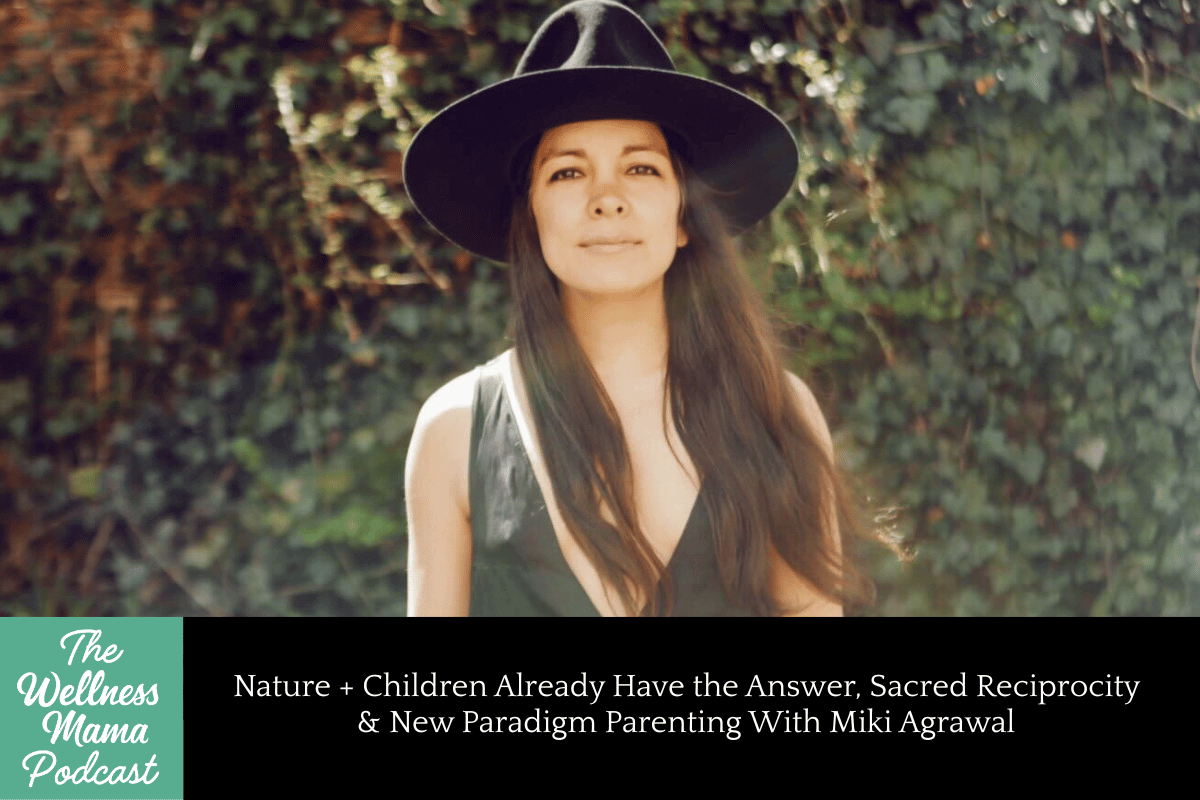
Katie: ?Hello and welcome to the Wellness Mama Podcast. I’m Katie from wellnessmama.com, and I am very excited for this episode that goes in many directions stemming from the idea that nature and children already have the answer actually to many of the problems that we face, and specifically how this is coming into play in, in a new way with addressing the plastic crisis, which is something I have been talking about for a very long time, probably close to 15 years at this point.
And that today’s guest is addressing in a big, audacious and fascinating new way. We also talk about the concept of sacred reciprocity with nature and new paradigm parenting. You might be familiar with today’s guest, but if you’re not, she’s absolutely fascinating. Miki Agarwal is celebrated as a visionary entrepreneur and is the driving force behind companies you may have heard of, like Tushi, Thinx, and Wild that have, addressed big problems in big ways, in ways that are good for both humans and the planet.
She’s the author of several books, but to me what’s fascinating is she’s a former professional soccer player, turned entrepreneur who opened the first gluten-free pizza restaurant in New York City, turned serial entrepreneur with these companies that address big problems in big ways. She’s been to all seven continents, including Antarctica with her son, and she’s an identical twin in an Irish triplet.
And I’m very much a fan of her most recent work, which like I said, is helping address the biggest source of plastic waste, which is disposable diapers in a way that’s regenerative and sustainable and might have the ability long term to actually really make a dent in the plastic problem that we’re facing nationwide. So, fascinating episode or worldwide, I should say.
Fascinating episode goes in many directions. I know you will enjoy it. She is such an inspiration. Let’s jump in. Miki, welcome. Thank you so much for being here.
Miki: Oh my goodness. I’m so happy to finally, I feel like we have been, supposed to be friends like years ago and now we’re finally doing it. It’s great.
Katie: Long overdue. I know. It’s, I feel like we know so many of the same people and I’ve known of you and followed your work for so long. So it’s an honor to finally actually get to have a face-to-face conversation with you and especially to like hear about some of the amazing things you’re doing. You have, I will admit, one of the most wild and impressive bios I have ever read in researching this podcast. Not many people get to say that they went from professional athlete to opening the first gluten-free pizza restaurant in New York City to multiple successful startup companies that tackled big problems, which I love because you’re continuing that theme currently. Like I love that right now I’m kind of behind the scenes getting to learn about and hopefully help a little bit with your new endeavor, which I think is tackling a big audacious problem.
And I love this. But I know that’s like a broad intro, but I wanna hear a little bit about your story and how it led here and the funny common thread of several companies that all have to do with butts. So let’s start there.
Miki: And now and finally, babies butts. Yeah, so I mean, I grew up half Japanese, half Indian to, in Montreal, Canada. Identical twin sister and a third sister’s 11 months older. So we’re Irish triplets. My parents had no help at all, so it was a quite, quite a wild journey. And, you know, early on I just learned the power of having different perspectives. You know, I think at dinner table we just always debated about different issues and because my mom was Japanese, my dad’s from India and we grew up in French Canada, there was always like the Canadian, the American, the Japanese Indian perspectives.
And so there was always beautiful, healthy debate. So growing up, I think it also led me to just asking questions all the time. Like, is this the best way? Are there better ways? Is this the only way? Could there be an even more elevated way to elevate people, the planet, support ecosystems in a new, new way?
My name in Japanese actually means three beautiful trees. Mi means three and Ki means tree in Japanese. And so I’ve always loved trees, I’ve always loved nature. I’ve always been such a nature baby. And Yeah, I kind of started my, my career, out of Cornell. I played soccer professionally. First I played at Cornell, then I played for the New York Magic. But it kind of, it’s a, it’s a long and convoluted story, but just not to kind of get too deep into it. Started my first business when I was 25 years old, asking the question like, is there a better way to eat America’s favorite comfort food, which was pizza? And I discovered that pizza’s a $32 billion industry.
Americans eat a hundred acres of pizza every single day. We love our pizza and wanted to create a healthy alternative to America’s favorite pastime. And so created the first gluten-free, farm to table, local, seasonal, organic pizza restaurant in New York City, and opened several locations thereafter. One of which has been open now this year, in the next two weeks, marks my 20 year anniversary for my restaurant being open, which is, dates me very much. But, yeah, I was 25 when opened, opened it, and it’s been, this year is our 20 year anniversary, it’s insane. And it also happens to be John Bon Jovi’s favorite restaurant.
Paul McCartney, Meryl Streep are always there. It’s really cool. I feel very, you know, my own restaurant. And then I started, Thinx the period proof underwear asking the question. Like I kept having period accidents every month. And I was just like, I can’t believe I’m, perioding everywhere again and having to go and clean my clothes and clean my chairs and my sheets and, and there’s gotta be a better way.
And tampons, pads, those are all bleached, they take hundreds of years to break down in landfills. They’re just terrible for the planet and uncomfortable, really bad for you. And so created the first pair of underwear, called Thinx, that’s leak proof, absorbent, antimicrobial, no shrinking that really supports women every day of the month.
And we have helped divert hundreds of millions of tampons, pads, and applicators from landfills. And we’ve also helped millions of girls in the developing world go back to school by partnering with these organizations in Uganda and otherwise that provide menstrual products to women and girls who were missing school and skipping work because of their periods.
And, so that was a huge, huge, you know, challenge of the status quo. And it was, we were able to really shift it through artfulness, through creativity, through accessible language, meeting people where they are, talking to them in ways that just makes sense to them and offering a beautiful new way.
And then I started Tushy, the modern bidet that washes your butt clean after you poop. I mean, you go through probably a ton of toilet paper. And right now, you know, Americans go through 15 to 20 million trees every single year for toilet paper consumption, and it’s a really crazy thing. Plus, they’re bleached, they’re processed. It’s just like, you know, every single roll of toilet toilet paper requires 37 gallons of water to make a roll of toilet paper versus just using a precise stream of water, you’re using so much less water precisely for your bottom.
By installing a bidet that’s super affordable, you’re paying yourself back. Literally after three months of buying a Tushy bidet, you’re paid back and you have to… All that toilet paper that you’re buying and buying and buying and buying. You don’t have to buy all that anymore. You’re cutting down your toilet paper consumption by 80%.
Or you can just eliminate toilet paper altogether and just use little towels. That’s what they do in Italy. They don’t even use toilet paper. They use towels because you’re precisely washing your butt and you just pat dry with a towel and you just switch the towels every few days or whatever ’cause it’s, you’re clean, you’re taking a little shower for your butt. And so we have helped really yeah, challenge the status quo in that space as well. And then I became a mom. And as you know, you go through like the one-way doorway of made into mother, you know, for a dad, bachelor to father. And it’s like a one-way doorway from an I/me consciousness into an us/we consciousness, and it’s just like I, you never look back.
You can’t. It’s like, what is the world my baby’s gonna grow up in? What products am I gonna put in them? What is the ecosystem I leaving my baby behind with? Like, what am I feeding them? Like what… you start asking all those questions you wouldn’t really ask before. And in that process, while changing diapers and diapers and diapers and diapers, I looked into it and discovered, whoa, every baby goes through up to 6,000 diapers that take 4 to 500 years to break down. So every single disposable diaper ever invented is still sitting in a landfill somewhere today. Like what the actual, right.
And so all of our diapers, everyone’s diapers, are still sitting in a landfill somewhere today. Just, just, just sitting there. And so we, you know, I really was like. So this is the magic of babies and children in nature and how we’re, if we’re super deeply aligned, they just give us the answer. Do you want me to stop there for a second and then, you know, or do you want me to quickly share the Hiro story and then…
Katie: Yeah, go into Hiro the story, ’cause I love this and I feel like this is gonna open the door into like such a deeper discussion on so many things.
Miki: Okay, great. So, so, know the story of how Hiro diapers, Hiro technologies came to be was from being deeply aligned and attuned with nature and our babies. And so I was, I started taking what I call Friday thinking days where I don’t take any calls or meetings on Fridays. I basically use that as a day to allow for creative ideas to download and just not just drowning myself in more, more reacting. And it allow and, and so much innovation, ideas, creativity, invention, comes through on those days. And so on a particular Friday thinking day, I was staring out the window and I was looking at a tree and I was like, oh my God, wait a minute. If breast milk is considered liquid gold, right? Like nutrient rich, mama juju, breast milk, nutrient rich, then baby poop must be fertilizer gold, right? And we’re wrapping like billions of pounds of this fertilizer in plastic. Throwing it in the trash, like billions of pounds of this mama juju fertilizer and throwing it in the trash. And what if… my question became like, wait a minute, what if the baby poop could fertilize something to grow and eat the diaper?
Like, could there be something that can break down diaper plastics? What could that be? And as I was asking myself what could break down diaper plastics, my baby Hiro at two years old comes running into my room and points to a book in my nightstand while saying Pachamama, which means Mother Earth. And I look and I pull out this book and I open it and it says, fungi can break down plastic. Right when I was asking myself what could break down plastic, my son, the baby came in, pointed to a book and gave us the answer, ’cause I was tuned into nature looking at a tree. And I really learned the power of the now and being fully present and being fully aligned. And when really, really listening and truly attuned energetically to the universe, the magicians of baby and nature appear to give you the answer.
And it really led me on this journey to bring together the Oceans 11 of top PhDs in mycology, micro-mediation, biology, bio-biochemistry. The top, top people in the space of micro-mediation. How do you break down things with the power of fungi, and have learned so much in the last four and a half years where, you know, fungi have been breaking down the carbon backbone of trees for hundreds of millions of years, and it turns out the carbon backbone of plastic is very similar to the carbon backbone of trees because plastic comes from fossil fuels and fossil fuels comes from dead trees and animals. And therefore, fungi can break down trees.
It can also break down plastic. And so we spent four and a half years really partnering with nature, looking at thousands of different strains of fungi, whittle it down to hundreds of strains. They’re non-toxic, culinary grade. They’re healthy. You can eat them. Please don’t eat them, but you can eat them. And they are truly the beneficial fungi of the planet, the ones that you know are really good for us. Not the ones that are not beneficial, but the ones… It’s just like there’s beneficial bacteria, there’s good bacteria, that’s, we eat probiotics and there’s bad bacteria. That’s not good for us. We’re trying to kill those. These are beneficial, good pro-fungi po, you know, that are here to support us in breaking down our plastic. And they’re non-toxic, like I said, culinary grade. And so how it works is a first iteration… if you go to hirodiapers.com, HIRO, diapers, you can check it out. And basically you just drop this little pouch into the soiled diaper.
So, you know, change a diaper off the baby. You drop this little pouch in, we call it one inspired action. That’s all it takes to change the world. It starts with one inspired action. We drop this little pouch into the diaper, you throw in the trash, and that’s it. And after that, in the, in the, the diaper will be thrown, ends up in a landfill.
And in the landfill, the ba, the baby poop will fertilize these little fungi to start to grow and then start. And our whole vision is for it to be landfill biodegradable in under 12 months instead of 4 to 500 years. So that’s a project we’re working on right now. Fungi that can break down plastic, starting with baby diapers, their number one household plastic waste item.
We wanna serve the mother, the mama, the family. We’ve created the best, truly best diaper in the market. It is the only unbleached diaper. It’s literally made with 50% less plastic than all leading brands, et cetera. Only where performance matters, and it’s like five times drier than leading brands. It’s up to three times, dries up to three times, sorry, absorbs up to three times faster than leading eco brands.
It’s just the best diaper that also comes with little fungi that can help break it down. I mean, it’s like a win-win. It’s the best performing and best for the planet. So my rant is over. That’s the story.
Katie: I love that so much because in the past I have done the cloth diapering thing for the sake of the planet and the sake of not putting junk on my kids. And I also know how much work that is and the allure of a disposable option. It’s just like you said, these are, I don’t think most people realize one of the biggest sources of plastic waste and the largest consumer source of plastic waste.
And I’ve been writing about the plastic crisis now for I think at least 12 years. And it’s gotten worse since I started writing about it. Like, not only we now know, this is not good for the human body to be interacting with plastic as much as it is in the modern world, but the planet is getting saturated. And we’re now, like the testing data is kind of insane on what’s in the ocean, what’s under 30 meters of ice in the Arctic. Like plastic has kind of thoroughly saturated the planet at this point. And so I think we are in a point where it’s like we have to start addressing this in a new and novel way. And I love that you got into this research with fungi because I think there’s so much more we can still learn from them, but I think they might actually have a chance at addressing this crisis in a sustainable way when nothing else seemingly can.
Miki: Hundred percent. I mean, 91% of plastic is not being recycled. It’s put in our landfills, put in our oceans, incinerated, and much of it is being mismanaged. And that’s what ends up in our rivers, in our streams and ends up in, back into our, our brains, our bloodstreams in our, in our reproductive organs and now in baby’s umbilical cords.
I mean, they’re found like too much in baby’s umbilical cords. That’s how much plastic is being ingested up to the tune of, to a credit card a week. Now it’s crazy that we’re all ingesting unless we really, really make a concerted effort to reduce our consumption. So I’ll, I’ll share more about our, our vision of how we’re thinking about creating a Hiro.
Katie: Yeah, I would love to go deeper on that. Yeah. Because I feel like this truly is, and I’ve heard Dr. Zach Bush say kind of through a multifaceted channel, we are on a pretty short path, kind of, of like some really bleak statistics related to human extinction. And then they all, to me, kind of overlap between the problems our planet, is facing that relate to these like levels of pollution across the board and how those things are impacting the human body, and the fertility crisis we’re now seeing, and the health crisis we’re now seeing across the board.
So all of these things are of course related and as he explains so well, it’s like the planet is a self-correcting organism. It eventually will correct these problems. It’s really the question of do humans get to continue to live here when it does? And that’s the the big question we get to wrestle with now.
Miki: Exactly. The way I think about it all the time is like when we have a fever, our body temperature goes up to kill off the viruses, to kill off all the bad bacteria in our bodies. Our body temperature goes up. The planet is going, is going through a fever. And the viruses are the humans. And so like the, so the global warming is the planet having a fever to kill us off, bring in like tsunamis and fires and, and disease and whatever, to just like decrease the population to get rid of the bad bacteria, the bad viruses.
And the beneficial humans, the beneficial folks are going to be the ones that stay and get to steward the planet if we wanna continue with our species.
The other thing that I really talk about a lot at Hiro is the idea of ecosystem consciousness. Like we, we care so much about ourselves. Our now when we have our babies, our family, our single family unit, but if we’re not thinking about the ecosystem that our babies are gonna grow up in, we are contributing to the extinction of our children. So to be like, I want my baby to survive on it, and then you’re buying all this stuff, you’re creating all this waste, and then babies are gonna go extinct. They’re gonna be full of diseases, full of plastic, full of… So what’s even the point of being like, my baby, my baby, my baby gonna buy all this stuff for my baby, and then your baby’s gonna grow up in a world that’s gonna kill them anyways.
And so it’s like we have to start to think in an ecosystem consciousness and not just in a and not also, not in a. family unit consciousness, we have to start thinking in an ecosystem consciousness. And so how we’re doing that at Hiro is that we’ve created this, we’ve really looked at that model, the reduce, reuse, recycle model, and we were like, wow.
Reduce, reuse, recycle. We’ve been heard, we’ve heard that for since the eighties or whatever. You know. Reduce, reuse, recycle. Recycling. 91% of plastic is not being recycled. It’s a complete bullshit, greenwashing, hoax. It is not real. It’s not true. also requires a lot of energy. It requires washing. It requires changing hands.
It requires moving things around. There’s still a lot of energy resource required for reusing. Still better than just throwing stuff away, but it’s, it’s not as good. Even like even people who say re, reusing diapers, like washing and washing and washing the amount of washing the water. Plus they also, now all the postnatal physical therapists say that the diapers are actually bad for mobility for babies ’cause they’re so bulky. And so there’s a lot of stuff also that’s challenging with reusing. The only thing we think that’s gonna serve is a new model, which we changed it from. Reduce, reuse, recycle to reduce, regenerate, reduce regenerate, reduce your consumption, reduce what you’re buying, reduce all this stuff. How are we doing that?
At Hiro, we are teaching parents elimination communication, how to get your babies out of diapers in 12 to 18 months. It is counterintuitive for any diaper company to do that, and we care about the ecosystem. If you’re… If you… so the first part is reduce. Reduce your consumption. We’re gonna teach you how to do that.
The second part is regenerate. If you’re gonna use any product at all, use a regenerative product. Use a product built on regenerative principles that are in this sacred reciprocity of birth, death, rebirth, transformation, birth of, you know, transformation, rebirth. Like there is this cycle that nature naturally flourishes in, easefully, effortlessly. And if we’re not in sync with the natural flow of the universe and nature, we are gonna be the things that stop that flow and are gonna get extinct so the flow can continue and be served. And so how are we doing that? Of course, we’ve partnered with nature. We’re the first product ever to partner, disposable product, ever to partner with fungi that can help return it back to the earth. We still wanna, my, my mission in life in across my entire life has is elevate people and the planet. Elevate people and the planet. Thinx elevated women and the planet. Tushy elevated people and the planet. My restaurants, elevated people and the planet, and now Hiro is also elevating people and the planet.
We’re still elevating mom’s exhaustion and the washing of the diapers and the trash and the poop. That’s not an ideal situation, so if there are very few items that have to buy, diapers are one of those items that are actually practical for today’s modern life world. And let’s find a version of it that has a regenerative principle built in with it.
And so I, I believe in like in, in, in, in making things ease easier for us. I mean, our life today is much easier than it was way back then when we had to do all this extra stuff. So I get that. But if we’re not thinking regeneratively, then we’re, we’re doing a disservice for the rest of our own, our own species to continue.
So that’s that balance that we are finding, that it’s like we’re meeting parents where they are, we’re providing you with a diaper that you know and you can trust and you can count on in your busy, busy life. But we’re bringing in that regenerative principle to it by, by talking about that one inspired action.
For to start, you’re adding this one little pouch in the diaper. You close it, throw in the trash. That’s it. One tiny little pouch addition. That’s it for you to help not contribute waste for your baby’s life. Like, come on. Like you could do that. In the future, that, that, that, our friendly fungi will be built into the diaper.
So you even have to do the one inspired action. But we wanna first teach parents that it’s safe, it’s non-toxic, it’s culinary grade, it’s safer than the diaper plastic itself. It’s safer than the, you know, we’re the only unbleached diaper, but it’s the only nature piece of the diaper that’s truly like natural, that is healthy, non-toxic. So first iteration, we want to make it be something that you add in after, to build that trust and then we build from there.
Katie: I love that so much, and I especially love that term sacred reciprocity because I feel like this is built in to nature and humans are probably the only species on the planet that has the ability to remove ourselves from that. Like all animals, all plants, all fungi live within that, that sacred reciprocity as this beautiful symphony. And we have, we can and have, removed ourselves in so many ways from that symphony with nature. And I talk about this on the physical health side, quite a lot of nature deficit disorder and how, my belief is that actually 90% of things we categorize as health problems are actually just that we are not living in alignment with what our bodies were designed to have in relation and harmony to nature.
And the beauty there is we don’t have to go live in the woods in a yurt with no lighting or electricity to fix it. We just have to understand that reciprocity and that symphony and bring that into our environment more, bring that into our lifestyle more and take it into account in our small daily actions.
And I feel like you are making that possible in such a dramatic way. But I would love to even go a little deeper on the sacred reciprocity concept because I think, I love that you’re tackling the biggest plastic waste first. And I’m guessing there’s many other ways we can in small ways with one small choice, like you said, contribute to that sacred reciprocity and shift our paradigm of how we think of ourselves and nature and the environment and make those little changes along the way.
Miki: A hundred percent. One of the things that we’re really excited to teach all of our Hiro parents is what we’re calling New Paradigm Parenting. And this new framework that we’re calling New Paradigm Parenting, and it’s this framework of how to become an eco forward parent leader. How do you become an eco forward parent leader, where you start to become a leader in your own micro ecosystem, your household? Then you become a, you know, leader of your community, where you start to teach parents based on what you learned with us. Simple, simple things like replace your little squeeze packs with a simple grinder that you bring everywhere you go. ’cause you can grind all your grownup food and just give it to your baby.
You don’t have to buy those plastic squeeze packs, just by the way are leaching plastic into your body, your baby’s body. Do not buy those again. Just get a little grinder and that’s it. And you know, cleaning products, you literally can just, you just need some vinegar and some essential oils with water. And that’s it. You don’t need more than that to clean surfaces. You don’t need to buy all these cleaning products over and over and over and over again. You just need some essential oils and vinegar and stuff like that. Here’s how you learn how to compost. Like you make a, composting is so easy. You can get electric composter one for your, for your, for your, you know, next to your sink.
It’s so, so easy to do. 24% of all landfill waste is food waste. And if we can just literally remove all that food waste and bring it and just have that at home and just compost it at home, it’ll save so much pain. Methane production, all that… CO2, all that stuff that ends up in landfills. It can just be literally, you know, brought back to earth and then delivered back into nature.
You, your garden, you can, even if you’re in New York City where there isn’t a garden near you, you can just take the soil that you create from any little electronic electric composter that you can get. There’s, it comes, it turns into soil and you can just bring it to your tree outside your house or wherever and just put that soil there.
It’ll be so, so, so good, healthy soil. So, there’s so many little tips like that, you know? Plus like, how do you build the awareness for the ecosystem consciousness? We’re gonna teach you permaculture. We’re gonna teach you herbalism. We’re gonna teach you how to really tune in with the natural world and use that as remedies and how to bring it back.
It’s, it is that, you know, ow do you honor nature? We’ve done so many ceremonies. Even as a company, we brought people to the waters and we offered flowers to the, to the waters, and to say, Hey, like, we’re giving back to you. Like we’re so grateful, like we’re bringing this into our practice. I just got back from the Amazon rainforest as well, just a couple of days ago, and actually the chief Minawa… it’s still, so you can still see my tattoo, he, he, he painted this tattoo on my arm, which, which some, which, which, means ever expanding tree. And his whole vision is like, can you take the trees nature in the Amazon and expand it to cities, expand it to the world, and expand that con, that nature consciousness to the world.
And that’s what we’re here to do at Hiro is to, and at Tushy and all the products I’ve ever done worked on, is to expand that nature consciousness so that we can create this really, really cohesive, beautiful, reciprocal world that’s not taking, that’s not just extractive, but it’s also… when we give like actually like there the natural endorphins in your brain, that’s same as like having an orgasm actually get released when you’re in deep giving mode.
When you’re actually in service. When you’re in true service, you do have those natural releases of endorphins, serotonin, you know, in your brain. And all these positive, you know, neuro… happy neurochemicals in your brain, you know, it’s, it’s, dopamine, oxytocin, serotonin, endorphins, like all of those get activated when you’re in service.
And so, Yeah. I think as you know, being a parent, you’ve been, you just are in service, you know, and I think if we also can parent the planet in the same way we parent our babies, we will be the, the change that this planet needs to see. And yeah.
Katie: And the beauty there I think, is the more we make those small choices and pour into the planet, it gives back in an exponential and compounding way. And I also love this common thread that seems to be really waking up in society of the return when you even say talk about like permaculture and herbalism, these are things that were like ancient sacred knowledge that often women carried and they’re coming back.
And I love that. And I love hearing from moms who have like gone deep on learning herbalism and are now helping in their communities with that. Or like all these beautiful different modalities. Or like one of my personal favorites is like, I have in my yard and in my dad’s yard nearby, bees. And I feel like bees are such a beautiful insight into the world.
We know like if the pollinators go away, the planet ends. So to me, like nurturing the bees and providing an environment for them is like a beautiful touch point with that sacred reciprocity and with seeing firsthand nature. And then the benefits we get back, whether it’s from gardening, from beekeeping, from any, from composting, it’s like we give nature scraps and it gives us back this like liquid gold soil that grows things that we can eat.
Or you know, we give bees a tiny amount of time and they give us honey, which is the only food that never goes bad. It’s just, it’s incredible because we can never kind of like outdo nature no matter what we pour in, nature will always pour more back.
Miki: It’s, it’s so true. And I always, you know, share this tidbit, it’s like, trees like are our greatest technology of our time. Like literally. They take in carbon dioxide, carbon monoxide, nitrogen dioxide, and transform it into oxygen for us to breathe, and we’re disrespectfully cutting them down to wipe our butts with them.
Like the audacity of disconnection and the, the wildness of that, when I think about it, is so painful. Like when you’re just like, how, how disconnected are we? To just be okay doing that. The thing that gives us oxygen to exist on this planet, we are cutting them down and wiping our butts with them. Like, it’s just about making those, those, those everyday inspired actions to stop consuming so much, only where is needed. And regenerate like partner with regenerative models, regenerative products. Products that have thought through the end of life of, you know, disposables. We need plastics. I’m not vilifying plastic in a way, like for transportation, for medical, for our phones, for this computer, for us to be able to talk for, it’s, it’s required. It’s the disposable single use parts that we need to really reduce, only when we need, just in the acute moments that we need them. We’re gonna teach you how to get out of them. We’re gonna teach you how to do it faster and better. And then if you’re gonna do, use any product, partner with nature, it’s that simple. Reduce regenerate.
Katie: I love that reframe, and I think like that alone applies in so many areas and if, and and it’s like compounding there as well. It’s like if we switch to if, when we can, buying things locally from farmer’s markets, using our own bags, not buying packaged foods in single use plastic, like that’s also better for our bodies.
Again, it’s like everything we can do that’s good for nature also returns to us exponentially. And I would love to talk a little bit more about, I love that term you used of New Paradigm Parenting, because I also feel like even in the 20 years I’ve been in the world of health and wellness and of parenting, I’ve seen so many shifts and it feels like there’s really like this massive groundswell of shift in understanding and energy around parenting with this current generation.
And I love to see this. I had a recent podcast where the guest explained the term kind of horizontal relationship in parenting versus vertical and how historically it was more of like a vertical relationship where the parent was like, I’m in charge and you are gonna do this because I said so. And there wasn’t like reciprocity and energy flow in both directions. And that we know psychologically for both parents and kids, it’s actually much healthier for there to be a horizontal relationship. So, not that we don’t guide our kids, but we understand from the beginning that they are equal in their, you know, in their autonomy and their respect, in their humanness.
They’re not growing into being humans. They’re already fully worthy of respect and agency and autonomy. So I would love to go deeper on new paradigm parenting. ‘Cause I think also this is part of what creates the next generation of humans that also help the planet and help solve these problems.
Miki: I love all that you just said. It’s so right on. It’s like how do you parent in a way that honors and celebrates our children as divine beings from the moment they’re born? I love that. And one key thing that I think about often when it comes to rearing children is the idea of emergence and cultivation. So emergence. And that’s also the same thing with business also, same thing with, with just with parenting, this whole system and structure. If we, again, look at nature, the nature, nature is our greatest technology and, and it’s been around for billions of years. Like, who do we think we are to like, you know, it’s so funny to me that we think that we’re like not as evolved as as nature. So in nature how it works, it’s, it’s, it’s an, it’s, it’s there, it’s a philosophy around emergence and cultivation. So it’s all about what is emerging. So when I think about my son Hiro. I’m always seeing what emerges in his interests, like what he cares about, what he’s into, and then we cultivate that.
We, we add water to it, we add soil, we weed it. We, we take the bad stuff away, we train and we keep, we cultivate. Then, then, then something else emerges and you cultivate that. It’s, it’s about emergence and cultivation. And I think as we’re starting to re attune with Nature Paradigm, I think new Paradigm Parenting is Nature Paradigm.
And it’s that paradigm where you’re like, oh,I wanna see what emerges in my kid and I’m gonna help cultivate that. Which is why we’re, we’re switching our kid to Montessori. Because Montessori is a self-guided, schooling system where it’s like you’re actually following the emergence of the children and then you’re able to cultivate their interests. You still, you know, you do your math and your, your science and your, your basic level of just understanding how the world works. But then you’re also just, it’s a self guide.
And the teachers aren’t even called teachers. They’re called guides. I love that in the Montessori framework because again, it is following that nature principle, that nature paradigm, which is emergence and cultivation. Like what is emerging and then how do I cultivate the things that are emerging? And so, yeah, I, I really, yeah, I really honor that, that the philosophy, the tuning back into nature in every frame. It’s like, let me look to nature, think about how to parent. Let me look to nature, think about how to build a business. Like we, when we started Hiro, we didn’t launch the business from like a PR campaign.
We actually launched as a prayer. We held a Zoom for like 250 people. We brought in indigenous leaders from the Amazon Rainforest, spiritual teachers from India, from the banks, the Gunga River. We brought in leaders from the Mayan, Mayan grandmothers, and we just sat there and launched the company as a prayer. And we prayed on the fungi. We prayed on this collaboration between nature and people, and that we can come together in true, true, authentic, high integrity collaboration together and really pray this project into being without any deleterious power structures, dynamics that are trying to old paradigm of more scale, trauma, scale, take, extract. That energy, like take that away and constantly tune back into prayer. When there’s feelings of fear growing a company, when there’s some challenges going on, where do we, where is it coming from? When we tune into where is it coming from? And the same thing goes to parenting. Am I parenting ’cause I want my kid to succeed amongst everyone else?
Or do I want to build an ecosystem that every being thrives together collaboratively, cohesively? Where is it coming from? And that’s this frame. It’s like, where’s the energy? Like I had a conversation even etoday with my president. We were like, let’s get energetically aligned. Like what is, what, what, where are some energetic blocks here?
And that’s how we’re talking at the company. Not like what are the KPIs? You know, it’s like where are the, where is the energy flowing and where is it not flowing? Let’s talk about where it’s not flowing and let’s clear those energy blocks and then build from there and let’s understand each other. Like, oh, your blocked ’cause of that, I’m blocked ’cause of this.
Like my story was totally different from your story. Let’s get aligned energetically. And it’s just always better when we get aligned energetically. In all parts of our life with, with business, with our children, with parenting, with planet. Went on a little bit of a tangent.
Katie: I love that. No, I love it. And I think we’re gonna keep seeing those changes, hopefully, and the more alignment in parenting and education in so many of these areas. And I’m, I am confident actually, I know the statistics can be bleak at times, but I’m confident that we actually still can shift these things in a very meaningful way. And that like the current generation is invested enough to actually start, I feel like, making those changes in significant enough numbers.
And I’m curious, like…
Miki: I hope and I pray. I hope and I pray. I hope and I pray that people aren’t just on their soapbox and saying that they want to make the change, but actually are taking these inspired actions are choosing with their dollars. Like I tell my team every day, our investors aren’t, aren’t are like the investors..
I mean, yes, we, we are grateful for the investors who invested the money to help grow this business, start this business. But our greatest investors are the people. The people who are going to support this project energetically, who are going to proliferate the message of nature healing nature. Here’s an example of our babies, you know, like diaper that can be harnessed with nature to help notcreate more waste, like, let us all join that together. Like I pray that people care enough to make this, this change. And it’s like even from a price perspective, our diapers are cheaper than Coterie or other big diaper diaper names, you know, diaper, all the diapers, all the wipes, all the fungi, 119.
If you get it through ambassadors, it’s $99 a month. Like, through you. If they get it through you, it’d be $99 a month for all the unbleached diapers, all the unbleached wipes, and all the friendly fungi for the whole month. $25 a week to help move the, our society and culture forward in a different way. I pray that people care, you know, I do.
Katie: Yeah, same team, and I do one of my core beliefs and part of the reason for my genesis in Wellness Mama and why it was created is I believe moms especially have a very unique power. And that moms are a force of nature in ability to create change. Because not only do we represent just purely fiscally the majority of purchasing decisions, which is huge, but more importantly like we are more often the ones hands-on raising the next generation. And so I think if this can change, I think moms are gonna be a big part of that.
And so I just am deeply honored that I get to speak to moms and that I hear from so many moms who are doing these things. And so I love every time we get to have conversations like this and really go deep on what some of those shifts are that we can pour our energy and attention and effort into in a way that’s really actually meaningful for shifting things for the planet, for our kids.
Miki: I’m so grateful for you and for your voice and for your consistency, and that’s what it takes. It’s a consistent delivering of a message over and over and over, and over and over again like. You know how long it took doctors to wash their hands before an operation, before it was implemented as a practice? Guess how many years? It took doctors to wash their hands after they knew that washing your hands before operating on someone would, would prevent infections. That until it became an actual policy. How long do you think it took?
Katie: I have no idea. It feels like it should have been instant, and I’m sure it wasn’t.
Miki: 30 years. 30 years and so, I hope and pray that it won’t take 30 years to implement a new regenerative mindset for consuming, and, and to actually, like, you know, the only consumers we want to have are the fungi. We want people to become stewards, like we wanna replace the word consumer with steward. You are stewarding this next generation.
You are stewarding your household. You are stewarding your home. You’re stewarding your life. You are a steward of this product that you want to purchase, and you’re stewarding it. What is it gonna go when you’re done with it? How are you gonna steward it and usher into its next life? The only consumer should be the fungi in the natural world to help it return to the earth. That is part of our frame as well.
Katie: I love that. And I will put links to obviously to the Hiro diapers and also to other things we’ve talked about ’cause I know you are prolific online and I can link to where people can go deeper on any of these things. But I am curious because you have now years of research into the plastic issue specifically, do you see fungi as actually being really a viable way to start tackling the plastic crisis in a like global scale way based on the, the data and the research you’re seeing?
Miki: 100%. I think fungi have been the greatest consumers and regenerators of our, you know, of hundreds of millions of years. So just to give you some context, fungi were brought to Amer, to America. Fungi were brought to the world, to the planet, over a billion years ago. And started to evolve, over the, they were able to literally ingest rocks and spit out soil, like learn how to transform into the entire underbelly of our planet. That come, comes from fungi regurgitating often. A big part comes from fungi taking in rocks and spitting out Earth for us to then start to build from… cut to like 390 million years ago, trees were formed.
Trees came to around 390 million years ago. And the carbon backbone of trees are called lignin. It’s the hard part of the trees that allow them to stand up straight. Now, when trees died, they would go timber and they’d fall down and die. Fungi at that time did not know how to take the trees, backbone, the lignin, and return it back to the soil. It took 70 to 90 million years for fungi to evolve to learn how to break down the carbon backbone of trees. So for those 70 to 90 million years, when trees or dead animals or whatever beings fell into the earth, they just remained there for 70 million years.
And that’s why what happened was when the earth started to like compress and compress the next layer, the next layer, over millions of years, all of our fossil fuels are compressed dead trees and dead animals that were not transformed by fungi over those 70 to 90 million years. So all the oil that we’re receiving, our fossil fuels, comes from that compressed, compressed, compressed, compressed dead trees and animals that were never, ever, transformed by the fungi.
So then cut to 70, 90 million years later. Fungi learned and evolved to grow, to spit out enzymes, to be able to break down the carbon backbone of trees to then bring them back to the earth. So what we’re, all we’re doing is tapping into this multi-hundred million year old technology, fungi, that have been doing this for that many hundreds of millions of years to break down the carbon backbone of plastic, which comes from fossil fuels.
And the fossil fuels comes from dead trees and animals. And plastic comes from fossil fuels, which means that it’s all the same carbon backbone, so it all knows how to serve each other. And so, yes. Is it a viable way? Absolutely. Are we still on the Hiro’s journey to make it a perfect way every time? We’ve been able to break down, you know, 80% of the diaper plastic literally looks like dirt.
I can send you the videos of this fish tank study that we did to break the diaper down in our lab, basically in six months. But under best conditions in soil, like under the best conditions. So now we’re on the Hiro’s journey with moms, with parents to put our fungi in the diapers and see under every different type of conditions, hot, dry, cold, wet. What other, you know, conditions do these fungi grow and thrive? And the good news is fungi can grow underground in anaerobic environments. It can grow in outer space, obviously in much slower paces, but it is still exponentially better than doing nothing at all. Do you know what I mean? Like people will go like criticize or people will say shit.
People will talk shit. People will like try and discredit, of course. But, is it better than any, than doing nothing at all? 1000%, yes. Is it a hundred times better than doing nothing at all? A hundred times, yeah, hundred percent, yes. And so is our technology gonna keep getting better as our fungi start to learn and grow and start to get, you know, more acquainted to the plastic?
Absolutely. But we’re on this Hiro’s journey together, and we want every parent to join this journey with us.
Katie: Yeah, and to me it’s really exciting that we’re gonna be introducing these fungi into landfills where there’s obviously, like you said, tons of plastic waste and getting to see what’s gonna happen long term as that reaches scale at some point. And it’s already so intelligent. Like I’m, I’m so excited to continue to watch that journey and I feel like we’ve gotten to go in so many beautiful directions with this podcast.
I hope we’ll get to have more conversations in the future. But for today, are there any things we did not touch on that you feel like are especially relevant and important and that you wanna make sure that mom’s hear today?
Miki: Yeah, I think it’s, ultimately, you know, we, we set out to create something without, without a compromise. And I think oftentimes when you are having to subscribe or buy into an eco living, there is some feeling of I have to give up something. Performance, you know, some kind of something. You have to give something up, or if you’re choosing a high performing thing, it’s not eco, so I have to make that choice. So what I’m so deeply proud of our team, after four and a half years of just like true like devotional work, is creating truly a uncompromising diaper that is both best in class from a performance perspective. It’s the only unbleached diaper in the market. It does not have that toxic blue line, the Sodium Bromothymol Blue line that goes from yellow to blue, which is actually not even allowed in adult cosmetics. It was created as a marketing ploy to get parents to change their baby’s diapers faster so they can go through more diapers and spend more money. We took that toxic blue line out. We, you know, have removed 50% plastic and then we got these third party claims back.
It is up to five times drier than leading brands. It is, absorbed up to three times faster than leading diapers, as I said, it is a best in class unbleached high-performing… We partnered with local cotton farms to create unbleached cotton back sheet and un, an unbleached inner core. It is truly the best. You actually can go to our website hirodiapers.com and read about our, the way we thought about constructing our diaper.
It’s under the, the, link the Truth about Diapers. We have a whole link called The Truth About Diapers. You can read all about our thinking around creating the best diaper possible for the baby and for the parent and for the planet. And coming, and having it come with these friendly, non-toxic culinary grade fungi that can help break it down after use and really complete that regenerative cycle.
So, you know, I really want parents to walk away feeling like, wow. Like I don’t have to choose between performance and being an eco parent, I actually can have solution here as a starting point. I get to become part of the solution by adding the one inspired action by putting a little pouch inside the diaper. I’m part of the solution for my baby’s future. I want that to be taken seriously. That’s what I really, I hope for.
Katie: I love that. And like you said, I do have a discount link, so I’ll make sure that’s in the show notes. For any of you listening, you can find that there as well as links to all of the other things that we’ve talked about. And I love that this does make it to where we don’t have to make a choice.
Because as the mom who for now 20 years has made toothpaste at home in glass jars and made laundry detergent from scratch and all the things, it’s nice to have something that is both the safest, cleanest option and convenient and addresses a problem, not just doesn’t contribute to a problem. So, like I said in the beginning, I’m a huge fan of your work.
You have one of the most fascinating bios I’ve ever seen, and I’m so grateful we finally got to connect and be friends and partner on this project, which I think is really solving a massive problem. Deep, deep gratitude. Thank you so much for your time today.
Miki: And to you, super deep gratitude and battle to your effervescence in this subject. And to be talking about plastic and planet, how it interconnects with being a well parent and well, you know, truly like building a culture of wellness. So thank you so much.
Katie: And thank you all for listening and sharing your most valuable resources, your time, your energy, and your attention with us today. We’re both so grateful that you did, and I hope that you will join me again on the next episode of the Wellness Mama Podcast.




Leave a Reply