Read Transcript
Child: Welcome to my mommy’s podcast!
Katie: ?And this episode is brought to you by Apollo Neuro. This is a tool that has really helped me feel more relaxed and de-stress. It’s an Apollo wearable that can be worn anywhere on your body, and it tracks sleep like other wearables. But unlike other wearables, it actually improves my sleep automatically.
Apollo was designed by a team of scientists and doctors to emit silent, soothing soundwave vibrations that actually feel really good and work in the moment, so it feels like a hug. These waves are proven in scientific studies to help us shift into recovery mode, so we experience less stress, better mood, more energy, and better sleep.
The sleep setting is probably my favorite. Apollo is also the first wearable proven to significantly increase HRV, which is heart rate variability, which is a leading biomarker for health and longevity. It works at the most foundational level to improve nervous system balance through our sense of touch.
Just like getting a warm hug from a friend or snuggling a pet. Apollo connects to an app on your phone so you can choose the settings for mood and energy and the level you need. I’ve used mine for years and I definitely noticed the benefits. I especially love it when traveling as well. It’s especially great for moms because it has no side effects and it’s safe if you’re pregnant or nursing.
You can learn more about Apollo and get your own by going to apolloneuro.com/wellnessmama. So find out more and get your own by going to apolloneuro.com/wellnessmama and use the code WELLNESSMAMA all caps and one word, for a discount.
This podcast is sponsored by Native Path and here’s a creatine benefit that might surprise you. It can actually support healthy weight management, but not in the way that you might think. See, creatine helps you build and maintain lean muscle mass and muscle tissue burns more calories at rest than fat.
So while the scale might go up slightly due to increased muscle and cellular hydration, which is a big concern for a lot of women. I firsthand know, don’t be afraid of the water weight that comes when you first start supplementing. Its hydration. And your body composition can improve dramatically over time.
For many women they fear creatine, thinking it will make them bulky. I can say from firsthand experience, that is literally impossible without extremely high testosterone levels that we don’t typically have as women without some form of exogenous support. That most of us are not doing. So instead we get that toned defined look that we want from having healthy muscles and improved body composition.
I have been lifting for a long time and I am certainly not bulky, and I wish I looked more muscular. Still remember that quality matters. So look for creatine monohydrate, which is the most researched form. And for many women, three to five grams a day is the sweet spot. But always ask your healthcare provider before starting anything, especially if you have a healthcare condition.
I use Native Path creatine, and for most women, creatine is one of the safest, most researched supplements available so it’s time we stopped leaving this to the men. Save up to 56% and get free shipping by going to wellnessmama.com/go/nativecreatine That’s wellnessmama.com/go/nativecreatine
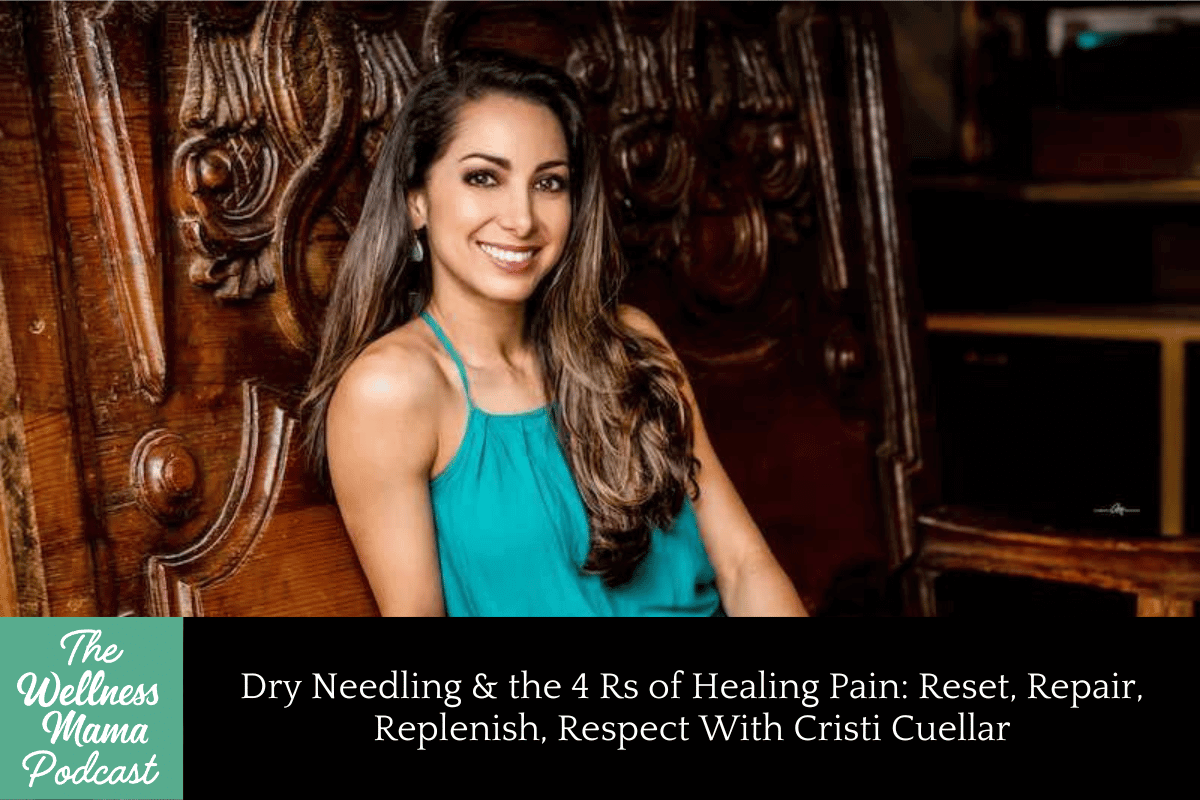
Katie: Hello and welcome to the Wellness Mama Podcast. I’m Katie from wellnessmama.com. And I am thrilled today to introduce you to an in real life friend who I’ve gotten to get the immense benefit of working with in her work of dry needling. And that’s what we’re gonna talk about in this episode. We talk about dry needling and what she calls the four Rs of healing pain, reset, repair, replenish and respect. And like I said, I got to do dry needling with her. It was my first experience with it. And it was incredibly profound and helpful. Christie is a holistic physical therapist dedicated to helping people restore balance to their neuromuscular systems, enhance their core strength, and elevate their athletic performance.
And she’s the founder of CC Dry Needling, where she redefines traditional physical therapy with personalized one-on-one care. And she also has a passion for helping women who are facing burnout, which we talk about in our second episode together. Let’s jump in and learn. Cristi, welcome. I’m so glad you’re here. Thanks for being here.
Cristi: I’m so excited to be here, Katie. Thank you. Thanks for inviting me. I’m really excited to share our stories together.
Katie: Well, thank you for being here. It’s an honor to finally get to chat here because we are in real life friends, and I will say you have one of the biggest hearts of anyone I’ve ever met, because before we were even actually in real life friends, you hosted a friend of mine who was moving cross country, not even knowing this person in the middle of the night at the expense of your sleep. And they still to this day, rave about how amazing you were. So it’s an honor to get to chat with you and learn from you. And also knowing you in real life I have gotten to do dry needling with you, which was an amazing experience and I feel like helped release some stuff that massage could never quite get anywhere near.
And so I wanted to learn from you on a deeper level about that today. I would guess some people have heard of this and I would guess a lot of people have not. So for anybody new to the term, can you tell us exactly what is dry needling and how it’s different than, for instance, acupuncture or massage, or any of these other techniques that someone might use?
Cristi: Yeah, well the term acupuncture comes from, acu- means needle or sharp. And puncture is, you know, the insertion into tissue. So acupuncture has been around thousands of years. It’s part of Chinese medicine. It is used to unlock or unblock chi energy throughout the body and Chinese medicine practitioners have used this for years to like open up meridians and energy in the body to balance out people’s energy. Dry needling on the other hand, is similar because it uses the needles. It uses the same needles a tiny bit a tiny bit thicker needle because we want the muscle to respond to the stimuli, to the needle, and I discovered dry needling in 2009 when I was working as a physical therapist in Las Vegas.
The therapist that I was working with said like, you know, he was always in this back room and he was working on a really strange case with this guy with some rib problems and shoulder problems and the guy would always come out and, I don’t know, he looked like he was just in a, it was like really intense, but he was getting great results from it and I asked him if he could needle me. So he used the acupuncture needles on my hip flexor. And at the time I was… I was training for a bodybuilding competition and I was doing these long runs and, you know, doing all the proper exercise for these competitions. And he needles my hips and my quad and the next day, I had the best run I’d ever had.
I could do the splits. I don’t know why I decided to like try the split, but like my hip flexor released. I mean, this was in 24 hours. So yeah, it’s been around over 15 years. It became a modality in Texas that is used by chiropractors and physical therapists. And yeah, the point of dry needling is to release tension in muscles and or reconnect the nerve to muscle connection. And I could go on about exactly what it’s doing but dry needling is more about tissue healing and resetting, breaking up scar tissue and even resetting the muscle to nerve connection so that patients can get back into healing and kind of releasing, so like, all the inflammation that they’ve had and, yeah, get back to moving better.
Most patients feel a difference in one session, and then other patients kind of need a few other sessions, like maybe according to their, to their injury.
Katie: Well, I definitely noticed a difference within one session and what surprised me, I expected that like the muscle might feel different or it might release things, or there might even be some soreness if I had been holding tension there for so long. What I didn’t expect was how it drastically seemed to affect my nervous system. And I’ve heard you talk about this or seen you talk about this in other places, but can you describe like what’s happening with the nervous system and what’s happening in the body? You mentioned the muscle to nerve connection. But that was what was really, what stood out to me was like, I was like, oh wow, I’m deeply parasympathetic.
It was like something that maybe my body was holding onto released, and I just felt that like profound, like, ugh, within my nervous system.
Cristi: Yeah, it was, it’s crazy. They didn’t talk about that, you know, during our certification. We do know that, you know, when there is a noxious stimulus and that twitch response happens, the body’s like, oh, what’s going on? And so your sympathetic nervous system does fire up. But then the longer the needles are in it kind of gets you into parasympathetic. And what I’ve learned in the last couple years with research on my own body, because we needled your we needled your neck and your upper trapezius. And so the neck and the upper trap, I mean, they are so connected to fascia that is connected to the top of your head. And some of those nerves are correlated with your cranial nerves.
And the most important cranial nerve that we know of is the vagus nerve and the vagus nerve runs along the neck. And like it’s under the sternocleidomastoid. And of course we know that fascia’s all connected. So it possibly stimulated your vagus nerve, which puts you into parasympathetic. The other thing that we know about the parasympathetic nervous system is that we have the most afferent nerve… We have the most nerve fibers or afferent nerve fibers at, in the back of the head, which are along the suboccipitals. On the back of the neck. And then we, there are some afferent fibers in the ears and there are along the sacrum. And I don’t remember if I did this, but there’s a really cool protocol that we do that we needle the back of the head and along the sacrum and crisscross the leads and it gets people into parasympathetic.
And I know that this ha, this happens just because I have my Oura ring and every time that I get needled in those areas, my fricking HRV, like, jumps, like, 12, 13 points. It’s really awesome. I think most patients or I tell most patients that they are gonna feel a little high and that they will sleep better and I’m sure… Did, do you remember sleeping really hard that night?
Katie: I definitely did. I remember you like told me to hydrate, so I was very intentional to hydrate and get electrolytes and minerals, and then I slept super, super hard.
Cristi: Yeah. Yeah, it’s awesome. I mean, it’s great for scar tissue and releasing any of these trigger points, but also there is this like retraining of the nervous system. I used to get needled along my low back, and my low back was just so tight for so long that we would remove the needles and the needles would be bent. But I think that I’ve just been in this like fight or flight mode and my erectors were so tight that I would bend the needles and it, we, I bent the needles like five or the first five or six times, and then after that it’s never happened again. But I’ve really believed that our nervous system needs some, like, nurturing and reeducation, and that’s what needling does in my perspective.
Katie: That makes sense. And I remember reading years and years ago, the book, The Body Keeps The Score about how so much can be stored in our tissue. So it makes sense to me that like if you’re able to release that it would have a ripple effect beyond just that area of the body or beyond even just the physical body. And you mentioned fascia, and I love anytime I get to learn more about fascia, but can you talk a little bit more about the connection there and trigger points and chronic pain and how like one spot can kind of be the root cause of like all these downstream issues when it comes to this.
Cristi: Yeah. Well let’s explain… Let’s like talk about what’s in a trigger point. So we’re here on our computers. Most people are, you know, working online. Most people that I see are in this like forward head posture. And so when a muscle stays in this continuous contracture, there’s extra acetylcholine, which is the chemical that a nerve nee… that a nerve… lets out. And then we have, you know, sodium, potassium, and it builds up at the motor end plate and it initiates a cycle of hypertonicity, and then it blocks oxygen, and then it causes ischemia. So then now this muscle is tight, there’s less oxygen, and then we’ll call this inflammation. And then the body calls in cytokines and bradykinin and prostaglandins and serotonin and histamine.
And then that area just becomes really acidic. And the other part of that is that it creates a less negative voltage in the muscle. Most of us are, we are supposed to be at negative 70 to 90, is that millivolts? And it disrupts like the muscle performance. So then you’re tight and then there’s supposedly I think it’s calcitonin gene related peptide, it increases the sensitivity of the receptors at the neuromuscular junction, and the muscle is just like painful.
And then there’s, it’s just sending the signals to your brain. So, once we can identify where that first trigger point is, and for, again, like when we’re talking about our upper trap, upper body tightness we will do several needles along the upper trap trigger point area or the upper trap line.
But the main therapeutic… the main therapeutic thing that we’re trying to do is this pistoning technique on the upper trap. And so it sends a nociceptive afferent signal to the brain and then a local twitch response happens and then it clears out the acetylcholine. So it like makes the muscle purge out the acetylcholine. Then the body is able to reuptake this, the right amount that it’s supposed to have. because usually there’s an imbalance. It depolarizes the post somatic membrane. And then it sends out signals to the collagen bundles to come like restructure the muscle. So it’s doing that. So basically it is causing, it’s like a mechanical disruption of the tissue fibers, because the tissue fibers are like in a knot and it’s like disrupting it.
And it’s like, you know, all these fibers are just like in a knot and it just like, lets it go and then the fibers are able to slowly over the next 36 hours restructure and like line up the way that they’re supposed to. So, because there’s a disassembly of the actin, of the actin myosin, that it allows the tissue to be more easily remodeled. And then it also causes like an analgesic effect. When you twist the needles, it’ll like release ATP and ADP. This is like really scientific. I, a lot of patients get really confused, but basically it’s just a big reset. And, okay, so we, you were asking about fascia. Fascia is like the skin over the muscle. And when say we were talking about how the muscle gets really tight and there’s less oxygen.
The fascia also gets thicker and thicker and thicker. And so we say like. I always describe it like fascia is like pantyhose, like a pantyhose layer over the muscle, but the tighter and tighter it gets, it becomes like denim, it’s so thick. And so we’re literally using the needles to like poke around and make it more porous so that it can move and be free the way that it should. Most… I explain this to most patients because they wanna, they’re really, they wanna know like the scientific, you know, explanation of what’s going on. But we also know, at a deeper level that yes, emotions are stored in fascia. Some patients will go there, some patients don’t wanna go there.
I’ve had several patients that start crying when they’re in a dry needling session, and they’ll remember. You know, our right side represents like our giving masculine side, and our left side represents our receiving feminine side. And there was a patient one time where she had like a shoulder issue. We dry needled all the shoulder and the upper trap and she started crying. And I’m gonna feel… I’m feeling like a little empathy for her. She hadn’t mourned her mom’s death and that came up during a dry needling session. And I feel like I am, my practice has grown the way I, the way it has, because I feel like not a lot of patients have the time and space or the space to work with a practitioner one-on-one to allow this release to happen.
And yeah, I, you know, fascia work is really special and can be intense and deep and intimate. And yeah, I like to, I like to allow the space or allow patients to bring up whatever they need to.
Katie: That’s incredible. Well, and I love that you mentioned the HRV side. That was a great analogy too with the pantyhose versus the denim and what our fascia is meant to be when it’s kind of in its ideal state. And I would guess this is very much a both and, but people I know who are do work in the world of like mobility and not just flexibility, but like true mobility and strength and full range of motion and really are aware of their fascia. And especially like fascially driven athletes, I noticed they tend to have very high HRV on average. And so I have no data to back this up, but I suspect there’s a, some connection between our fascia health and our. HRV and our nervous system, and I hope to keep learning more about that. But I wanna hone in on something else you said.
You mentioned the muscles becoming acidic and I would love, obviously dry needling can come into play here in seemingly a huge way, but are there anything else, other things we can do to kind of replenish our bodies and our body chemistry after an injury or after even a workout when we’re in that acidic state?
Cristi: Yeah, well, we talked about, I kind of have these pillars of this holistic physical therapy model that I talk to about to patients. And we can go over them one by one in depth, but one is resetting the nervous system with dry needling. Two would be repairing the tissue, rebuilding collagen and you know, stretching and moving. Three is replenishing chemistry. Because it’s all about chemistry. We know that, you know, we know that like water and hydration is important. But there’s also, you know following the having a diet where you’re not in a, an acidic way and eating foods that kind of bring more alkalinity to your body and have more negative electrons like vegetables is very important.
And then number four is respecting yourself and just like the mental, emotional part of healing. So you were asking about chemistry and whoa, I lost you. Oh, you were asking about chemistry and just being less acidic.
Katie: Yeah.
Cristi: Yeah. So number one I usually talk to patients about electrolytes because they are, most people come in so dehydrated. They are being, they’re in sympathetic nervous system mode. And they’ve like drank coffee because they’re going, going, going. So just being a little bit dehydrated affects the chemistry. So I ask them to drink more water, add electrolytes. I also just, you know, I could, I’ll tell them like, just add real salt to, Himalayan salt, into your water. What else? Having a anti-inflammatory diet. We all know that sugar and refined carbohydrates just like, don’t, they’re, they don’t like contribute to healing. Eating a good amount of protein is really great. And breath, I would say breath and oxygenating our body is the most alkaline thing that we can do.
And also, you know, the more breath you have, the more, the more negative you’ll be. But a, well, a, what did I say? A healthy, a healthy… Well used muscles do not exhibit trigger points. And so when you’re using your muscles well and you’re moving and breathing, the muscles are always gonna have amazing integrity. But most of us are like this and we’re hunched over and we’re in one position or posture. And the other thing is, is when we’re hunched over, our liver is being squished. Our diaphragm is squished. And then, you know, our paraspinals are in a lengthened position, but they’re like learning to be that way. And then our hip flexors get tight. And then so we contribute, we continue to go into this forward head posture and also anterior pelvic positioning.
And if our, like, If our organs are not opening up and oxygenating as well, then yeah, those are gonna be acidic too. I know that every organ has its own pH level and, you know, optimizing each organ needs to be, is very important for overall voltage, I would say.
Katie: That makes sense and I totally wish that we were neighbors and I could just come dry needle with you all the time. I am curious though, if someone wanted to implement this as a tool. Obviously they wanna find a good practitioner close to wherever they live, and I’ll put your information for anybody who lives in the Austin area. But what would be an ideal, like perfect timing or amount that you would recommend is that people are gonna make this a part of their lives and their [19:38-21:25] routines.
Cristi: Yeah, if I had all the resources and time, I would dry needle every two weeks. I also dry needle, as a female, I dry needle a week before my menstrual cycle. I just feel like I’m in a little bit of more, little bit more inflammation. So doing the parasympathetic protocol really helps my body get into alignment. And there is, I can’t make claims, but dry needling your low back before your menstrual cycle. Oh my gosh. It really helps. It really helps like women’s issues and it has in mine. But I’d say every two weeks. Yeah, dry needling is an excellent tool. You can dry needle your upper traps, you can dry needle for low back pain. You could try and dry needle for IT band issues. I’ve dry needled people with plantar fasciitis.
I’ve dry needled, tennis elbow, golfers elbow, rotator cuff strains. TMJ. I mean, name a muscle strain, you can get it dry needled. My, were you asking about information? My information? I’m in Austin, Texas. My business is called CC Dry Needling. We have, we have a team. I have a couple practitioners under me. I work, yeah, in close to downtown Austin. And I have an Instagram handle. It’s @ccdryneedling. What else? My website has lots of information. I talk about trigger points. We talk about the nervous system, and yeah, we’re physical therapists, so we evaluate the patient with a thorough physical therapy evaluation.
And if they do not qualify or it doesn’t seem like dry needling is a good fit, we also, you know, thoroughly give ’em the assessment and we’ll treat them with therapeutic exercise, other manual therapy, manual therapy modalities. And yeah, our, the goal is to get patients out of pain and back into their sport.
Katie: Amazing. Well, I’ll put all those links in the show notes. And lastly, I know we’re gonna get to do another episode so you guys stay tuned. I think that one will be really phenomenal as well. But for anybody who’s scared of needles, I would guess that’s probably the biggest objection that comes up when it comes to dry needling. What do you tell people who want to do dry needling but are afraid of needles and what helps them to be able to feel safe with dry needling?
Cristi: Hmm. Well know that when you come to CC Dry Needling, it’s a one-on-one… It’s a one-on-one environment, so anything you need to express, you can freely express it with us. You actually don’t even feel the needle. It feels like a finger like tapping you. You do feel the twitch response, which feels like a really fast, like muscle spasm, and that’s what sometimes scare- surprises people. But you really, you really don’t feel the needle. If you ever do it’s like maybe hitting a superficial nerve. But we do use these techniques where we kind of press with our hands and you don’t really feel the needle. And so we’ll talk about like the underlying fear of needles and what it really means. But here, yeah, people say that they really don’t feel the needles. If it really does hurt, we will find another way to treat you.
Katie: This has been such a fun conversation. Like I said, it was amazing to actually get to experience dry needling. I’m a huge fan now and I love that I got to learn more about it today as well as everyone listening. Thank you so much for the time, and you guys stay tuned. We’re gonna get to do another episode and go deeper on some other fascinating topics. But for today, Cristi, thank you so much.
Cristi: Thank you. Thank you so much, Katie. This is great.
Katie: And thank you for listening and I hope you will join me again on the next episode of the Wellness Mama Podcast.





Leave a Reply