Read Transcript
Child: Welcome to my mommy’s podcast!
Katie: This podcast is brought to you by Hiya for children and especially I love to talk about their new greens line for children. Now, I have tasted these vitamins and they’re delicious, and my kids are the ones who really love them though. And I love that they’re getting the nutrients they need without the sugar because most children’s vitamins are basically candy in disguise with up to two teaspoons of sugar and dyes and unhealthy chemicals or gummy additives that we don’t want our kids to have.
So Hiya created a superpowered children’s vitamin that’s chewable, without the sugar or the nasty additives and it tastes great. My little ones love it. They especially are designed to fill the most common gaps in modern children’s diets to provide full body nourishment with a taste kids love. And it was formulated with the help of pediatricians and nutritional experts and pressed with a blend of 12 organic fruits and vegetables, then supercharged with 15 essential vitamins and minerals, including vitamin D, B12, C, zinc and folate among others.
It’s also non-GMO, vegan, dairy free, allergy free, gelatin free, nut free, and everything else you can imagine. I love that they test every single batch with third party testing for heavy heavy metals and microbials in a qualified GMP compliant lab using scientifically validated testing methods so you can be completely at ease knowing it’s safe and nutritious and it’s designed for kids and sent straight to your door so you don’t have to worry about ordering.
My kids really like these and I love that refills show up on schedule with no stress. Also, again, honorable mention to their new greens because if you are tired of battling your kids to eat more greens, their Daily Greens Plus Superfoods is a chocolate flavored greens powder designed specifically for kids and packed with 55+ whole food ingredients to support kids’ brains, their development, their digestion, and kids actually like it. We’ve worked out a special deal with Hiya for the bestselling children’s vitamin. Receive 50% off your first order. To claim this deal you must go to hiyahealth.com/wellnessmama. This deal is not available on their regular website. To get your kids the full body nourishment they need.
This episode is sponsored by Native Path, and I wanna talk about something we don’t discuss enough, which is how we lose bone density faster than men, women do, especially after menopause. And here’s another place creatine is a secret weapon because it doesn’t just support muscle, it also supports bone.
And when combined with resistance training, creatine can help increase bone mineral density and reduce the risk of age related bone issues. So it’s an easy insurance policy. And as we age, maintaining our muscle mass becomes crucial for mobility and independence. Creatine helps preserve our precious muscle and helps us stay strong, stable, and living life on our terms.
But quality matters. So look for the most researched form, which is creatine, monohydrate. And I personally use Native Path creatine. A lot of research points to three to five grams a day is the sweet spot. Though do your own research and talk to your healthcare provider. I sometimes experiment with up to 10 grams myself.
For most women, creatine is one of the safest, most researched supplements available. And it’s time we stopped thinking of it as just for men. Save up to 56% off and get free shipping at wellnessmama.com/go/nativecreatine So that’s wellnessmama.com/go/nativecreatine
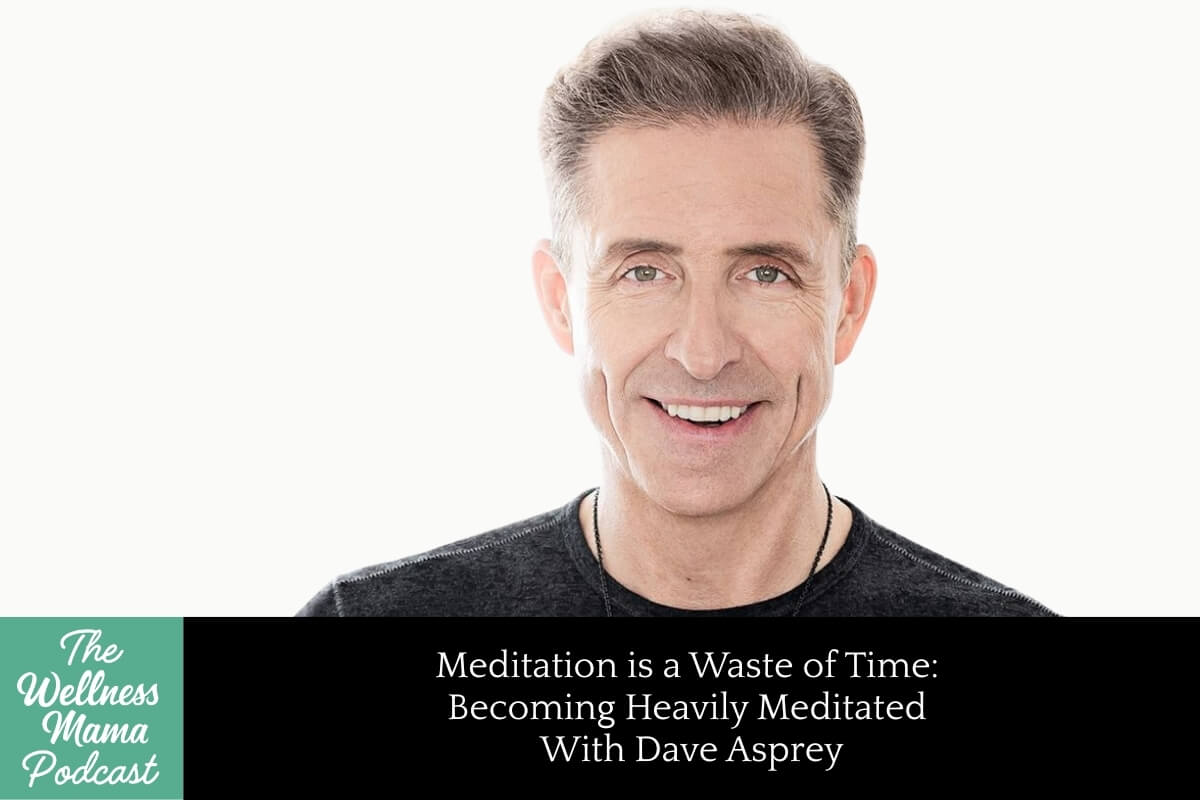
Katie: Hello and welcome to the Wellness Mama Podcast. I’m Katie from wellnessmama.com, and this episode is controversially about how meditation is a waste of time and why there’s a lot of caveat to that statement. However, I love that we delve into that controversial statement and how to become Heavily Meditated. And I am here with a friend and the founder of Bulletproof Coffee and the father of biohacking, Dave Asprey, who I’ve had on before. He’s often referred to, as I said, the father of biohacking. He has multiple bestselling books, but I love that he gets a little controversial and tackles a lot of different topics that all interrelate in his new book, Heavily Meditated.
And we go into what led to this book, how it ties together the science and the mystical, how we’re seeing this trend more across society. Why he stands behind that statement and that meditation is a waste of time and what to understand about it. He mentions if he can trigger you in this episode it means we were a loaded gun and what to do about that. I feel like this is a very practical and applicable episode that gives some breathwork tools. Some tools we can do, including one he calls BICEP, which I had never heard anywhere but him.
And we get to talk about how we both integrate this in our personal life, including I talk about my experience in complete darkness in a cave. As well as going through these past few months a dark night of the soul of sorts, and what I learned from that. I hope that you enjoy this episode as much as I did. So let’s join Dave Asprey. Dave Asprey, welcome back. Thank you for being here again. It’s always such a joy.
Dave: I’m so happy to be here, Katie. We’ve known each other for so many years that getting to just sit down for an hour and talk is kind of cool.
Katie: It is, and I feel like it’s been quite the evolution this past, like over a decade that we’ve known each other. For you in biohacking and all of the kind of leading the charge of all these waves of biohacking. Recently I was at your biohacking conference, which I think was the best one you’ve put on yet, it was phenomenal. And got to see everyone in one place, which was amazing. And what I’m really actually excited to go into today, because this is a topic that in now almost a thousand podcast episodes, is recurring advice among high achievers, health experts and mindset experts, which is the topic of meditation. And I also feel like this is elusive, especially for busy parents.
For moms especially, I hear this being, it’s difficult to make this a practice when our lives are so busy. You’re a parent also and you run companies and have a very busy life. So first of all, I love the title of your new book, which is Heavily Meditated. Great job on the title. But I would love to delve into this topic today because you have the reputation as kind of the ultimate biohacker, and I love that you decided to bring meditation into the focus of that. But I would love to hear what led to and what surprised you most in writing a book about meditation.
Dave: Well, meditation has always been a part of biohacking. When I first came up with the idea for biohacking, I published this infographic on Twitter. And I was saying, okay, there’s mind, body, and spirit, and if you want to change the environment around you and inside of you, so you have control of your state and control of your biology, what does that mean? Well, it turns out the easy things are food and nutrition and sleep and circadian biology and cold and hot and all the environmental signals. And things that at this point, I think a lot of people have heard about, intermittent fasting, clean keto, like all this stuff where I’ve led the charge and really, you know, 1400 episodes in on the podcast and nine books.
Like I’m just sharing the best experts in the world I can find and saying like, this stuff is real. It works. It’s worth your time. But along the way, I talked about discovering this idea of putting butter in coffee on the side of the holiest mountain in the world, in a remote part of Tibet doing training with shamans. And I’ve studied over the last 25 years with a lot of spiritual lineages and gone deep on practices and breath work every morning for five years. I ran a breath workshop with a guy who invented holotropic breathing, Stan Grof, who’s also the father of what I would call psychedelic therapy at this point.
So I’ve been one foot in the mystical and one foot in the science. About 10 years ago, right after I started Bulletproof, I started a company called 40 Years of Zen. This is a facility in Seattle where executives and powerful people and influencers and you know, family office people, they come and they spend five days with me and my team reprogramming their brains. And it is the equivalent from a brainwave perspective of meditating every day for 20, 30, 40 years. And with more than a thousand people, who have spent five days with electrodes glued to their brain doing specific meditations I teach them, I have enough data. And enough training from these different ancient practices to write a book that is different than any book ever written.
And it’s actually not about meditation. It’s about this ridiculous and offensive idea that meditation by itself is a waste of time.
Katie: I love that. That’s definitely a controversial statement, so I’m gonna need you to elaborate on that. But to touch on something else you said that I think seems to be kind of rising in the collective consciousness right now is that idea of the mystical and the science. And it seems like the, those, while they seem to be very separate in the past, are now, we’re realizing how much they converge. But okay, let’s talk about why meditation, as it’s typically understood, is a waste of time.
Dave: Ok. And then I wanna go back to your point you made there, because that’s a really important point that is, I think, really interesting about like the history of science. But why would meditation be a waste of time? This is something you’re gonna love, Katie. And it’s because if someone told you to drink eight glasses of water a day, is that good advice?
Katie: Arguably with caveats.
Dave: Oh, arguably with caveats. So it’s actually crappy advice because it’s too simplified to be meaningful. Was there electrolyte in the water? How hot was it? How much did you breathe? And how big are you? Oh, and how big were the eight glasses anyway? And when did you drink them? Because all of those really matter. So the reality is that having properly hydrated cells and adequate blood volume are critically important for living a long time performing well and being healthy. But drinking eight glasses of water don’t get you there. In fact, it could take you in the wrong direction, right? So, hmm. When it comes to meditation, everyone should meditate more. I should meditate.
Okay. Well, why? Like, what’s it for? And it turns out there are different kinds of meditation for different results. Right. There are meditations that will ground you and meditations that’ll blast you off. And just like with food, what’s the best diet for humans?
Katie: Yeah, absolutely. There’s no unique one single diet. It’s unique to each person.
Dave: Yeah, there’s some basic principles, but basically you need to personalize it. So when it comes to something like meditation, 98% of humans were involved in agriculture for most of the last few thousand years. And the other 2% were involved in war and hunting, right? Defending. Well, which type are you? Because if you have the kind of brain where, oh look, there’s people running away from that I should run towards it to help the people or to put out the fire, and you just do it because it’s in your bones. The meditation meant for someone who’s a farmer is not the meditation for you and vice versa. So you ought to match the meditation technique to your neuro patterns and the results you want.
And even then, meditation is still a waste of time. And why, like, am I just offending you? By the way, if I’m offending you, the key thesis of Heavily Meditated is if I can trigger you, it means that you are a loaded gun and my finger is on your trigger, and you shouldn’t allow me to do that. So if I’m triggering you right now, like take a deep breath, go into your meditation state and learn some more because this is real stuff and I had to go through all this myself. When you look at why is meditation, even if it’s the right kind for you, a quote, waste of time, well, it’s better than not meditating, but we used to take 10% of the population or so, throw them in a cave or a monastery and tell them just sit there and meditate and write what you notice. Give it to the next generation.
And in like 500 years, we’re gonna have some wisdom. Like there’s whole monasteries full of scrolls. There’s the Vatican Library full of all this accumulated wisdom for meditating. The problem is it’s kind of a full-time gig. I have friends who meditate two to four hours a day every day. That means they’re not parenting during that time, right? It it means they’re not serving other people. And I respect it deeply that they have the discipline and desire and they’re doing what works for them. I would do it as well. And I have religiously woken up at 5:00 AM and meditated for 90 minutes with breath work and chanting and candles and the whole nine yards.
And I did it reliably for more than a year to see what would happen.
And the reality is I got some benefits, but it was a huge burden. So what I want is I want to be able to reach the highest states of meditation, the many different states available, in one minute. Because it would be more time effective. Just, I also would like to do all of my exercise for my entire life in one minute. Don’t know how to do that yet. It’s probably unlikely, but if I could, wouldn’t that be convenient? Okay, so both of those are unlikely to happen, but let’s put that as morally superior goals. Because they value your energy, your time, and your focus as a human, right? So in my unique part of the biohacking world. I don’t want you to waste any energy on something that isn’t improving the world around you or improving you.
Because why not? Unless you don’t wanna improve yourself, you just wanna go have fun, which I would argue having fun is improving yourself. Right? So, let’s just remove inefficiencies that way. So most of Heavily Meditated is about the techniques and the technologies that go beyond just meditating. So that you can amplify accelerate or go deeper in a meditation, usually in less time. And I write about psychedelics. I write about some things that happen in the bedroom that produce altered states as reliable as psychedelics. I talk about a very unique practice that is new in the world of biohacking. In fact, I named it, it’s called BICEP and we can go into that if you’d like. It has nothing to do with the BICEP on your arm.
And of course talking about psychedelics from a scientific and a spiritual perspective where you have, what do we know from a brainwave perspective and then what do we know from a shamanic training perspective? Because there are different lenses on the same reality. And in Heavily Meditated I talk about other things, like the three different buckets of breath work. So it’s not that you should just go do breath work, you might want to know what kind of breath work to get what results. And the list goes on and on about these things that are deepening and accelerating because my goal is to understand why I meditate, what do I want to get out of it? What changes do I want in myself and my perception of the world and my perception of others? Once I know that, then I can do the right thing.
And if you haven’t done that and you’re just waking up and doing what some biohacker guy like me said, you know, wake up, maybe have a late breakfast, unless there’s certain cases, and have some red light. If you don’t know why you’re doing any of those things and you’re just like a meat robot going through it, you’re doing it wrong. I don’t want you to do anything I’ve ever talked about unless you have a reason for it. And the reason’s a good one. That’s why I wrote it. The other, the other reason, Katie, if I’d have talked about being trained as a shaman, and I’m not a shaman, but I’ve just done a bunch of the training and studying with different esoteric lineages around the world.
If I’d have said that at the beginning of starting the biohacking movement, there would be no biohacking movement, I took a calculated risk. I’m like, I’m gonna talk about shining lasers on my brain. Wearing literally tinfoil hats. Okay. Just talking about electrical, like earthing and grounding and things like that, which now we all understand. But when I talked about these, even when I talked about meditation, just kind of gently at the beginning of this, there were no CEOs out there who would say, yeah, I meditate. This is, you know, 15 years ago, if you talked about yoga, meditation, all that, you were absolutely a whack job and no one’s going to want you in leadership.
So we had this like corporate armor in Silicon Valley and everywhere else. And I made it the job of biohacking to dismantle that armor. And that meant introducing the more spiritual aspects later in the evolution of this movement.
Katie: Oh my gosh. Okay, so, so many directions I wanna go with that. And I feel like that actually circled perfectly back to that. It seems like we have now entered a time, at least the beginning of one, where that divide is not there strongly. And I’m seeing much more overlap of what used to be entirely the realm of the mystical or the spiritual with what science is finding.
And I have a feeling those circles will continue to overlap more and more. Definitely wanna follow up on several things you said. Let’s go back to the BICEP method, because I, I’m like, I’ve glanced through your book. I’m gonna read it in depth, but I wanna hear what this is and how to apply it.
Dave: Okay. The title of the chapter is called Go Spank Yourself, which made me laugh. And BICEP stands for brief, intentional, conscious, exposure to pain. You’re like, what? Why would everyone do that? And I remember in like seventh grade or something, I heard about these old monks in the past. They would like flog themselves. They’d whip themselves every morning when they wake up. I was horrified. I’m like, they must think they’re such sinners and such bad people. They have to beat themselves every day. Like, this is so toxic. And then I heard about yogis who lay on a bed of nails. I’m like, thats weird. And I’d asked the teacher, well, why? Why do they lay on the nails? Oh, to show they were good yogi.
I’m like, oh, so it’s like a yogi competition. I get it. Right? And then there’s these other examples throughout history of humans choosing to do things that hurt but don’t cause permanent damage. And like, why, why would they do that? There’s the, some of the, the really radical traditions in indigenous North America like the Sun Dancers, you know. There’s, there’s piercing and how many addicts have you met who are recovered, who don’t have at least one tattoo? Dude it’s like all of them. And it’s, I’m not making fun of addiction or tattoos at all. I have caffeine tattooed on my BICEP. It’s the only tattoo I have. But the reason that they’re all doing that, oh, and the reason biohackers get in cold plunges is because doing something for one to three minutes that actually hurts but doesn’t damage you, and doing it under your own free will changes dopamine receptor sensitivity by up to 250%.
And to translate that, it means it takes less dopamine to give you willpower and motivation to do things that matter in your life and in the world. So the monk was flogging himself, so it took less willpower to be a good monk. The yogi laid on the bed of nails, so it took less willpower to be a yogi because it provides lubrication in your neurochemistry to make your life better. And the addicts, who are getting a very painful tattoo, they’re doing it because the pain of that tattoo, it regulates their nervous system sometimes for weeks and weeks. And let’s not even talk about the other way people treat themselves that way which is the title of the chapter, but actually go into that in a different chapter in the book.
So. Yeah, there’s a reason we seek these things, and it’s because it makes our nervous system and our neurochemistry work better. There’s also Texans who eat jalapenos. That’s another way of getting our, getting our pain in. So if you like your habaneros, you know, liquified and all over your tongue, you’re just making your life better through neurochemistry.
Katie: Well, and really to your point, to some degree, probably everybody does this in some form, whether it’s exercise, whether it’s cold plunges. But that idea of like getting comfortable in the discomfort, whereas my friend Ryan says like the beauty is in the contrast. I feel like you just explained the scientific reason for why the beauty’s in the contrast.
Dave: It’s part of it. And you’ll see guys like Andrew Huberman who I actually had him on my show before he had a podcast. And we talked about this a little bit, but, he’s talking about this like, do stuff that is hard and that sucks, you know, like rucking up a mountain or something. It turns out that’s exercising different neural circuits than doing something that’s painful. So, it turns out the BICEP method is like, you know, one or three minutes of, oh, this water’s really cold. Like, ow like, oh man, I don’t wanna lay on this spiky mat right now. Right. It’s just brief. If you were to do that level of intensity for 45 minutes or an hour, it would just cook your nervous system and it would just overload you.
So it’s kind of like the difference between doing chronic cardio and doing high intensity interval training. You get more results and less time with high intensity interval training. And so when it comes to the BICEP, the first letter B is brief, is super important. So going to the gym isn’t BICEP, right? Forcing yourself to like do that last chin up, while it has merit and it actually is gonna help you build muscle, it’s not gonna trigger the BICEP circuitry. It may help you with addiction and cravings, but it’s doing that because it’s triggering endorphins, not dopamine sensitivity. And so I go through this in the book with, you know, some science and just like, how do we actually approach this?
Okay, so what if you read Heavily Meditated and you felt like you wanted to meditate every single morning, but now you know about BICEP. So you start doing one minute of something like lay on a spiky yoga mat before you meditate. But then it makes you require less willpower so you meditate more regularly, which was your goal. Because it was easier. So if we can make doing things that benefit you and others easier, less friction, less effort, you will more likely do them and you’ll probably do them better and more often. And this makes the world a better place by just removing friction that we don’t need.
Katie: I love that, and you’re definitely the only one I’ve heard talk about that directly like that. I love that you make it applicable and tangible in a very short way. This is not like an hour long daily practice. And that’s one thing I feel like that has been a recurring theme for all the years that I’ve known you is like you take these concepts and then you figure out how to make them effective in the least effort or time possible so that people can actually do them. Because like, like you said, it’s great and amazing and incredible that there are people who meditate for hours a day. That is certainly not my life as a mom. So how do I actually…
Dave: Any parent man, I was doing that, you know, 90 minute every morning at 5:00 AM, until I had kids. And then they just destroy any schedule that you have in your life. It’s just like, and as soon as you meditate, they secretly know using quantum biology or something, oh, mommy’s meditating. Boom. And then they just go and interrupt you. Like it’s built in. So I respect man, six, that’s a lot. Two is enough for me.
Katie: It’s like that running joke among moms. If you want your kids to pay attention, go to the bathroom, try to do anything quiet. Read a book, they instantly know.
Dave: Or take a shower, anything. Right?
Katie: Yep. Okay, let’s circle back to breath work also. Because I feel like this has been really helpful for me because it’s something tangible. Like I had trouble with, I think I had a false definition of meditation years ago actually. That was the problem. But the idea of trying to turn off my brain was never effective for me. But I love breath work because it was something that helped me kind of reconnect with my body. Which at that point for me was extremely helpful. And I hear so many people talk about breath being the master switch of the nervous system. So I’d love to hear the different kinds we can use.
Dave: Most of the types of meditation that work very quickly, they’re somatic practice. Which means they’re felt in the body. And the most precious piece of information in Heavily Meditated is the recipe I use when execs come and spend $20,000 to spend a week with my team and neuroscientists tuning their brain. It’s called the Reset Method. And it’s in the book where it’s eight steps around turning off anything that’s a specific trigger. And that is also a somatic practice. But breath work makes you focus on how it feels in your body. Because like, oh, where’s the breath? Is it my stomach? Is it in my chest? Is it somewhere else in my body? So the three buckets of breath work are things that remove stress, right?
Like that just are grounding and calming, right? And alternate nostril breathing would be an example of that. Or breathe in for four seconds, breathe out for eight seconds. These are things to just calm, right? However, there’s also types of breath work that are for, we’ll say, psychedelic experiencing. Just out of body mystical experience. And if you don’t know the difference, like I heard breathwork was good, so I’m gonna do some Holotropic or Wim Hof advanced stuff, and you’re like, or Joe Dispenza, you know. And all of a sudden you’re like launching to outer space. Like, I just wanted to calm down and now I’m experiencing my birth again. Right. And so we don’t wanna, we don’t want you to go there.
Understand not all breath work is the same, just like not all food is the same. You can have the Cheetos or you can have the grass fed steak. They’re both food. They’re not very much related. Right? So understanding that… And in the middle there’s like a peaceful, focused kind of breath work. And it’s, there’s between like three and five kinds of each sort of breath work that I go through in Heavily Meditated. So that you can read that and go, which one of these stands out as something that’s worthy of my attention. Right? And if one of them, you look at it and you get that somatic sense, that felt sense. Oh. I don’t know why, but when I read that, like I perked up or like the hairs on the back of my neck went up, or there was a flutter in my stomach, great.
That’s the one. You’re unlikely to do everything in Heavily Meditated. Like all my books, I’m like, here’s the canonical list of things. Here’s why you might choose to use it to get this goal for you and when you read it, you’re not supposed to do everything. But now you know it exists. So you know the universe to choose from. The reason I’m so focused on effectiveness and efficiency is because when I weighed 300 pounds, when I had chronic fatigue syndrome, when I had just chronic sympathetic activation, the fight or flight all the time, without even knowing it, I didn’t know what to do and I just did everything. And I spent two and a half million dollars reversing my age and. That was two and a half million dollars over 20 years.
You don’t have to do that all in one year to get results. In fact, I really shouldn’t have spent more than a hundred thousand dollars over that time if only I knew what to do. And I even look at my company Upgrade Labs, the world’s first biohacking facility. We’ve got nine locations open now and more than 30 opening. It’s a franchise so we can open them quickly. And there was neurofeedback available at Upgrade Labs along with about 10 other biohacking modalities. And I opened this because there was nothing I could do if I wanted to have all 10 I’d have to spend all my time driving around. It was very expensive and there was no one place to go. And even if there is one place to go, you’re not gonna do 10 things every day. Right?
Which ones do you do today based on how your body is now and your long-term goals? And so that’s an AI problem and we’ve got that solved. So people come in and we’re like, we’ll tell you what to do at home or in an Upgrade Labs. Because no one is capable of doing everything possible to improve themselves. Even if you know, there are people in the longevity fields who will spend eight hours a day on longevity practice. Now you’re only awake 16 hours a day, so you spent 50% of your waking hours trying to live longer. You better do 50% better. Just to be broken even. I wanna spend closer to an hour a day on my longevity practice. And my goal is still to exceed our current best, which is 120 years. I just wanna do 50% better.
So I wrote a major New York Times bestselling longevity book called Superhuman about how I’m gonna make it to at least 180 and you can too. And it doesn’t require millions of dollars. Even though I have spent that, and that’s because someone had to do it. But I didn’t want to, and a lot of it was wasted and some of it was, wow, that costs, you know, $200,000 to do gene therapy or advanced stem cell things. It’s gonna cost a thousand dollars in 10 years. So the early stuff doesn’t work well and it’s expensive by design in every technology evolution or revolution.
Katie: Yeah, I do appreciate that you are the very expensive Guinea pig for all of us in that. And that you’ve been so candid about, here’s all the things I’ve tried and candid about the things that we’re not really a high ROI for what you spent on them or things that you’ve tried and not kept as part of your practices as well as the ones that you really do still consistently do. I love that, what we’re talking about now, meditation and this integration of self, is on that list.
And I don’t know about you, but one thing I’ve noticed in my personal life and seemingly also kind of as a trend within the wellness world over these last, for me also, about 15 years is that while there are these amazing tools and biohacks and fancy supplements that we can use, and those have their place, certainly, especially within a personalized framework, to me, I keep going back to the foundational human thing as kind of the remedies to Nature Deficit Disorder.
And so even when I have access to all these fancy tools, I find what feels to me the most impactful is getting my sleep dialed in, getting my mental and emotional health in a good place with things like meditation and breath work, and then getting sunlight, hydrating with minerals. Like getting those little small things dialed in over time, seemingly are the most effective and least expensive things we can do.
Dave: Dark may be one of the most underappreciated supplements in the world and we’re so aligned on that. One of my companies, Jesus, 12 years old now, is True Dark. And we make glasses that you can still see through that tell your brain it’s pitch dark. And in the last year we published in a medical journal a study using EEG measurements from 40 years of Zen, my neuroscience company, looking at what happens when you wear the darker true dark glasses designed for sleep and jet lag. And what we found was that 15 minutes of wearing the true dark glasses, which simulate absolute darkness, even though you can still see some colors the brain shifts like you’re meditating.
It’s like noise canceling headphones for your eyes. And we see a drop in the focused aggressive beta waves. We see a big increase in alpha waves. So you can change your state just with light. And we have this, like, horrific use of outdoor night lights around people’s homes and it’s destroying insects and it’s destroying birds and you can’t see the stars. And this is a public health crisis. That little green LED on your smoke detector, it is measurably shortening your life. Ruining your quality of sleep. And so there’s four colors of light and two other variables that we control with the true dark technology. So you put on a pair of glasses and then your whole brain shifts, but you get to sleep.
So if you sleep well and you wake up, go outside, get some sunlight. That’s really cool. It doesn’t work with sunglasses, doesn’t work with regular glasses. Get as much sun on your skin as you can unless you live in Canada where I’ve lived for 13 years, where there’s no sun to get on your skin. And then eat food that doesn’t have a lot of toxins in it. You know, do your best throughout the day. Perfection is nowhere near required. So totally aligned. But I would also say access to nature, it’s a privilege. If you’re in New York City, you’re gonna go to Central Park. You think that’s nature? It’s not. It’s just the best replica of it you have. And there are studies that show looking at a photo of the sun or the moon has physiological effects on you. Just a photo, right? And putting pictures of plants up in your house can make a difference.
Not as good as having real plants, but real plants get moldy sometimes. You might not want them or they die when you’re on vacation. You know, some people don’t have a green thumb. So, yes, nature’s wonderful. And if you live in a part of the world like you do, where you have access to it, I, in Austin, I have a ton of old trees in my backyard. You know, when I’m sitting in my cold plunge, I’m surrounded by life. But not everybody lives in a place where you can do that. And if you’re in, you know, one of the cities I just visited in Kenya or Madagascar, there’s 5 million people in the city. There’s slums everywhere. There’s no nature, right? You know, there’s just the ditch full of plastic in the back and it’s pretty brutal.
So there’s still sunlight, there isn’t darkness anymore because of these cheap LED lights. And what no one really talks about is that if you want international funding for LED lighting, they’ll only fund the bright white 5,000-6,000 K bulbs, the ones that reduce fertility the most. If you want the healthier ones, which are the 2,700 or 3,000 K, the warm white, yeah those ones aren’t covered by subsidies. Only the ones that reduce fertility and make humans weak. I don’t know who’s doing that, but someone is.
Katie: I feel like you were also certainly one of the early pioneers talking about light exposure, and I love that this is now more known within the mainstream even, but I’ve talked about it a lot too, about junk light. And our light environment potentially being as important or even more important sometimes than our food quality because of how directly it impacts our circadian biology, which is like really a control switch for hormones and for so much else. An extreme that I recently got to experience that I’m by no means recommending, but I’ve had potentially the toughest three months of my life in the past few months and I got to a point where I realized, okay, I cannot escape from this darkness, so I’m gonna go into it. And I went into a cave for almost four days with no light, no sensory input, no food, no people, no sound.
And in going in and facing my own darkness, kind of metaphorically, and what I was unwilling to feel, it was an incredibly emotionally profound experience. But physically it was a massive reset button. And I realized how quickly without those light cues, like I just felt kind of like lost in the darkness. Like there was without, I realized how much the light anchors for me. So again, I’m not recommending that, that was an extreme version, but it helped me really understand and viscerally feel how much light impacts our biology. And I feel like this actually is one of the highest ROI things we can do is really getting, like you’ve talked about over the years, a good light environment in our home.
To whatever degree possible, getting natural light as much as we can and limiting those junk lights, especially at night.
Dave: I love it that you’re talking about spending time in a cave. And there’s a whole EMF and like earth shamanic realm connection from caves. My other spiritual book was called Fast This Way, and I hired a shaman to drop me in a cave in 2008 with no people around for 10 miles. Because I realized that I would eat if I was lonely, and I knew that if I didn’t eat, I’d get hypogly-bitchy. So I’m like, I’ll just face my demons where there’s no food and no people. I wasn’t in darkness all the time. I was at night because it was a cave, but I, it was in the sun during the day.
Same thing. Like, it is really profoundly transformative to just connect with yourself in an environment like a cave. A darkness meditation’s been on my list for something like 20 years. It’s just finding enough time to go do that with all the other things.
And there are about five different darkness meditations that you can do. I only knew about two of them and I was doing one of those spiritual conversations that we all have with chat GPT, at least I hope we all have them. If not, you should try it. And it’s like, oh, you know, you would like all these things. I’m like, dude, I have done every single thing on this list. I’ve written books about most of them. And you already know that because you’re chat GPT. It’s like, yeah, yeah, okay. And it says, well, you know, you might wanna try a, you know, darkness retreat. I’m like, yeah, it’s on my list, but what specific form would be best for me? And it named three types of darkness Meditation from old lineages, like the bone tradition, which is a precursor to Buddhism and some of the shamanic lineages. And it’s like, oh, you might like that one. And like, whoa, that’s mind blowing.
So like all of our spiritual esoteric knowledge, it’s in there. You just have to know how to ask. Which is profoundly amazing because it means you don’t have to find a master or a guru from one lineage and join the secret club and spend 20 years learning it to get access to their one technique that they didn’t share with their tribe next door that had a different technique. We need access to all of this ancient knowledge, like it’s the time for us to step up that way so that we can actually be in charge of our state and understand the ways we influence other people in the world just with our way of being. And I’ve intentionally not joined any lineage or practice. I’ve gone deep in them, but I’ve always been a tourist because I’m synthesizing knowledge between them. And same thing, biohacking, is it functional medicine?
No, but I lectured a longevity doctors. Is it, you know, meditation? No, but I have a neuroscience company. Is it circadian biology? No, but I’m into that and, you know, built a company around it. You know, is it exercise? Well, only when you have to, because I wanna spend a lot of time on that. Like, is it diet? If you want it, is it supplem-?… It’s all the above. It’s like what are the, all the variables? And what drives me nuts, if you were to ask a sheep herder, and I think I can say this because I actually, you know, built a regenerative farm with sheep, what causes a herd of sheep to move? Like what’s the one thing? And they’re like, it’s not one thing. Like maybe it was the sheep dog. Maybe it was you. Maybe it was like… it could be anything.
Well, our biology is sheep. It is not, well there’s one thing that’s making you old. No, it’s not one thing making you old. It’s at least seven different big buckets and each one has thousands of variables and the combinations are almost infinite, but we can tease that out. Which is something I’m working on doing with the upgrade labs AI components that, it’s like lab tests plus wearables, plus 187 million data points of your performance when you come in. Like, oh, maybe there’s at least direction. It’s not gonna be perfect, but it’s gonna be, well, maybe you wanna have two sheep dogs and one fence, and that’s gonna work most of the time for your flavor of sheep when it’s sunny, like, we don’t know, but we can figure it out.
So the whole world’s like that. And when we go in one special, oh, I’m a kidney doctor. Like, oh, so you’re not a liver doctor and what you give me for my kidney won’t work? Oh, great. Or recently I was working with a very top level pro athlete, like yesterday, and she’s having profound brain fog. And there’s several different reasons for it. It’s a complex scenario, but one of the big causes is that her doctors put her on an NSAID. Something like ibuprofen but a different version of it that causes leaky gut. And the person had genetics that make leaky gut more inflammatory than normal. So you get a leaky gut from the drugs they gave you so that your joints don’t hurt and now your brain doesn’t work but you go to the brain doctor but they don’t know about the gut.
So, everything in life is that. It’s like, what is the recipe? And the thing that drives me nuts, whether we’re talking about big pharma for sure, but even some of the exercise recommendations, some of the, even the meditation things, they’re very focused on one thing. And if you were a big pharma company and you’re saying, well, I’m a research scientist, my name is Lane and I have a PhD and I’m a big troll. And you were, I’m not talking about anyone in particular. But if you did that and say, I’m gonna run a test to see if bread exists, and I baked yeast, I baked the salt, I baked the water, and I baked the flour. There is no such thing as bread because I think there’s one cause of bread and like anyone who’s not completely on crack or something is gonna say, well wait.
You need all four of those things at the right ratios and mixed at the right time and then cooked at the right temperature and then cooled the right way to get the right crumbly crust. Right? You do all that right, you have an amazing loaf of bread. Well, there isn’t one variable, but most of us, because it’s intellectually easy and it takes less electricity in our brain, so our brain tricks us into believing there must be one cause. And unless you can prove that there’s only one cause of something, it is actually intellectually a poor decision to say there’s one cause of my stress. I promise you there’s not. Like, there’s one cause of my lack of sleep. No. There might be the largest contributor, but there’s a hundred causes, and if you change this, this one may become less strong or more strong.
So you’re more conducting an orchestra. It’s like vibe coding the recipe in the kitchen going, you know what? I just know it needs a little more salt. I know it needs a little bit more of this. And you do that with your life. That’s really what biohacking is.
Katie: I love that. And it is a perfect analogy for how those factors are different for each of us. Though the kind of common universal human framework is beneficial. And that’s something that took me maybe 10 years in the wellness world to really fully understand is, especially when I was trying to reverse my own autoimmunity, I would try every protocol from every person and get mild results. But what I eventually realized was these people all figured out what worked for them.
And the real lesson in that is the experimentation. And the N of 1 study on me of what will work for me, and I can gain inspiration from all of those, but none of those exact systems will work as a blueprint necessarily the same way for me. And that’s why I say so often, we’re each our own primary healthcare provider.
The most valuable study we will ever undertake is that of ourselves. And I feel like that’s true in the mental emotional realm as well as the physical realm. And that actually there’s very little separation there. That’s another area where you think of those as separate categories when really they’re so interrelated.
Dave: They are so interrelated and your path and mine are so similar. That’s why when we first connected years ago, I’m like, oh my gosh. Like, it’s so fun to talk with you. Because enlightened self-interest, which is also known as desperation, will cause people who are really sick do things that are unnatural or extreme in order to heal. Because the alternative is really dark. And people who haven’t gone through what you went through with your autoimmunity… I try to put words to it. I’m 300 pounds, you know, when I’m 22 years old, at three knee surgeries, arthritis since I’m 14 and 15 years of antibiotics. And the doctor telling me, Dave, you’re at high risk of stroke and heart attack. I’m like, I’m 28 years old. Like, what is even going on? I thought I was eating healthy.
I’m exercising all the damn, like all the things. But the thing that most people connect with is the idea that you’re driving and your car starts slowing down. So you push the accelerator all the way to the floor. Okay, good, it’s gonna speed up. And it keeps slowing down. But like, what are you gonna do? Push harder on the, there’s no more push to give on that pedal, right? The accelerator won’t go down anymore and the cars slowing down and you’re like, what do I do? You’re pretty much helpless. Like, should I just pull over on the side of the road and give up because that’s what it is? Or am I just gonna have to do anything necessary? And there are people who are predators and sell things that just don’t work.
Some of them, I think I’ve talked to some where I’m very sure because they aren’t, just about tell you, they’re just taking advantage. They know it doesn’t work and they don’t care. They pretend like they do. In fact, there’s a lot of those in health. And there are a lot of other people who have the one ingredient thing, and I don’t like to play the take down game unless I’m playing with trolls, in which case it’s just for fun. That’s my love language is triggering trolls. But, celery juice. Like it doesn’t cure diabetes guys. It really doesn’t. Right? And yes, it has some active water and some minerals, and also has a lot of oxalates and some other stuff in it that probably isn’t so good for you. But it also could be good for you.
But like it’s not a panacea. It’s not gonna be one thing. And it’s what you talked about Katie. It’s, okay, how do I get my environment set up so my body mostly works? And then how do I do the really deep, difficult work of regulating my nervous system consciously? And that’s why Heavily Meditated is my most important book. Because we haven’t talked about the big thing in it, which is triggers. The thing that companies, religions, politicians, teachers, parents use to control you is triggers. And triggers don’t happen because you chose them. They happen because it’s your nervous system doing what it’s designed to do. Even your cells themselves, they’re just trying to keep you alive.
And the framework in Heavily Meditated is something I’ve taught throughout biohacking, but it, the vision of it has tightened as I’ve learned more and just taught it more. And it’s that your body processes reality before you have a chance to think. And when I say before you have a chance, if I clap my hands, we all know, well, it took some time for the sound to go through the internet and through my speakers, and then I heard it. But that’s a lie. Once that sound hit your eardrum, there’s a one third of a second delay. Before your auditory processing circuits in the brain get any activity at all. This is a censorship window where your body gets to sit on it, your mitochondria and your distributed systems for sensing reality and decide whether they’re gonna show it to you and how you’re gonna feel about it. Right?
And then it goes to your brain and it takes the rest of the second for your prefrontal cortex to think about what it was. So there’s a separate intelligence that’s not you, that’s running your interface to reality all the time, and it’s manipulating you. And it’s run by mitochondrial programming. And people are like, Dave, that’s bs. So you ever lean on a hot stove and go, you know, that’s pretty hot. I guess I smelled some sizzling. I think I should move my hand. No, you jerk your hand away before you even can think about it being hot. And then you say, look at me, good thing I pulled my hand away before I got burned. And you take credit for what the system did, but you didn’t decide, you were not in the loop.
Something else was fully deciding what your body did. So, the argument in Heavily Meditated is that there is a separate intelligence inside of you run by your mitochondria designed to keep you alive. And it runs on a very simple set of rules that are so simple a single bacteria can do it. Because this is the operating system for all life. You want to know what the rules are? All right. This is why meditation works so well. Okay. Something comes into your field, into your environment, and your body says, number one, is it scary? These are all F words. So fear is the first one. If it’s scary, run away from, kill or hide. And do it before you have a chance to think. Because it could be, you know, a baseball coming to your head.
It could be a tiger. You don’t know, but you’re gonna react and you react before you think. Okay. If the body determines, it’s not scary, then is it food? Remember, bacteria have to do this. These are not highly intelligent, aware decision making things. So fear, then food, eat everything is the rule. And you want your body to do that because these mitochondria that think they’re running your body, and largely they are. There’s been enough famine in the past that you should just eat everything. And then the third one, all life has to do it to stay around for multiple generations. That’s an F word. You know this one very, very well, right? Katie? It’s fertility, of course. I don’t know what you’re thinking about, right? You got six kids, right?
It could be the other F word. But what this means is that at all times, microsecond by microsecond, your body’s processing reality saying, do I need to kill it? Can I eat it and can I hump it? And only after that do you get to even know it’s there. And if your body wants you to hump it, you’re gonna, it’s gonna come to you. Wow. Look at those legs, or whatever the thing is, and it’s gonna come with a feeling. Or it’s gonna see the cheesecake and go, ooh, doesn’t that cheesecake look sexy? Or it’s gonna say, oh no, look at that criticism. I felt unsafe when my coach criticized me in third grade, so therefore, and I could have been ostracized, so therefore, ah, run away, defend, deflect, makeup some other stuff. So is there anything you’ve ever done that you’re ashamed of that isn’t one of those three mitochondrial behaviors?
Katie: Ooh, yeah, they do kind of fit in those categories.
Dave: And this is what’s missing from meditation teaching and even from psychology and therapy, is that it is not you doing those things. It is your body doing those things. In fact, I had the honor of speaking on stage at one of my consciousness events with Victor Chan, the Dalai Lama’s best friend, co-author, who’s known him for 50 years. And I gave my talk about these F-words. And there’s two more F words that are really good ones. And when I went to interview Victor, he turned the mic around. He said, Dave, after I heard about the F words, all the things the Dalai Lama’s been saying for the past 50 years make a lot more sense. Because there’s a reason for the ego. It’s to keep your meat alive as if you’re not in there.
And all life shares these principles. And the way we run away from kill and hide varies by species. Right? The way we eat everything varies by species. And the way we reproduce varies by species. But we always do that and we do that before we think with our little brains. Our brains are not nearly big enough to process reality, which is why our body does it for us and gives us a little tiny slice so we can think about it. But the next F word, after those is friend. All life supports its own species and the ecosystem around it automatically. So kindness is wired in our bones. This is why we formed tribes. This is why biohacking became a global movement. because we needed a tribe. This is why you have a church group. This is why any kind of club, any kind of group that you join, it nourishes you.
And the final F word is forgiveness, which is how you turn off fear triggers. And forgiveness is not a thought, it’s a somatic experiencing. And that’s what I’m teaching as like the crown jewel of Heavily Meditated. This is what the world’s top executives and highest performing people do so that they are un-triggerable. So that you become more resilient. Because everybody knows a situation where you’re in a room and someone says something mean to another person, right? And the person’s like smiling and they’re pretending like it didn’t get to them, and they’re like, no, everything’s fine. Let’s go about it. But we all know that there’s a lack of congruence and that person’s inner state and their outer state do not match. It’s inauthentic.
What you want to be is the person who sits there and someone says something mean to you and your inner state doesn’t change. So then whatever you do in response is authentic and real. And you didn’t have to bear the cost of being reactive when you didn’t want to be. So the Buddhists teach there’s three levels of consciousness. And the very worst place to be is apathetic or numb. So above that is empathetic. Oh, look, I feel other people’s pain. But Katie, if you’re empathetic and you walk into a McDonald’s, you’re not gonna like what happens to you because there’s a lot of people in a lot of pain in line at McDonald’s because they haven’t learned how to eat yet, right? So empathy is better than nothing, but it is not a high form of consciousness.
It’s just the first step on the ladder. The step above it is compassion. And compassion is when you automatically wish other people well. Before you judge them, before you think about it, you just build it into your operating system. You know, I want everyone around me to be, you know, at peace. So whether or not someone is nice to you or mean to you, or they look a way you don’t like, or they remind you of something, none of that matters. You just automatically wish them well, even if they’re a dick. I can say that on your show, right? And then. The highest level though is what we would call equanimity or resilience, but what they would call enlightenment, and that is simply the ability to choose your state no matter what’s happening in the world around you.
That means that if there’s something on the news from whichever tribe is currently doing whatever they’re doing on your channel, it doesn’t trigger you, at all. And you can look at it and go, I’m aware that that’s a lie, but I’m not angry that it’s a lie. Therefore I have agency to do the right thing. But if you get angry, there was a person trying to make you angry so they could control your behavior, right? So this is the path towards happiness, towards great parenting, towards great relationships, is that you’re aware of your state all the time and you get to choose it. And the second part of it, the reason I wrote Heavily Meditated is that there are so many states available as a human that are not common states. These are altered states. Healing is an altered state. Service to others is an altered state. Flow is an altered state. Grace is an altered state. Exaltation is an altered state, and there’s a whole chapter in the book, a very tasteful chapter, but it’s on 20% of people report meeting God during orgasm at least once in their life. So why is intimate connection with like your sacred partner, why is that not as valid as breath work or going off and eating some mushrooms? Because it is also a practice and it could be a deeply profound spiritual practice. And all of these, our range of sensations is so magical and we live in a narrow window. And part of your job, whether you’re a biohacker or just an evolving human, is what is the entire range that my body and my mind and my soul are capable of?
And how do I learn to access those on demand with the right tools? And I will say there is a chapter on psychedelics. Ketamine is an option with the doctor’s supervision at 40 years of Zen. But you do not ever need to take psychedelics to do it. You might decide to do them one time to feel a state and learn to replay it. Or you may say, I don’t need to do it because I learned breath work and I trip balls on that. And that’s fine. It’s all okay. But what I want you to know is there’s a vast world of experience that is available to you that you haven’t seen and don’t know about. And that’s why I wrote the book, like here’s the fastest path I know of to get to that state. And there might be three paths. Pick the one that looks most tingly to you and do that.
Katie: I love that. And to echo what you said, I will say these past few months that have felt like very much a dark night of the soul for me, I have done psychedelics in the past, including the strongest ones we know of, and they are child’s play compared to what I felt in the states of just facing that with no psychedelic help whatsoever. So definitely, very viscerally have felt what you’re talking about. And love that you are pulling all of these things together. Highly recommend the book. It’s on my nightstand right now, a review copy and I’m very excited to finish it. But Dave, it’s always an absolute pleasure and joy to get to chat with you. I hope we get to see each other in person sometime this year and get to do more episodes in the future. But thank you so much for everything you’ve shared today. This has been so much fun.
Dave: You’re welcome Katie. Thanks for the work you’re doing in the world. A thousand episodes. You keep bringing it. And thanks for going through the dark nights of the soul. It’s hard to do it. Few people have the courage. And it’s even harder to talk about it. So you’re doing the world of service by just being open. Sometimes you gotta go deep to evolve, and I’ve been there, so congratulations.
Katie: Thanks Dave, and thanks to all of you for listening and sharing your time with both of us. We’re so grateful that you did, and I hope that you’ll join me again on the next episode of The Wellness Mama Podcast.




Leave a Reply