

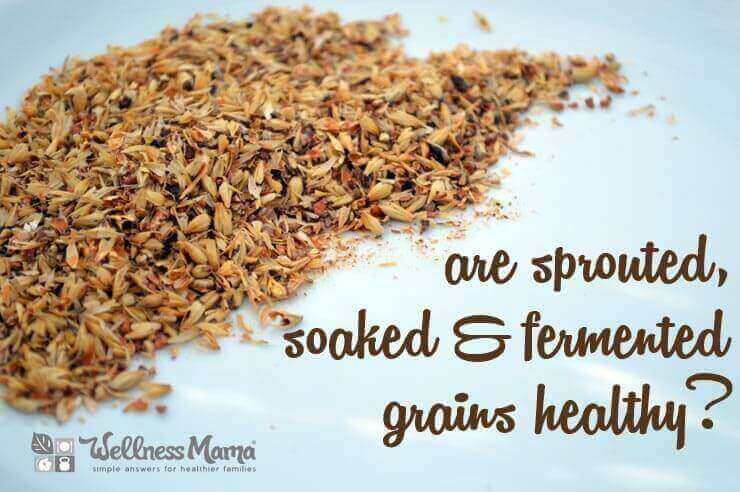
Are Sprouted, Soaked and Fermented Grains Healthy?

This is one question I probably get asked via email about ten times a week, and for good reason. There is some disagreement in the health community about traditionally preparing grains, and it seems that there is a good body of evidence on both sides.

Maybe you’ve been asked why grains are bad when people from other countries (usually Asia and Italy are mentioned here) are able to eat them regularly and still stay thin. [Side note: I'll be addressing both of these misconceptions soon, but the short answer is that besides the big difference is genetics, there are some other huge dietary difference that make up for this, and Italy is seeing rapidly rising rates of obesity and heart disease. If you want a statistically valid comparison, squatting while using the restroom actually seems to be one of the best predictors of longevity...]

Even in the health community, there is a split between WAPF (Weston A. Price Foundation) followers and the Paleo/Primal/Low Carb group on the health and necessity of grains and if they should be eaten at all.

You might have read my stance on how grains are killing you slowly, but as there are claims that these traditional preparation methods reduce the dangerous properties of grains, it is worth another look.

What are Soaked, Sprouted or Fermented Grains?

All grains have various properties that protect them in the plant world and allow them to survive to produce seed. In animals, these protective features are often claws, teeth, sharp spines, venomous fangs, etc, or the ability to run away and escape enemies, but plants protective features tend to be a lot more subtle.

Since plants aren’t able to fight or evade, their protective mechanisms are less noticeable. Plants like poison ivy or poison oak have obvious protective mechanisms like the itch-inducing oils on their leaves.

The protective mechanisms of those amber waves of grains are harder to identify externally. These crops are often eaten by animals, so their protection lies in the ability of their seeds (the “grain” itself) to pass through the animal and emerge on the other side as a pre-fertilized seed, ready to grow.

Plants accomplish this through the presence of gluten, other lectins, enzyme inhibitors and phytic acid which allow the grains to pass through the digestive system without harm to the plant. (note: Phytic acid is especially damaging to bone and tooth health and has been linked to tooth decay) These indigestible compounds are great for ensuring the plants continued fertility, but they can be very harmful to humans.

From a previous article:

Gluten is a sticky, water soluble protein that is found in your favorite grains (wheat, rye, barley, etc). Grains like corn, rice and oats have similar proteins that cause problems over time. Gluten and similar grain-based proteins work to break down the microvilli in your small intestine, eventually letting particles of your food leech into your blood stream (a lovely term called “leaky gut syndrome”) causing allergies, digestive disturbances or autoimmune problems.

and

Lectins, are mild toxins the inhibit the repair of the GI track. Lectins are not broken down in the digestive process and bind to receptors in the intestine, allowing them and other food particles to leech into your bloodstream. Nothing like pre-digested food circulating the blood stream! The body views these lectins and the food they bring with them as dangerous invaders and initiates an immune response to get rid of them. This immune response to particles of common foods explains the allergy creating potential of grains.

Soaking, Sprouting and Fermenting

Traditional cultures where grains were consumed regularly or in large amounts found ways to reduce the harmful components of grains through methods like soaking, sprouting and fermenting.

These methods are designed to do what our body can’t and break down the anti-nutrients (gluten, lectin, phytic acid, etc) in grains so that they are more digestible to humans. Evidence shows that these methods do indeed make the nutrients in grains much more bioavailable and reduce the anti-nutrient properties.

These methods rely on using an acidic medium in liquid to soak the grains, a constructive environment to soak them and let them sprout, or a process like sourdough fermentation to alter the chemical make-up of the grain.

Certainly, most grains consumed these days are not prepared in any of these ways, but from a health perspective, are sprouted, soaked or fermented grains healthy?

Are Soaked, Sprouted and Fermented Grains Healthy?

From a nutrient perspective, grains prepared in these ways do have much higher nutrient levels and lower anti-nutrient levels than grains that are just ground into flour and baked, but should they be eaten?

The question remains, do these methods reduce the harmful properties enough to make these grains safe to consume. Mark Sisson sums it up well in his article about traditionally prepared grains:

Soaking and Sprouting:

Effect on phytate: If the grain contains phytase, some of the mineral-binding phytic acid will be deactivated, but not much. And if the grain has been heat-treated, which destroys phytase, or it contains very little phytase to begin with, the phytic acid will remain completely intact. Overall, neither soaking nor sprouting deactivates a significant amount of phytate.

Effect on enzyme inhibitors: Well, since the seed has been placed in a wet medium and allowed to sprout, the enzyme inhibitors are obviously mostly deactivated. Digestion is much improved (cooking will improve it further).

Effect on lectins: The evidence is mixed, and it seems to depend on the grain. Sprouted wheat, for example, is extremely high in WGA, the infamous wheat lectin. As the wheat grain germinates, the WGA is retained in the sprout and is dispersed throughout the finished plant. In other grains, sprouting seems more beneficial, but there’s always some residual lectins that may need further processing to deactivate.

Effect on gluten: Sprouting reduces gluten to some extent, but not by very much. Don’t count on it. A little bit goes a long way.

Adding fermentation to the mix reduces the harmful properties even more, but does not completely render them harmless.

The presence of these anti-nutrients in all grains also explains why people who avoid wheat for health reasons but still consume “gluten-free” foods may still have health problems. Wheat is definitely at the more dangerous end of the grain spectrum, but the others aren’t harmless by a long shot, and many of them are higher in simple starches than wheat.

So, Should We Eat Them?

Certainly, these methods of preparation do improve the nutrient profile of what is otherwise a harmful food to consume, but this still doesn’t mean that sprouted, soaked or fermented grains are healthy or that we need to consume them.

If you are going to consume any grains, it would definitely be better to prepare them in one of these ways (or all three!) to make them less harmful to your body, but I stand by my assertion that there is no need for grain consumption at all.

There are no nutrients in grains, even traditionally prepared ones, that are not found in other foods, and many other foods are higher sources of nutrients than traditionally prepared grains.

It should be noted that all plant substances have properties that can make them harmful to humans in some way, but that it is much easier to reduce these harmful properties in other plants (cooking cruciferous vegetables like Broccoli and cauliflower, peeling and cooking sweet potatoes, etc). This is also why I recommend limiting beans, nuts, etc or soaking and dehydrating the nuts to remove the anti-nutrient properties. (More on this soon)

So, in short, I don’t recommend grain consumption at all, even if they are properly prepared, as they aren’t an exceptional nutrient source and they do have harmful properties. If you suffer from an autoimmune condition or leaky gut, even these types of grains should be carefully avoided as they can make the condition worse.

For the small percentage of the population that doesn’t have any food related problems and that have excellent gut health, some of these grains might be ok occasionally in moderation, but other than taste, there is no reason to eat them.

There is also a definite difference between grains high in anti-nutrients like wheat, barley, etc and ones like white rice (not brown rice) which are naturally free of the more potent anti-nutrients like gluten) and which seem to be somewhat less harmful.

The other point worth mentioning is that even sprouted, soaked and fermented grains cause a spike in insulin and can inhibit weight loss and lead to other health problems if eaten in large amounts.

Summary

  • Yes, these methods do reduce the harmful properties but do not eliminate them. As grains still aren’t a stellar source of nutrition, even with all these elaborate preparation methods, and they can be/are harmful to many people.
  • For the little bit of nutrition they might provide, the benefit is still overshadowed by the harmful properties that still exist in small amounts (gluten, lectin, phytic acid, etc) and they take an extreme amount of preparation time and energy for this small amount of nutrition.
  • If you have a strong, healthy gut, eat an otherwise nutrient rich diet and go to these great lengths to properly prepare grains, you might be able to tolerate them occasionally, but why go through all the trouble when we live in a time where there is access to healthier foods (vegetables, meat, good fats, etc).
  • In an age where we are bombarded by toxins in our air, water and food supply, removing grains (even traditionally prepared ones) is an easy step we can take to improve our health and to make room for other, more nutritious foods in our diets.
  • If a substance (in this case, grains) might be harmful for you to consume, and there are no negative effects of removing it, logically, it would be wise to avoid it.

What do you think? Do you consume sprouted, soaked or fermented grains? Totally disagree with me? Let me know below!

Like What You Read?

Sign up for exclusive Wellness Mama updates to get my newsletter, coupon codes, & bonuses emailed FREE! (No spam ever, I promise!)

About Wellness Mama

Wellness Mama is a full-time housewife with a background in nutrition, journalism and communications. Her passion is helping others achieve optimal health through a “Wellness Lifestyle.” She has helped hundreds of clients lose weight, increase athletic performance, improve fertility, and overcome numerous health problems and diseases. Connect with her on Twitter, Facebook, Google+, & Pinterest.

Disclaimer: Many of the links on my site, especially those from Amazon, Mountain Rose Herbs, Tropical Traditions and OraWellness are affiliate links. Should you click on these links and decide to purchase anything, I will receive a small commission and you will have my sincere thanks for supporting Wellness Mama!

DISCLAIMER: The statements made here have not been approved by the Food and Drug Administration. These statements are not intended to diagnose, treat or cure or prevent any disease. This notice is required by the Federal Food, Drug and Cosmetic Act.

  • http://twitter.com/LilBintheBigC Lina B

    This post came just in time! I just had this exact same conversation with my dad about grains this morning on my blog lol!

  • http://www.facebook.com/Sharper43 Stephanie Harper

    So glad you wrote an article on this.  Shakeology is coming out with a new flavor called Tropical Strawberry.  But they have changed the protein to make it vegan-friendly by making the protein source a sprouted brown rice protein. I think I read that it’s also fermented, as well as sprouted, but I can’t be sure. I just don’t know much about this new protein source. (all other flavors are whey protein isolate)  I’m excited to try it, but the “rice” part kind of worried me.  This eased my worries a little bit to really try it out.  If I have issues, I’ll can easy switch back to the other flavor that has whey protein isolate.

  • Dogfood

    I honestly think we need to start throwing physical, as well as air, quotes around “food” when describing those substances that do more harm than good to our systems. There’s a whole range of things growing out in the world and it’s only by convention that some of them are lumped in with bacon and cauliflower. We really need to Pluto most of these grains and vegetable oils that are crowding the cupboard. If you can start aligning them more with grass, trees, and motor oil, it’s going to go start eating at the subconscious and perception will slowly give rise to reality. By continually giving donuts the same status as tallow, we’re simply making it all the harder to get the point across.

  • Brenda

    Wow-Two articles in two days from you well written about two different subjects that are confusing. (yesterday it was about fats) This answered questions I have been wondering about. Well done. I agree that grains are highly over rated and unnecessary. Something else that could have been talked about more in this article is the ‘fiber” of grains. The fiber in grains is damaging to the digestive system. Not all fibers are created equal and the fiber in grains is as much as they would have believe (other plant foods have more) plus it is a different kind of fiber that is actually damaging. Do you agree?

  • http://wellnessmama.com Wellness Mama

    Excellent point!

  • http://wellnessmama.com Wellness Mama

    Agreed! My manifesto against grain fiber is coming soon :-)

  • Gracenbloomdonna

    Have just recently jumped on the ‘anti-nutrient’ learning curve.  Thanks for the information.

  • jacey

    Be careful…Shakeology claims they are healthy, but it’s loaded with fructose!

  • Jayleigh83

    I agree! I am so passionate about the removal of grains from our diets. And GMOs are a WHOLE other piece to this. I think Dr. Davis (Wheat Belly) brings this into light. Very interesting.

  • Venus

    Hi wellness mama! I was wondering if you have read the books Deep Nutrition and Food Rules by Catherine Shanahan? If not, you should definitely read them, they are extremely interesting and I think that they would be both interesting to you and beneficial for the blog and your nutrition knowledge.

  • Tina Basinger

    I’m pretty much anti-grain, but have had a hard time keeping them completely out of my system.  I must ask though, what is bad about sweet potato skins that you said to peel them?  I always thought the skins held a lot of vitamins, etc.

  • Jen

    Love this article!  I have a blog with a friend who is a Paleo follower and I write from a more WAPF perspective.  However, I am completely baffled by the over emphasis on grains in most of the WAPF blogs that I read.  I do not understand the mindset that just because you ‘can’ sprout/soak to make it better than you should — always.  There is a reason why those grains are so difficult to process — because we shouldn’t be eating that many of them. 

    My new philosophy is that I will have 1-2 meals a day with a grain (rice or a sourdough bread slice)  The majority of the meal as a healthy fat, meat, and veggies, broth, etc.  If a dessert is desired, it’s now a grain free dessert and I make it as nutrient dense as possible.  My new favorite squash porridge – YUM!

  • http://wellnessmama.com Wellness Mama

    There are some anti-nutrients in the potato skins that can be harmful to some people.

  • Janet

    Hi Wellness Mama – wondering what you thought of the post on Food Renegade today (http://www.foodrenegade.com/win-enrollment-healthy-whole-grains-class/) about “healthy whole grains” through sprouting and fermentation?

  • http://wellnessmama.com Wellness Mama

    This is definitely one area where I diverge from the WAPFers like Cheeseslave, Food Renegade, Healthy Home Economist, etc. I’m yet to see any of them provide detail or proof of the “nutrients” we miss by not eating grains, and while I agree that these ways of preparing make grains less harmful, I certainly don’t agree they are necessary or good!

  • http://www.facebook.com/LorriMiller Lorri Miller

    This was a great post!!! One thing that finally sealed the deal for me was reading about all of the changes to the proteins that wheat has undergone through over the last 50 years or so in “Wheat Belly”. Although I’d known all about the reasons why grains should be sprouted, soaked and fermented and even though I knew that grains were keeping me heavy (and craving them more), I just couldn’t get it out of my head that “Jesus ate wheat” so it can’t really be all that bad! Reading “Wheat Belly” helped me to understand that while it’s true that Jesus ate wheat, the wheat that He ate resembles the wheat that we eat today in name only.

    Thanks, as always, for such great information!!!

  • Judy

    How do I find the article about fats that you mentioned Brenda? I’m having trouble finding it. Hope someone can help!

  • http://wellnessmama.com Wellness Mama

    I have, but don’t think I’ve mentioned/reviewed them yet. Thanks for the suggestion and I will re-read and suggest them soon :-)

  • Dan Moffett

    Thank you for the information. I’ve read your articles on grains. They have helped me change my lifestyle. Since I put the wheat out of my diet I have lost 148 pounds. My energy level is through the roof and I feel great. I am constantly asked how I’ve lost the weight and keeping if off for 2 years now. I tell my story in my blog. I’ve put links to your articles on the blog.
    My blog is at: http://danmoffett.blogspot.com/

  • Dan Moffett

    Thank you for the information. I’ve read your articles on grains. They have helped me change my lifestyle. Since I put the wheat out of my diet I have lost 148 pounds. My energy level is through the roof and I feel great. I am constantly asked how I’ve lost the weight and keeping if off for 2 years now. I tell my story in my blog. I’ve put links to your articles on the blog.
    My blog is at: http://danmoffett.blogspot.com/

  • Dan Moffett

    Thank you for the information. I’ve read your articles on grains. They have helped me change my lifestyle. Since I put the wheat out of my diet I have lost 148 pounds. My energy level is through the roof and I feel great. I am constantly asked how I’ve lost the weight and keeping if off for 2 years now. I tell my story in my blog. I’ve put links to your articles on the blog.
    My blog is at: http://danmoffett.blogspot.com/

  • Dan Moffett

    Thank you for the information. I’ve read your articles on grains. They have helped me change my lifestyle. Since I put the wheat out of my diet I have lost 148 pounds. My energy level is through the roof and I feel great. I am constantly asked how I’ve lost the weight and keeping if off for 2 years now. I tell my story in my blog. I’ve put links to your articles on the blog.
    My blog is at: http://danmoffett.blogspot.com/

  • Dan Moffett

    Thank you for the information. I’ve read your articles on grains. They have helped me change my lifestyle. Since I put the wheat out of my diet I have lost 148 pounds. My energy level is through the roof and I feel great. I am constantly asked how I’ve lost the weight and keeping if off for 2 years now. I tell my story in my blog. I’ve put links to your articles on the blog.
    My blog is at: http://danmoffett.blogspot.com/

  • Irish Colleen

    I sprout, soak, and ferment my own grains, legumes, and the like.  I sprout, dry, seal, and store them for when I need them.  I grind what I need and repackage the remainder.  I don’t eat much in the way of grains but when I do, I choose sprouted.  It’s certainly an improvement over incredibly processed, chemically laden, items in our public food supply so if you are going to eat grains, sprouted would be far more beneficial if you are going to eat them.  I think sprouted, soaked, fermented is not so much of a gluten issue as it is a whole food, knowing where your food came from, research what you feed your body, and make better choices.  

  • fariha

    i have just made the mistake of buying white sprouted wheat.  Do you think if i fermented this sprouted flour it might reduce the WGA? 

  • JenRivers

    Wow, this article is so interesting. Grains are one of the foundations of our diet! We often buy sprouted grain products made by Ezekiel, but never sprout and rarely soak grains in our home. My husband and I, along with our fifteen month old son are ready to try this 90 day grain-free challenge to see how we feel. I am inspired! Wellness Mama, are there any grain-free cookbooks you’d recommend? Thank you!!

  • Victoria Robinson

    At Aldi today, I bought a bag of pinto beans, and one of Great Northern beans. Are these safe to eat, by chance?

  • Therese’

    Thankyou for such a great site! I have not had time to browse the whole site, but what I have seen so far is great! Therese’

  • Pingback: Grain Corn | Corn

  • Pingback: what is the paleo diet? (plus how I’m doing it) | Sarah Wilson

  • topolina

    Shocking! I eat my home made granola for breakfast and also chew on almonds and different nuts almost every day. I don’t feel physically bad after, so the article really made my world stop for a second.

    But I keep wondering – are almonds, cashews, pine nuts, pumpkin seeds ecc bad for you as well? I really like them and lentils too, I eat them for proteins, because I don’t really like meat (where else could I get my proteins? I’m not a beliver of protein shakes and bars).

    AND – please help me! What should I eat for breakfast then?!?!? :D (I’m serious, although laughing:))

  • http://rockymtnferris.com/ Drew

    Thanks for the article. I really like the information that you have put together here!

  • Thejbiddy

    Do things like amaranth, buckwheat, millet, and quinoa fall under the same discussion, or are they better than the grains mentioned in your article?

  • http://wellnessmama.com Wellness Mama

    In some ways, they are “better” than wheat and the worst offenders, but they do fall into the category of not being necessary since other nutrients can be found in higher amounts other places, and some people will still have a reaction to them.

  • http://www.facebook.com/evie.andrews3 Evie Andrews

    I’m new to all this grain free thing. I have recently come across that I need to eliminate them to help my acne. I really don’t want to give them up as they are a staple that I have grown up with. Everything has grains in it. All the food I’ve learnt to prepare has grains in it. It has been quite frustrating really, but having read this blog with the simple yet easy to follow facts it has made me more detrmined to keep trying new things. Thanks heaps.

  • http://wellnessmama.com Wellness Mama

    You’re welcome :-)

  • No

    What about quinoa?

  • kristy

    I struggle with this issue a lot and would love to hear your thoughts. My family of 6 spends quite a bit on groceries, but we really cannot afford to spend more. I have lowered our grain intake but we simply can’t afford a no-grain diet. I would have to big time sacrifice my convictions on the quality of meat we eat to have the money to even reduce our intake a little more. It is frustrating but I just don’t see any way around it…something has to give in regard to my convictions in order to keep to our budget…

  • Jckstokes1

    I’m gonna have to checkout chai, that’s a grain isn’t it? Didn’t I see it recommended here?

  • http://wellnessmama.com Wellness Mama

    Chia seeds are not grains :-)

  • LisaD

    I use organic sprouted whole wheat flour.  Should I be soaking this before using it?  I am currently experiencing pregnancy induced gluten intolerance.  I still need wheat flour for my 3 young kids, it makes a meal stretch.  I want to prepare this flour as healthily as possible.   Thanks for any help!

  • Oneawesomebunch

    I do love alll the info on why the grains are bad for you. I new to this and I need to know what or where you find out what I can serve my family instead of grains?

  • http://wellnessmama.com Wellness Mama

    Vegetables are always a great option and starchy foods like sweet potatoes, squash and root veggies have a lot more vitamins than grains :-) A lot of my recipes sub vegetables (zucchini lasagna, spaghetti with squash or cabbage, etc.

  • Christina

    One thing I find rather frustrating about everyone who bashes grains is that very few of you acknowledge situations like the one mother a few comments back who can’t afford a Paleo diet. I’m on GAPS right now and have been grain free for 6 months, and boy has it taken a toll on our bank account! And that’s just with one person grain free, my husband still eats (soaked or sprouted) grains. It’s really not practical at all (financially speaking) to raise a family on the Paleo diet. I definitely understand being grain free if you have gut issues and need healing, but I do wish Paleo bloggers would give a little grace to those who are just struggling to put whole foods of any kind on their tables. The other issue is guilt – I’ve been in traditional foods and Paleo circles long enough to know how much controversy there is about pretty much everything – if we tried to follow the “right” thing to the “t” we’d die of the stress and guilt before we die of the grains and legumes!

  • one-marian-mother

    yes, i do. Jesus ate grain, so did almost all of our ancestors. i always use sprouted nuts/flours/seeds/beans – but i think that eliminating all of these if you are having no health problems and enjoy them constitutes an excessive pre-occupation with the health of the body. i have great gut health, eat grains or beans with every meal and have zero belly fat after having 3 kids (and one is only 5 months). i’m northern european. and i second the GAPS link that is rarely talked about. few understand digestion like dr. cambell and she approves of both grain and pork in a healthy gut, and nuts for even an unhealthy one.

  • Lisa

    I know how you feel, because I have the same problem as you. Food prices are getting higher I just have to keep in mind that we have to have “moderation in all things”. Even with the food we eat. Eating the grains that are less harmful are better to buy, even if it lowers food cost. If I wasn’t pregnant then I would be making mine own bread and other things and not buying so much. I also live in the big city and there is no space to grow my own garden, which helps lower food budget. Hang in there, you are not alone.

  • http://twitter.com/prairiemuffins Nellie Ann

    I work on a mill, and I found this really interesting. We feature and greatly encourage gluten-free products. As a girl of the great American Heartland, it is hard to stop eating wheat. I want to make the switch to gluten free, but I have a taste for wheat products and I know how to use them better. Do you have the sources (studies/stats/journals) that you got this info, so I can learn more?

  • http://twitter.com/prairiemuffins Nellie Ann

    I, too, have your problem. We have cut red meat for the most part in my family, merely because it is too expensive. You can make more dishes with “kinder” grains like rice, quinoa, or millet and use herbs like cinnamon/cardamom or cilantro/lime to vary flavors. Another art to master is tofu. Tofu is very cheap and high in protein. Just be sure buy the organic stuff, to avoid the downside of processing.

  • Guest

    Could you share some links?

  • Stefa folle

    I have been trying to eliminate grains and realised quickly that I cannot afford this diet!
    Anyone has good recommendations on books for soaking,sprouting and fermenting grains?

  • http://www.facebook.com/bubbles1281 Sarah C. Johnson

    I know this reply is long after the post, but if you are still interested check out the Paleo cookbooks like Well Fed, Everyday Paleo, and Practical Paleo. The last one covers in depth a lot of what is wrong with eating grains and what they do to you as well as recipes. Also, Against All Grain is a blog site with lots of awesome recipes. Good luck!!

  • Morneau_for_4

    Why do we have to acknowledge other people’s situations? Do you think acknowledgement will make unhealthy choices more acceptable? Face it: our economy has reached “stagflation.” Higher prices, no growth. Think about reasons why food prices have skyrocketed and complain to your lawmakers instead of lecturing us. Mandatory ethanol production has increased corn prices, which in turn increases pork prices. Subsidies also keep prices artificially high. Cumbersome regulation, Big Food lobbying, and public health hysteria has made whole foods more expensive and not even available in some areas (raw milk, etc). Go complain to the lawmakers who have put us in this position. Or vote them all out.

  • http://www.facebook.com/richard.patterson.7140 Richard Patterson

    I am not a parent so perhaps this is a pipe-dream: Might the kids be satisfied by using fatty foods like butter, coconut oil and roasted coconut chips (with cinnamon and erythritol)? Costco now sells Kerry Gold grass-fed butter in 3-packs for perhaps $6.00.

  • Poppins

    A great book with lots of traditional food recipes(including soaking and sprouting), as well as interesting tidbits, is “Nourishing Traditions” by Sally Fallon. I personally have found it helpful in clarifying these most disputed questions(fermented dairy, properly prepared grains) as well as making yummy food.

  • Felicia Alvarez

    I’m sorry, but I disagree. It really is only more expensive to eat Primal/Paleo if you are trying to recreate a SAD menu with “legal” components. Just drop the grains and replace with more non-starchy veg. Three ounces of meat or other protein (eggs, for example or dairy if you use it), with an ample salad or a cooked leafy green and a brightly colored veggie are a complete meal. Or make a soup with bone broth and lots of veggies and a little meat. It doesn’t have to be complicated. We are just so used to the stuffed feeling we get from a starchy diet and the over-eating that grain cravings lead to, that we can’t imagine we could be satisfied without them. Give it about five to ten days and you would be amazed at how much money you can save.

  • Felicia Alvarez

    The grains of Bible time are very different genetically from the grains of today. Now they have been selectively bred to not only be shorter for ease of harvest but to contain even higher levels of phytates and other anti-nutrient because these protect against crop damage by pests and increase storage time, even at the cost of the health of the consumer. And by the way, while Jesus’ diet probably included the ancient forms of these grains, it didn’t include pork. Just sayin’.

  • http://eatingrd.com/ Kristen

    Very interesting, I’ve been gluten-free for awhile and mostly grain-free to help bring down my inflammation/leaky gut from chronic stress. Would brown rice syrup have these anti-nutrients as well? Or just unfavorably spike insulin? Thanks

  • http://wellnessmama.com Wellness Mama

    IT would mainly just be problematic for the sugar spike…

  • Elaine

    I have been taking Barley Gold…tell me what do you think of this product?

  • http://wellnessmama.com Wellness Mama

    Personally, I wouldn’t take it…

  • Elaine

    So you have head of Barley Gold..they say that there is no phytic acid ..they have neutralized it all.???

  • Elaine

    What about nuts…are they ok to eat?

  • http://wellnessmama.com Wellness Mama

    Yes, but they are also better soaked and dehydrated

  • Los

    Hi Wellness Mama,

    I think the content you are sharing to the public is great and the fact that you are exposing some grains and beans that have some negative impacts on the body.

    I come from a family of doctors and was raised by one. The doctors I am associated with are not your typical medical doctors. They utilize whole food supplements and organic ailments to treat most patients depending on their status. They resort to drug prescription and pain killers when the patient is in shock or suffering from high levels of pain.

    I want to share this companies website with you and the others of this board so that you can see what real medicine is. Comb through the website and read the ingredients for each product. This is the drug companies true fear.

    What is funny is you never hear about these kind of supplements only in Whole Food or in health shops that sell you the striped down versions. Now you can’t buy these products directly you have to get them from a doctor because you know if this was available to the masses that would destroy the drug companies but at the same time protects doctors such my family that practice

  • Los

    If you want to make the cost worth it your going to have sacrifice time.
    Grab a bucket and google organic vegetable gardening. You can grow vegetable anywhere the only factor is the climate your in that limits what you can garden.

    BUT, you can grow at least 3 vegetables OR MUCH MORE that you normally see in most supermarkets,

    Word to the wise I am a 22 year old college economic/finance student and the cost of vegetables and food in general will increase quite drastically the next 10yrs and will continue to rise and you better believe your taxes are going up. I will not explain how just keep note of prices. It will be good to incorporate a self-produced food system/source now so you get used to the practice.

    The benefit is instant cost saving and it is guaranteed not GMO or pesticide-free because you control the process.

    *MAKE SURE YOU LEARN THE ORGANIC METHOD

  • Los

    Listen, you cannot just begin categorizing all these foods as good or bad.
    First of all if you really want satisfy your body, schedule a blood test with your doctor and find out your blood type before going structuring your diets.

    You can’t just fill a plane with regular non leaded from exxon lol.
    Every person has a different blood type or a combination of them. For example I am blood type A and most red meats do not go with my blood type and do me more hard then good. I can eat fish and turkey but after that I basically reap maximum benefits from any nuts, grains and vegetable.

    In the stone age not all humans had the same diet. They ate what they had access to and this depended on their location. A good example is Italy current day, if you go to the cost you will barely see people eating any red meats. The majority of what they ate came from the sea and surrounding vegetation. Italians in the mainland would live primarily off of meats and grain and some veg. My point is in ancient times most groups of people living on the planet had VERY different diets.

    We are their ancestors and the proof is in our blood what they ate and those everyday food they consumed are what benefits you depending on your blood type.

  • http://www.facebook.com/benfaust8778 Ben Faust

    Meat is better for you than sprouted, cooked grains? I find that very hard to believe. Even lean meat makes the blood “fatty” for around four hours after consumption, during which time that fat floating around in the blood can cause issues. Your body also produces a large amount of acid while digesting it (which can take 24 hours), throwing off your PH balance and leaching calcium out of your bones. Excessive grain consumption obviously isn’t good, just like a lot of otherwise healthful things. I eat sprouted rice and natto (fermented beans) for breakfast mixed with raw vegetables (about a 30:70 ratio), and have seen an increase in energy and overall health, including weight loss, since doing so. Just cutting out all animal products has broken me out of the “can’t lose any more weight” rut. Of course, Los makes a very good point about different diets for different people.