Read Transcript
Child: Welcome to my mommy’s podcast!
Katie: ?And this episode is brought to you by Apollo Neuro. This is a tool that has really helped me feel more relaxed and de-stress. It’s an Apollo wearable that can be worn anywhere on your body, and it tracks sleep like other wearables. But unlike other wearables, it actually improves my sleep automatically.
Apollo was designed by a team of scientists and doctors to emit silent, soothing soundwave vibrations that actually feel really good and work in the moment, so it feels like a hug. These waves are proven in scientific studies to help us shift into recovery mode, so we experience less stress, better mood, more energy, and better sleep.
The sleep setting is probably my favorite. Apollo is also the first wearable proven to significantly increase HRV, which is heart rate variability, which is a leading biomarker for health and longevity. It works at the most foundational level to improve nervous system balance through our sense of touch.
Just like getting a warm hug from a friend or snuggling a pet. Apollo connects to an app on your phone so you can choose the settings for mood and energy and the level you need. I’ve used mine for years and I definitely noticed the benefits. I especially love it when traveling as well. It’s especially great for moms because it has no side effects and it’s safe if you’re pregnant or nursing.
You can learn more about Apollo and get your own by going to apolloneuro.com/wellnessmama. So find out more and get your own by going to apolloneuro.com/wellnessmama and use the code WELLNESSMAMA all caps and one word, for a discount.
This episode is sponsored by Native Path, and I wanna talk about something we don’t discuss enough, which is how we lose bone density faster than men, women do, especially after menopause. And here’s another place creatine is a secret weapon because it doesn’t just support muscle, it also supports bone.
And when combined with resistance training, creatine can help increase bone mineral density and reduce the risk of age related bone issues. So it’s an easy insurance policy. And as we age, maintaining our muscle mass becomes crucial for mobility and independence. Creatine helps preserve our precious muscle and helps us stay strong, stable, and living life on our terms.
But quality matters. So look for the most researched form, which is creatine, monohydrate. And I personally use Native Path creatine. A lot of research points to three to five grams a day is the sweet spot. Though do your own research and talk to your healthcare provider. I sometimes experiment with up to 10 grams myself.
For most women, creatine is one of the safest, most researched supplements available. And it’s time we stopped thinking of it as just for men. Save up to 56% off and get free shipping at wellnessmama.com/go/nativecreatine So that’s wellnessmama.com/go/nativecreatine
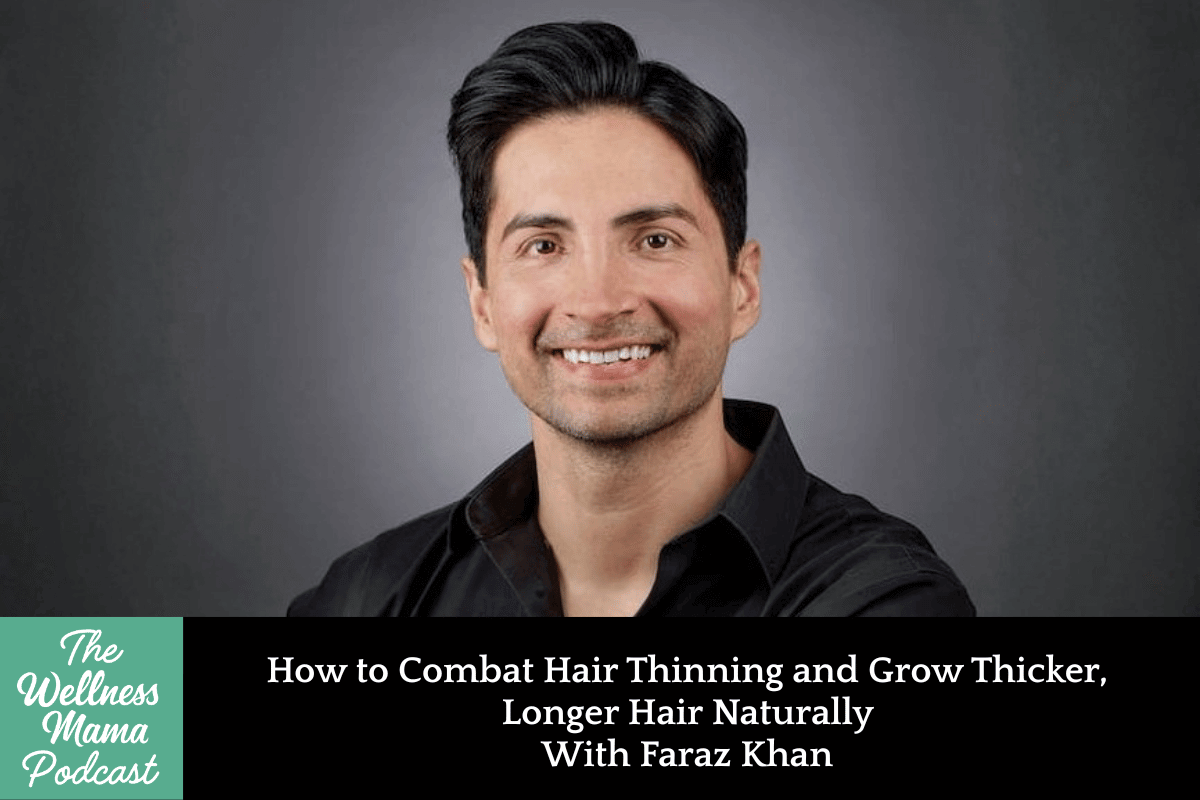
Katie: Hello, and welcome to the Wellness Mama Podcast. I’m Katie from wellnessmama.com. And this episode tackles the topic of how to naturally combat hair thinning and to get longer, thicker hair naturally. And today’s guest Faraz Khan has a fascinating story with this. With very early hair loss and his incredible journey to reverse that.
He has amazing hair now. And what he learned in the process, including how this is a very multifactorial approach, how a lot of the common advice is not necessarily helpful and the things that actually seem to work and move the needle. I learned a lot in this episode. It’s something I’m trying now currently, not because I’m necessarily losing my hair, but because after six pregnancies I would like it to be a little less dry and a little thicker.
And so I’m trying his products now as well. I think you’ll learn a lot in this episode. And he really tackles some of the root causes, including a lot of things that are within your own power to shift within your lifestyle at no cost that can really benefit your hair. So let’s jump in and join him now. Faraz welcome. Thank you so much for being here.
Faraz: Katie, thank you for having me. I’m really excited to be on your show.
Katie: I’m excited to chat with you, not only because you are an in real life friend, but because the topics we are gonna get to dive into today, I feel are very relevant for women at various phases of life in general. And for a lot of people actually, post COVID. This is a pain point that seemingly isn’t solved for a lot of people. And that is the topic of thinning hair and how to grow thicker and longer hair naturally. And I feel like even for people who maybe don’t have alopecia or an acute issue, we still all wanna have healthy, beautiful hair. I know this is something that for me with like postpartum, I have had ups and downs with over the years and a lot that goes into it.
So as a little bit of background, maybe give us some of how you got into your research around this particular area and then kind of some of the background things that are going on in the body when there’s hair loss.
Faraz: Yeah, totally. This has been a very, very long period of suffering for me as one of the biggest insecurities I’ve had in my life. I was 21 in college, confident, college athlete, soccer athlete, and my goal at that time was just to be confident and get a girlfriend. But the universe had other plans and which was, I was shampooing my hair one time and I looked down on my hands and it’s full of my beautiful dark hair. I was just so shocked at that moment. My stress levels went from a 4 to an 11, and I started thinking about, well, why is this happening? You know, this is not fair. Why is God doing this to me? Like, what did I do, I’m a good kid, you know? And the thought of having a girlfriend was now further and further away because you have, you’re losing your confidence. l
So I was blaming myself and I didn’t know why this was happening. I started thinking of where this was coming and so my dad’s side of the family had a lot of hair. My, my grandfather had so much hair, I couldn’t believe, even more than me at 21. But my mom’s side of the family, there was thinning going on. There were two, one where the other one was rapidly losing his hair. Okay. Genetic. It came side, I’m cursed trying to do all the things. I tried the biotin supplements, I tried other supplements. I tried hair oils, rosemary oil, other oils that made my hair smell a lot. I tried yogurt in my scalp, egg yolks, like, shampoos, everything that I could.
I tried a lot of things and none of them stopped my hair loss, but they slowed it down a bunch. And I remember my grandmother telling me that, you know, if you shave your hair, then it comes back thicker and coarser. And so I was so desperate that I shaved my head three times to try to save my hair. But that doesn’t do anything. Newsflash, it doesn’t help. And so don’t try shaving your head. I don’t even look good with a shaved head. And so that just kept going. At the age of 25, after grad school, I was so frustrated with my hair loss that I went to a hair transplant surgeon in Denver, Colorado. And I said, please, doc, (this was in 2005), I said, please, doc, put me outta my misery. I can’t do this anymore. I’m tired of waking up with so many hairs on my pillow.
And so, really nice lady doctor, she said, you know, you happen to have female pattern hair loss, not male, which some men can have. And this is because I got it from my mom, presumably. And so she said, I can’t, there’s no area where you have lost all of your hair, so I can’t just transplant them in otherwise. This is why women have challenges with hair transplants because when you try to transplant hairs into areas where there’s other hairs those other hairs can fall off because of shock loss. And so she said, you can’t, you’re not a good candidate, but I’ve got a pill for you. And I said, okay, what’s the pill do? She says, well, it’s called Finasteride, which I’m sure anybody, even women with hair loss, would’ve heard about. But it has a whole list of sexual side effects for men. And I said, no, I’m at the, I’m in the prime of my life sexually.
I’m not gonna take this pill. And so I go home and seven days of more waking up and a bunch of hairs on the pillow. I called her and I said, gimme a pill, I’ll take it. And so I did that for 12 years and then after that, and still my, hair kept falling out over time. And it got to the point where in Los Angeles, that’s where I lived at the time, I was using hair fibers in my scalp to kind of cover some of the thinning areas so people couldn’t see my scalp. And LA is a town where you get judged very quickly in appearance, and so I was doing that. But then changed my car into podcasting and as in particular, and there’s gotta be up there. And so I world to lost conferences, mirror doctors. And then I traveled, I traveled to Bangkok for, six different cities.
And then really learned from them, either, also, on, in front of the camera and also behind the camera. Because they took me back into their practice and they showed me they were doing PRP, they were doing hair transplants. And so I really got to see both sides of it. And then I came back and consulted with chemists. I read hundreds of scientific papers. And then I said, okay, I’ve been unsuccessful this whole time, but is there a way to get my hair back without using pharmaceuticals? That was the big question I was trying to solve. And the answer I came to after about year and a half of research into this space is that, yes, there’s a way, but the big aha for me is that you cannot do one thing at a time.
Because all of us have probably tried a shampoo or a supplement or a serum, and it may have worked, but more likely than not, it did not. And so the big aha I had is that you have to do four or five things at once for hair loss in particular, for it to actually have a measured impact on you. And so immediately I was applying caffeine to my scalp and I didn’t have any caffeine at the time, so I’d just make coffee and then use a cotton to like put that into my scalp, which messed up my countertops. But I was spending maybe two hours a day and 500 bucks a month on this new technique that I’d found. And lo and behold, three months later, I had a lot of hair growing back and I was looking at the mirror and just smiling.
For the first time in my life, I was smiling about my hair because I had all these hairs growing back. And so that gave me a lot of confidence. And I realized that it doesn’t have to be permanent. You don’t have to lose your hair if you can address it the right way. I’m not saying that everybody is gonna get results, but most people can. And especially for women, because hair loss is multifactorial for women and really it doesn’t go all the way like with men. And so, that’s when I enrolled three female friends and two male friends to try to do this one as well, just to make sure it works on others. And the women, had better results than the men. And so for men, now, I advise maybe adding a couple extra things. But for women, they had great results with the protocol, and that’s when I decided to bring these products to market.
But the biggest aha for me is after all of those experiments that we did is that you want to try, you want to have multiple things at the same time. Three to four to five techniques at the same time to get really good results with hair growth. So that is my big, aha that I’ve learned from like 25 years of struggle, with hair growth. And if you want, we can get into some of the root causes, especially.
Katie: Yeah, I would love to go into the root causes and then of course hear more detail about the protocol as well. Because I’m sure people have come across things, especially on Instagram. I see so many ads for them for different just shampoos or like the single products you mentioned. And it makes sense to me that it would be like many areas of health, like a multifactorial thing. And that for someone who is having that experience, you’d wanna address as many things as possible and get results as quick as possible. So definitely wanna get there too. But let’s start with what are some of the primary reasons going on? I would guess we’ve got like hormone imbalances as one potential cause.
I know people talk about hair loss post COVID. Seemingly there could be a stress factor, even if it’s cellular or mitochondrial stress. But what all is going on when someone starts losing their hair and they haven’t had that before?
Faraz: Yeah, great question. So the number one root cause of hair loss and hair thinning in men and in women is hormonal, as you said. And when I talk to, I talk to a lot of women and this is what they suspect all the time. And they’re right. They’re absolutely right. So what happens, especially for women after the age of 35, after the age of 40, is your estrogen and progesterone levels start to decline. And this leads to a relative imbalance with testosterone. This testosterone now converts to dihydrotestosterone or DHT, and DHT travels up to your hair follicles, to the receptors in your hair follicles and starts to shrink them. Over time, the hair gets thinner and thinner and whispier, and you see this in men.
So you’re absolutely right Katie. The number one reason of hair thinning in women and in men is hormonal. And women, I talk to a lot of women all the time and they suspect it is their hormones, and that’s absolutely true. For women what happens is that after the age of 35, their estrogen and progesterone levels start to decline, which leads to a relative imbalance with testosterone. This testosterone converts to dihydrotestosterone or DHT, and it travels up to your hair follicles and it starts to shrink them. This is why you see men that are, you know, between ages 18 and 25, have such rapid hair thinning and hair loss is because testosterone levels are very high at that time.
But for women, this happens after the age of 35, after the age of 40, as their hormones start changing. And so that is the number one reason. And so what we want to do is we wanna block or reduce the amount of test to dihydrate testosterone. Using, there’s natural supplements that we can use, but one question I’ve gotten on this is how do we know that it’s hormonal hair loss? Well, if you are over the age of 40, that’s almost always at risk for women. But, I have a friend, Lisa, she lives in Chicago. She asked me this very question and I said, Lisa, next time you’re washing your hair in the shower, just take all the hair strands in your hands and then stick them in the tiles in the shower, and then just look at them.
Look at them right then, and then come back and look at them later. If you notice that some hair strands are thinner and some are thicker, then that is a telltale sign that you have hormonal hair thinning going on. The other one is that you have, when you have hair loss on the top, the crown, or all the way to the front and the temples, that is the danger zone for hormonal hair thinning. And so if that’s where you’re losing your hair, it’s more than likely it’s hormonal. And so then at that point we have different strategies to kind of combat the hormones. The other thing that you brought up, Katie, was COVID hair loss. And we also see ozempic hair loss kind of lumped into this.
But there’s this high levels of stress that can happen for short periods of time, like childbirth also falls in this category. Childbirth, COVID. We’ve got ozempic hair loss. So some of these things are surgery. You could have a breakup, you could be moving to a different home, to a different city where there’s a lot of uncertainty or you know, something in the body that changes. This can cause an acute hair loss or acute stress, and your body thinks that it’s in trouble, that your survival is at stake. And so what the body does is it pulls all the critical resources and minerals, vitamins away from the hair follicles, which are ultimately expendable. They’re not important for you to survive. It pulls all the critical resources away towards the core organs.
And so what happens as a result is that your hair follicles shift from the growth phase into the resting phase. A lot of them will shift and then they have to fall out before they grow back again. So women might lose 40, 50, 60, 70% of their hair two or three months after COVID, two or three months after childbirth. And so it’s a very scary time and it’s a very delicate time because your hair is going through this renewal process. And what we wanna make sure is that every single hair grows back. But for women especially, what happens is that there’s multiple root causes of hair thinning going on at the same time.
And so even though your hair is supposed to all come back, there’s something else that might be preventing a bunch of your hairs from growing back. And so we wanna address all of those root causes so that you have the best chance of getting the thick hair that you had. So that’s COVID, and that’s short term stress.
Katie: Which, and it makes sense to me that there would be a big hormonal component. And like I said, I’ve experienced the postpartum hair loss and the hormone side of that. I know many women talk about it. And it was my experience of having like amazing hair during pregnancy and then the hair loss after, and then it all comes back. So I’ve seen the ups and downs with hormones. What are things we can do, especially at home, where like, are there things we can do that we’re, are with own, in our own ability to do without having to go through like hormone replacement or talk to a doctor? Like how do you encourage women to navigate that?
Faraz: Yeah. So a couple of other things that are, that happen quite frequently with female hair loss in particular is this ongoing stress because women are doing so much, you’re taking care of the kids. You probably have parents that are aging, and so you’re taking care of them. You’re probably taking care of the house, you’re buying everything for the family. It’s, a woman does two or three jobs full-time and it doesn’t get enough thanks for it. So I really want to acknowledge all the moms in this audience. You guys are carrying the weight of the world on your shoulders, so kudos. With that said, this comes with the higher amounts of stress. And so, and this is ongoing stress, different from acute stress that we talked about with COVID, et cetera.
And so this ongoing stress also has been linked to ongoing shedding. So you’ll just lose, you know, 50, 60, a hundred, 200 hairs every single day. And you’re not quite sure why this is happening. So this is this ongoing shedding that’s happening. And what you can do at home is to get more grounded, get more balanced, maybe take walks, maybe do start a meditation practice. But anything you can do to lower your stress will go a long way towards stopping this particular type of hair loss. The other aspect is we get, with a nutritional hair loss, there’s five ingredients that are very, very critical for hair growth and healthy hair. And these are vitamin D3, folate, B12, zinc and iron. And so you wanna make sure you get all five of these in the middle of the range, not on the low end.
A lot of us are on the low end with vitamin D3. You wanna be in the middle of the range for all five of these, if not a little bit higher than the middle. But the middle is fine. And so I had a friend in LA, Ashley, she called me and she said, hey, I’m losing my hair. I don’t know what’s going on. So you know, she’s only 34. I said, hormones should not be an issue at the moment. So I asked her, what’s changed? And she goes, well, my coworker left and now I’m having to do her job. And so I’m doing more, you know, I’m staying late. I’m stressed. So obviously, okay, stress is one factor. And I said, has anything else changed Ashley? And she goes, no, nothing’s changed. Oh, actually, I’ve gone vegan. Over the last four months, I’m like, okay, cool.
No problem. But if you are gonna go vegan, then that puts you at risk for being low in iron, B12, folate, and also zinc. And so those are all critical nutrients for the hair. So, at home you can do this. You wanna make sure that you are, you’re getting enough of those big five. And you know, next time you go to your doctor you can even do a test. But you could do this at home even without a test. Just make sure you’re getting enough of those five nutrients and you’re supplementing if you’re not getting enough of those, right? So you can do that at home. In addition, people talk about hair loss shampoos all the time, and this is probably the least thing I would try because they’re not that effective.
The reason why is because most women wash their hair one to two times a week. It is just what it is because I talk to women a lot and if you’re washing your hair so little and you’re applying shampoo for five minutes a week, it’s just not that effective. I would much rather you use a hair serum that stays on your scalp for 8 to 10 hours or something that’s more effective for longer. Or a supplement for example. Instead of trying to rely on a shampoo. And a lot of companies will market their shampoos as hair growth shampoo, and it’s gonna do this, and it’s gonna do that. Unfortunately, that is just marketing speak. That is not true. So I would caution women from relying too much on shampoos as your go-to strategy for hair growth.
Katie: That makes sense because it’s not, it’s just not on the scalp that much. And I know there’s like, seemingly, I’ve seen so many protocols with hair oiling, which you mentioned you tried with hair serums. Like what are the things that actually move the needle? And also like, is there a like an order and a protocol to this? Because I’ve seen so many conflicting things of like, never do it on dirty hair. Only do it right after washing your hair, but then you have to wash your hair again. Like what is the rhythm for all that?
Faraz: Yeah, I love that question. So the order would be, I’m a big proponent of whatever you can use consistently is very, very important. And so if you’re going to use a serum, a lot of, at least on TikTok, you’ll say, oh, rosemary oil did this or that. Have you tried using rosemary oil every day? It’s impossible, right? You cannot, women will not wash their hair every day, so you’re not gonna be consistent. And so what I highly recommend is to use a water-based serum. That you can use every single day. So it’s not oily, it’s not mucky, it’s not dirty, it’s not gonna attract more dust and dirt into your hair follicles. It’s gonna allow your scalp to breathe. It’s gonna allow your sebum to be redistributed, and you’ll actually use it every single day.
So for hair serum that you can apply in the evening, that kind of dries off by the time you wake up in the morning and you can style your hair normally, that doesn’t cause you to, you know, wash your hair every second or third day. That allows you to keep your hair wash schedule, as long as it’s a couple of times a week. I do recommend, if you’re experiencing hair thinning, then washing your hair a little bit more, at least two times a week, if not more, can help keep the scalp very, very clean. The other thing that you could do is I love brushing. I absolutely love brushing the scalp or massaging the scalp. When I was losing my hair for 20 years, I absolutely did not want to touch my hair at all, because every time I touched it, more hair would fall out.
But I was thinking about it the wrong way because the more you massage your scalp, the more you brush your scalp, the more there’s circulation coming in. That circulation brings nutrients. That circulation brings vitamins which are very, very critical to your hair. So I’ve turned around on this and I’m a big proponent of massaging and brushing your hair or your scalp. You wanna be very gentle with your hair, but firm on your scalp. And then you want to use a water-based serum that is effective. And what is effective really? So I can touch on this. In both when it comes to supplements and when it comes to serums for hair growth, or stopping hair thinning, you wanna target the root causes.
Which is how we think about it, is to target all the root causes that are implicated with hair loss. So what are the root causes? We’ve got hormonal impact, which we wanna balance with DHT. We’ve got inflammation that has been linked to hair loss, so we wanna make sure the inflammation levels are balanced. There’s oxidative stress. That can cause hair thinning and hair loss. So we wanna make sure we address that. There’s low circulation. This is a big one. We strongly believe in this low circulation, which, you know, you’re not getting enough blood flow and nutrients. So that’s a big one as well. So what you want- and then stress of course, as we talked about, that’s a big one.
So what we want to do is to create a protocol that addresses all of these root causes at once without you having to buy 15 different products, which is what I had to do when I was going through this journey. So if you’re using a supplement, then I encourage using a supplement that’s well balanced, that covers everything. It gives you the nutrition, but it also balances all the root causes of hair growth. As many as possible, at the same time. Same thing for the serum. I want it to be water-based. I want it to address inflammation, circulation, hormones, oxidative stress, scalp aging, all of those at the same time without you having to go buy other things. The third, the other item that I really love is a derma roller.
And by itself, a derma roller has shown about 15% net new growth without any other ingredients, without any other protocol mixed in. And so if you can add a derma roller and use it one to two times a week, that’s highly effective. When I work with women, I typically recommend that and they use a derma roller as well. And so that is something. So if you were to do a protocol, Katie, as you asked me, I would do a supplement that targets as many root causes as possible. I would do a serum that targets as many root causes as possible and is water based and clean. I would do a derma roller and I would do a hair brush. This is the minimum I would do.
And then we could talk about a shampoo, but that’s way lower on the scale for me than these big four.
Katie: I love it. I’m taking so many notes and I would love to go through a few rapid fire clarifying questions. The first being with a derma roller, any specifics around that? Is that on clean hair only? Is that at a certain time of day and or like how do you make sure you do it in a way that doesn’t like damage the hair themselves?
Faraz: Yeah, yeah. So you can use a derma stamp, which goes directly into the follicle, but I found that working with women is that there, it just takes too long. And so it has to be quick. It has to be in and out, 15 minutes, because you wanna derma roll the areas of your scalp. You wanna buy a stainless steel roller. The maximum length you want to go is one millimeter. Any, more than that, you can go too deep and you have a risk, you might damage the scalp more than you’re helping. And so what this does is- also you want to use it, I typically use it in the evening. I use it a couple times a week. There’s millions of people using derma rollers, by the way.
You can Google, you can YouTube them and see their protocols. But, I use this in the evening, so I’ll wash my hair in the morning. I’ll use the derma roller in the evening, and then I’ll apply a scalp serum. So I’ll apply a serum, water-based serum, because when you use the derma roller, your channels are open, so it leads to better penetration of the scalp serum. And so that’s why it even improves the efficacy of the scalp serum during that time. So if you’re doing it a couple times a week or even once a week, then use the serum right after. And then you just go to bed, wake up the next day, you can wash your hair or you can just style it if, if it’s possible for you to style.
I typically just style my hair normally the next day and I go about my day. So I don’t wash it every day. But it is important for you to have clean hair before you use the derma roller. because otherwise germs can get in. Also, the other thing I do with the derma roller is I dip it in, sorry, I’m going over on this question, but I dip it in alcohol for a few, for five minutes to kill all the germs before I tip- apply it on my scalp.
Katie: Oh, that’s a great tip as well. And I realized not everyone might be watching on video. I’m seeing you on video while we record, but some people might just be listening. So I felt it important to point out that you have really amazing hair now. So for anyone doubting like this definitely does seem to work and it brings up some other rapid fire questions. I know I see a lot of things floating around about red light for hair. I’m a big fan of red light in general and actually tell people like, you don’t even have to spend thousands of dollars for like whole body red light, go in the sunrise and the sunset, nature provides it in abundance. But for hair specific, is there anything to these red light helmets or more specific red light devices?
Faraz: Yeah, yeah, great question. I get this all the time. And yes, there is. I categorize all of these treatments and techniques into two different buckets. One is a hair growth promoter versus one that addresses root causes of hair thinning. And so what I categorize the red light therapy is in terms of hair growth promoter. Because it increases your mitochondrial function and energy in your cells, which can allow the cells to do their job. Now, what I don’t love as you also don’t love Katie, is the $5,000 hair helmet. Like that’s insane to me. Most people I talk to will use it for three to four weeks, maybe eight weeks, and then it’s gonna sit in a closet somewhere. Never to be used again. So if you can add on, so do the basics. Do the basics right.
Address the root causes, and then you can add on the red light therapy in addition. I prefer a cap because it’s more cost effective. And again, long term nobody uses it. But don’t waste a lot of money. It can help. So I, I’m a proponent of it, but don’t waste too much money on it.
Katie: Okay, so what about some of the more controversial things I hear people talking about being especially damaging for hair, specifically dry shampoo and hair extensions. What’s your take on those?
Faraz: Yes. I’m not a, I’m not a fan of hair extensions. I am, also, birth control comes into this controversial aspect. And dry shampoo as well, because dry shampoo is typically just hiding or masking the dirt that’s in your hair, but it’s not going away. It’s still sitting on your scalp. And it’s blocking your scalp from being squeaky clean, which is what we want. It’s, getting the sebum kind of stuck in there. And so what I recommend, especially if you’re losing your hair as a woman, you wanna wash your hair two to three times a week to keep it relatively clean. And like we said, we wanna apply a water-based serum so it doesn’t make your hair oily. That’s how I would go about this.
And, yeah, for a shampoo, you can use any caffeine based shampoo that- caffeine seems to be an activator of hair growth or prevents some of the hair loss. So you can use a shampoo that includes some caffeine, 1% caffeine is what’s recommended. And so that’s what I would do. And, yeah.
Katie: Okay. And you mentioned birth control. I’d love to go a little deeper on that as well as talk about what about things like testosterone supplementation or other hormone replacement or supplementation. How, how does that impact hair?
Faraz: Yeah, totally. So with hormone supplementation, so we see hormones changing in a woman’s body in a few different areas. One is when they have PCOS and it’s early, they’re younger in life maybe, or even mid age, that’s fine. But there’s higher amounts of androgens or male hormones in a woman’s body at that time. And so those translate, again, like you said, a higher testosterone converts to DHT, which causes hair thinning. Same thing happens when you are supplementing or using exogenous testosterone therapy, then you’re adding testosterone into your body, which is really good and healthy in most ways. But if you’re experiencing hair thinning, and I talk to women about this, I recommend pausing the testosterone therapy while we get your hair in a really good place.
So three to five to six months, let’s grow a lot of your hairs back that’s been thinning. And then we can slowly start to add testosterone back at very low levels and then go higher to see how your hair responds. But testosterone- and what’s interesting about testosterone is that it just might not be the testosterone. A lot of things can kick off hair loss, like high blood pressure and metabolic dysfunction and stress levels. It just kicks it off. And then you get the hormonal hair thinning going. And so it doesn’t almost always have to be testosterone. There can be many triggers for it. But what we wanna do, if we notice there’s hormonal thinning going on, we wanna lower the risk factors, which is the testosterone, for a brief period.
And then once we get your hair back to where it is, then we can start adding that back on. With hormonal hair. Sorry. With birth control, Katie, I’ve heard many doctors say this and that with, when you take that on, it changes your hormones and you know this, quite well, I believe. And so it changes your hormones in your body and that can start to kick off something as well. We, there are so many triggers to this hair thinning puzzle, and so we want to make sure we are very, very delicate with hormone changes or blocking or changing hormones inside our bodies. And in many ways, birth control has been linked to additional hair loss as well.
Katie: Got it. That makes sense. In light of the hormone connection, what about people who have specifically dry or brittle hair, and that’s their complaint? Even if it may or may not be thinning, but their hair’s very dry.
Faraz: Yeah. Great question. So what happens is the curlier your hair, the drier is gonna be. And the reason is, so, African American hair is very, very curly and coily and kinky, and the reason it’s more dry is because it’s hard for the moisture to travel down kinkier hair. So if you have straight hair, like Asian hair, or even straight Caucasian hair, then it’s easier for the moisture from your scalp to travel down the hair strand. But the curlier the hair gets, the harder it is for moisture to get down. So if you are, you know, if you are, if you have those genetics, if you have kinky or coily or even curly hair, then you’re at risk for having dryer hair. Anyway. Two, regardless if you don’t have, if you’re not at risk, but you have drier hair, what happens typically is that you’re not getting enough oils, enough fats in your body.
So you want to get omega threes in particular. Olive oil is a good one. You wanna get some of the key nutrients like zinc and vitamin Bs that are very, very, very helpful. I would also encourage getting some silica and keratin that helps with the hair strand itself. That can help improve and reduce your breakage, which a lot of women go through.
Katie: Got it. That makes sense. Yeah, I feel like I had very straight hair early in life, and then over time in six pregnancies it changed and got curly, but I was still treating it as straight hair. So for a while I’m like, why is my hair so frizzy? And a friend finally told me, I think you have wavy hair and you’re just not taking care of it correctly. And she showed me how to like, wash it a little differently. And that turns out I do have wavy hair. So I’m still learning about, and my hair’s more dry since having so many kids also. And I feel like you’ve given us such a great comprehensive look at all the important, like really the levers that make the big difference and the things to actually address that are gonna work versus just like dumping money on things you see on Instagram.
How quickly do people typically start to see this turnaround? Like it seems like you maybe saw results pretty quickly once you actually figured out all these things to address. And I know this is a really stressful thing, like it was for you, for anyone who’s in that experience. So if someone is willing to address the things you’ve talked about, how quickly might they see a difference?
Faraz: Yeah, also a great question. Typically because of the hair growth cycle, it takes about 90 days, 3 months, to see results. Anybody that promises you hair results in 10, 20, 30 days… Six weeks… Six weeks, you could maybe start to see some early results, but you will see real hair growth in about two to three months timeframe. More, higher than two, usually. And so that is why I highly recommend going with a company also that can guarantee your products for that amount of time. For a lot of these companies that sell you hair pills or serums for example, they have a 30 day money back guarantee, which I’m like, what’s the point? You’re not gonna see results, especially with hair. And so why are you offering such short guarantees?
And that was one of my frustrations with the industry when we were working on our products, is that, is just, it doesn’t set you up to succeed in the right way. And so just be patient. Please be consistent. Give it 60 to 90 days and you will see results if you’re using the right products.
Katie: Amazing. And I love that you already gave us the breakdown of like, what are the important nutrients you need to look at? What are the important things that actually need to go on your scalp? And I know you also have done a lot of work to create the products that simplify that for everybody. So can you tell us about what those products are? And I know there’s a special discount as well, so that’ll be linked in the show notes. For anybody listening, there’s a special code for you at wellnessmama.com, but give us the break, the rundown of the protocol that you have and that people can just really like just get access to and use immediately without having to formulate like you did.
Faraz: Yeah, yeah. Spend hundreds of thousands of dollars in multiple years trying to learn, the physiology and the details behind hair loss. So we’ve compiled, after I got my big aha moment, and I said I started seeing results with people that combined so many techniques at the same time, I said, how could we enable individuals to get their hair growth results that I had gotten and some of my other friends had gotten, and some of her early customers had gotten? And so we put together a 90 day, a three month bundle that includes the supplements, three supplements, three serums, a derma roller, and a hairbrush. All together in one bundle that you can buy from our website, fullyvital.com, and you’ll get 15% off your purchase if you use the code WELLNESSMAMMA.
And so the goal behind all of this is to create something that you can just buy one time and use it for three months and get results. So like I said, our supplements targets six root causes of hair thinning. Our serum targets five root causes of hair thinning. I’m super excited that in our serum we just added exosomes, which have been so far, only technology or I guess, growth factors that you could only get at a dermatologist office and you could only inject them for $5,000 at a time. But we’ve added the exosomes plus growth factors into our serum. And so we’re incredibly excited about that. We’re also gonna be probably the first company that adds senolytics into our serum. And senolytics are very, very, they’re very, very buzzy in the anti-aging world because they help keep your youthful cells youthful and young and get rid of the older cells.
And so we’re adding senolytics into our hair serum very shortly. And so I want to say that we’re cutting edge in terms of using the best of anti-aging, the best of longevity, the best of hair growth science to create products that really move the needle. And to add to that, because I suffer from hair loss for so long, we offer you a four month money back guarantee. A 120 day money back guarantee. Because like we said, it takes about 90 days to get to see real hair growth results. So we wanna make sure we cover you for 90 days plus shipping time. Plus if you miss a couple of days. To make sure you get results. And if you don’t for any reason, if you don’t get results, just e-mail us, call us, text us, and we’ll refund your money.
There’s nothing, you have no risk at all to try this out. And that’s primarily because I suffered with this problem for so long. And then I’ve got one other thing that I want to add is we just launched a collagen that we believe is the best collagen in the world. And of course I’m biased, but this contains a hair growth complex that has silica, that has biotin, that has keratin, that also has AnaGain Nu, which has been proven to stop thinning in 28 days. We’ve got that. We’ve got prebiotics and postbiotics for a better absorption and gut health. And we’ve also got four different types of collagen in there. Be that, bovine collagen, chicken actual membrane, as well as marine collagen.
So we’ve got everything in there in the supplement. Super proud of it. And what I’m gonna do is for anybody that buys the 90 day bundle. We’ll offer you the collagen absolutely for free, full, a full-sized collagen for free. Just, you know, we had to have to keep this within three to four days of this podcast coming out. So just if you’re hearing this right after it comes out, you’ll get a free collagen as well if you get the 90 day bundle.
Katie: Amazing. Well, like I said, I’ll make sure that’s easy to find in the show notes. And last question for this episode is, are there any specific cautions or times when women need to modify or not use certain products? Like I have a lot of moms listening, so potentially things like pregnancy, postpartum, are there times when they need to modify?
Katie: Yeah, absolutely. That’s a great question as well. So what I would recommend is that if you are pregnant and right after as you’re feeding your baby, breastfeeding, we typically recommend not using the supplement as much. We recommend, you know, using the prenatal supplements or the postnatal supplements that you have from your doctor, working closely with your physician or naturopathic doctor that you might be working with. And just get outta that phase first before you take any supplement. And especially even our supplement. And so that’s just a overabundance of caution. Because we wanna make sure that you’re super healthy and before and after pregnancy. Also during pregnancy, as Katie noted, you’re gonna have gorgeous hair because of the estrogen that’s gonna kick in and the progesterone that’s also present at that time.
So you’ll love your hair during pregnancy, there’s no worry there, but post pregnancy, you will start to lose, most women will start to lose hair about two, two and a half months after pregnancy. And so what you can do before then or during then, you can use your serums for sure. You can use derma roller, you can use the hairbrush obviously, but I would just caution and wait until you’re done breastfeeding before starting the supplement.
Katie: Amazing. Well, this has been very enlightening. I definitely learned a lot and feel like I have some fun things that I’m gonna get to try as well and report back. It’s always a joy to get to chat with you, and I know we’re gonna get to record another episode, so you guys stay tuned if gray hair is something you also wonder about and want to address as well. But for this interview, thank you so much for your time. This was so fun.
Faraz: Thank you so much for having me on, Katie. Appreciate it.
Katie: And thank you for listening and I hope you will join me again on the next episode of the Wellness Mama Podcast.






Leave a Reply