
Homemade Remineralizing Toothpaste Recipe (Natural + Simple)

Katie Wells Avatar

Reading Time: 5 minutes

This post contains affiliate links.

Read my affiliate policy.

remineralizing toothpaste
Wellness Mama » Blog » Natural Home » Homemade Remineralizing Toothpaste Recipe (Natural + Simple)

I’ve mentioned before how I stopped tooth decay and helped remineralize teeth. For healthy tooth enamel, it’s important to focus on good nutrition and have a great oral care routine. If you’re dealing with sensitive teeth, this homemade remineralizing toothpaste helps reverse and prevent demineralization!

When I was actively working on my cavities I used a two-part approach. First, I addressed my mineral levels through what I ate and drank. I also used a natural remineralizing toothpaste for enamel repair. I’ve since noticed a huge improvement in tooth sensitivity and no new caries!

A Remineralizing Toothpaste

There’s a lot of information about tooth remineralization, a process many dental health professionals previously thought impossible. This article details the science behind tooth remineralization and which foods to eat (and avoid!) for success. You’ll also learn why most toothpaste ingredients, even those with natural ingredients, aren’t the best.

Conventional formulations like Sensodyne reduce tooth sensitivity with fluoride and potassium nitrate. While I’m not a fan of fluoride, there are other issues with some brands that claim they’re remineralizing.

Silica, especially in whitening toothpastes can sometimes be too harsh. The SLS added for foaming can cause mouth and gum sensitivity. Nano-hydroxyapatite toothpaste has recently gained popularity as an alternative to fluoridated toothpaste, but it presents problems too. You can read more about that here.

Over the years I’ve uncovered a lot about having a healthy mouth. What I’ve found mirrors my own experience with natural, fluoride-free toothpaste and a remineralizing diet.

Don’t want to make it? Try the remineralizing toothpastes at Wellnesse!

Natural Toothpaste

I’ve definitely noticed major changes in my teeth after using this toothpaste. It gets rid of buildup to help with teeth whitening and makes them feel really clean. Others who’ve tried it have told me the same thing.

The most surprising change in my teeth was that they’re no longer sensitive to cold! For as long as I can remember, biting into anything cold (or even thinking of it!) made me shudder and hurt my front teeth. After changing my dental care I noticed I could eat cold foods without my teeth hurting. I’ve never been able to do that before!

This toothpaste recipe is kid-approved, and since it has no fluoride, it’s safe for babies, toddlers, and those with thyroid problems.

Ingredients and Substitutions

I’ve made several toothpaste recipes over the years with varying ingredients. All of them have ingredients that help strengthen enamel (and improve sensitivity) to some degree. Here are the ingredients and what they do for a healthier mouth

  • Calcium – I used to use calcium carbonate in this recipe to help rebuild enamel. While it’s still a good option, calcium phosphate is even better. You can even use finely powdered, dried eggshells for calcium if preferred. A coffee grinder works well for this.
  • Baking Soda – A gentle abrasive that helps clean teeth and reduce plaque buildup.
  • Diatomaceous Earth – Mineral rich and full of silica for strong teeth and bones. It’s also slightly abrasive to clean teeth.
  • Xylitol – Adds some sweetness to balance out the mineral taste. Xylitol also has a lot of oral health benefits and helps prevent cavities. If you prefer not to add it though you could replace it with a little stevia to taste.
  • Coconut oil – This helps pull everything together and turns it from a powder into a toothpaste. Coconut oil also helps reduce plaque, prevent gingivitis, and balances mouth bacteria. If your house is colder you can replace half of the solid coconut oil with fractionated coconut oil or MCT oil.
  • Essential oils – These add antimicrobial properties for oral health and freshen breath. Some good options include cassia cinnamon, clove, peppermint, spearmint, myrrh, or sweet orange. Start with a little and increase as desired in the recipe to avoid any irritation.
  • Mouth oil – Instead of adding essential oils, try a premade healthy mouth oil. I like this one from Wellnesse that features ingredients like manuka, and organic cinnamon and mint essential oil.

A note on abrasiveness: There’s been some concern diatomaceous earth or baking soda can be too harsh on teeth. While we don’t want to wear away enamel, DE and baking soda can be gentle options. Baking soda rings in at a 2.5 on the MOHS hardness scale compared to silica at 6 or 7. DE is even gentler than that with a score of 1 to 1.5.
remineralizing toothpaste
Print
4.48 from 227 votes

Remineralizing Toothpaste Recipe

Make a remineralizing toothpaste to freshen bad breath and strengthen teeth with enamel healthy ingredients.
Prep Time10 minutes
Total Time10 minutes
Yield: 4 ounces
Author: Katie Wells

Equipment

Materials

Instructions

  • In a bowl, mix together the calcium, diatomaceous earth, baking soda, and xylitol.
  • Add the coconut oil a little at a time until you reach the desired consistency.
  • Add essential oils or Balanced Mouth Blend if using.
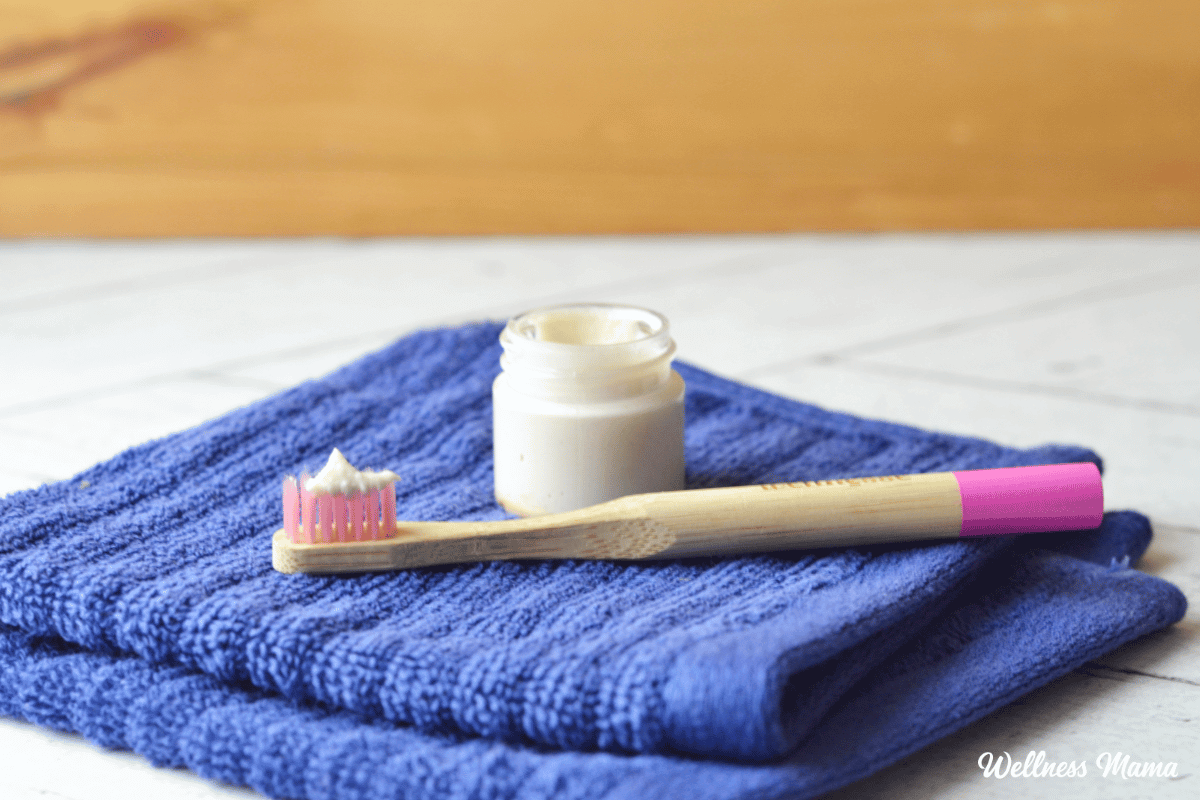
  • Store in small glass jar.
  • Use a clean popsicle stick or spoon to scoop some out and onto a toothbrush. Do not dip the toothbrush into the jar as this introduces bacteria and cause it to spoil faster.
  • Storage and Shelf Life: Store in a cool place away from direct sunlight for up to 2 years. Replace it if it starts to smell off or look discolored.

Notes

  • The amount of coconut oil can vary you need to form a paste consistency can vary from 1 and 1/2 TBSP to 2 and 1/2 TBSP coconut oil. You can also replace half of the solid coconut oil with fractionated or MCT oil if your house is cold. This keeps it from getting too hard!
  • If you don’t have a 1/2 Tablespoon measuring spoon, it’s the same as 1 and 1/2 teaspoons.

More Natural Oral Care Options

Oral hygiene involves more than just toothpaste! Here are some more healthy mouth products to make or buy. I’ve included my brand Wellnesse for those who are too busy or just want a premade option.

The Internal Side of Remineralization

Remineralization doesn’t only happen in the mouth. Simply using a toothpaste with a higher concentration of minerals likely won’t be enough to help teeth. Remineralization is a whole-body process. In order for it to happen we need enough of certain nutrients, especially minerals and fat-soluble vitamins.

When I was actively working on remineralizing my teeth, I focused on a specific nutrient-rich diet. I also avoided foods with sugar and phytic acid and added other lifestyle factors to boost nutrient levels. You can read my daily oral health routine in this post.

Getting enough minerals and fat-soluble vitamins are important not only because they support the body as a whole, but they create more mineral-rich saliva. Our bodies need healthy saliva to deliver the necessary nutrients to teeth.

I saw the best results with this two-pronged approach: eating for oral health and using this remineralizing toothpaste!

Ever made your own remineralizing toothpaste? Let us know how it worked!
This homemade remineralizing toothpaste uses all natural and safe ingredients to naturally clean teeth and provide necessary minerals to the mouth.
Sources
  1. Dodds, M. W., Johnson, D. A., & Yeh, C. K. (2005). Health benefits of saliva: a review. Journal of dentistry33(3), 223–233.
  2. Valkenburg, C., et al. (2019). The efficacy of baking soda dentifrice in controlling plaque and gingivitis: A systematic review. International journal of dental hygiene, 17(2), 99–116.
  3. Reade. (2023). Mohs Hardness (Typical) of the Abrasives.
  4. RTS Tools. (2019). MOHS Hardness Level.

Become a VIP member!

Get access to my VIP newsletter with health tips, special deals, my free ebook on Seven Small Easy Habits and so much more!

Easy Habits ebook on ipad
Katie Wells Avatar

About Katie Wells

Katie Wells, CTNC, MCHC, Founder of Wellness Mama and Co-founder of Wellnesse, has a background in research, journalism, and nutrition. As a mom of seven, she turned to research and took health into her own hands to find answers to her health problems. WellnessMama.com is the culmination of her thousands of hours of research and all posts are medically reviewed and verified by the Wellness Mama research team. Katie is also the author of the bestselling books The Wellness Mama Cookbook and The Wellness Mama 5-Step Lifestyle Detox.

Comments

1,496 responses to “Homemade Remineralizing Toothpaste Recipe (Natural + Simple)”

  1. Tanya Paez Avatar
    Tanya Paez

    Would not the essential oils destroy the plastic bag if you were using it? Also, would tea tree essential oil be good added in? Would orange or tangerine essential oil be safe for children to use?

  2. Chloe Elise R Avatar
    Chloe Elise R

    Sorry if anyone has already asked this, but what amounts would you suggest putting in of the GSE and Trace Minerals? I’m assuming only a couple drops? Thanks for this recipe! Stoked to try it.

  3. Susan Walker Avatar
    Susan Walker

    Has anyone else had sore tissue (gums, inner lips) from using this? I think it’s the baking soda because I had the same sensation when I tried brushing with plain baking soda. Does this go away over time?

  4. Andrew Avatar

    Hi, I was wondering how you got it to the consistency of toothpaste. I couldn’t get it unless I added some water. The color also seemed to be yellowish instead of white.

    1. Susan Walker Avatar
      Susan Walker

      Did you look at her post on Squeezable toothpaste? I added some water to the warm toothpaste then kept shaking it until it set up a bit. It DOES seem to dry out around the opening. Gotta watch where you aim it when you squeeze!

  5. Karen Avatar

    I am a big fan of Diatomaceous Earth. The diatoms are very small crystal-like substances that kill bugs (I use it outside to create a bug-free zone & inside on my carpet for the same reason). I do believe they would scratch teeth enamel.

    But DE is loaded with silica. The trick is to dissolve the DE in water; the silica gets dissolved & the diatoms drop to the bottom. What I will do with this toothpaste (trying my first today) is mix up the rest of the recipe, then dissolve the DE in water & use the liquid to moisturize just before brushing.

    1. Susan Walker Avatar
      Susan Walker

      You can buy silica drops at the health food store. Would that solve the problem?

      1. Karen Avatar

        I think I misspoke about leaving out the DE. DE is used in water processing plants, swimming pools, even beer making to kill bacteria and bad germs. So, it is probably added to the mix for this effect. It just has some win-some-lose-some effects: add it & get the germ killing effect but scrape the teeth.

  6. Kristen Leveille Avatar
    Kristen Leveille

    I use baking soda mixed with water for a paste and add crushed strawberries. One for the taste and two they are a natural whitening agent! Works great and all my kids love it!

  7. Stacey Hoskins Scott Avatar
    Stacey Hoskins Scott

    I just made your toothpaste…I know it will take some getting used to, but approximately how many drops of oil do you use? I used peppermint oil and it still tastes somewhat bitter to me. I don’t want unrealistic expectations so just wanted to be sure. Also, it is kind of gritty…is that ok? Thanks!

  8. Chris Avatar

    I was wondering if this is safe for children to use? Specifically for a young child who isn’t great about spitting yet?

  9. Amanda Avatar

    Im sorry if this is a repeat question…. I have found several recipes for homemade toothpaste all of which include an option for stevia or xylitol…. I ran across one that also listed raw honey for the sweetener…. can you give me your thoughts on that, please. I already have the raw honey, and I KNOW it is natural. The jury still seems to be out on the other two.

  10. Adrienne Cox Avatar
    Adrienne Cox

    Is it a problem to just swallow this toothpaste when done brushing? I have been doing that to avoid the drain getting clogged with coconut oil. Thoughts?

    1. Nicole Avatar

      Swallowing is probably not a goof idea. You end up swallowing all of the stuff you’ve brushed off of your teeth.

  11. Sara Avatar

    Hi there! The dentist has told me I have an ‘exposed root.’ It’s hard to drink cold water in that part of my mouth, etc. He wanted to prescribe a specialty fluoride paste (MI Paste) to reduce sensitivity and I declined for obvious reasons. Coming across this, I want to make it with hopes of healing my ‘exposed root’ without the use of fluoride.

    With that said, do you think I can use straight magnesium powder (I talk CALM every night before bed, and I agree with you that it’s magical) in place of the calcium powder or calcium/magnesium powder you suggest? It’s a powder form so I’m thinking it won’t change the texture too much (plus I wouldn’t have to buy anything extra), but I’m also curious about the necessity of calcium in toothpaste to heal this painful root issue.

    Thank you!

    1. Sara Avatar

      Same question about the magnesium goes for your Tooth Powder as well, which I plan on using in conjunction with this.

  12. Caitlyn Baldo Avatar
    Caitlyn Baldo

    Wellness Mama, which of your tooth paste/powder recipes do you recommend the most, especially for kids???

  13. Taimay Jones Avatar
    Taimay Jones

    Can you omit the baking soda? I am having a hard time with the taste even with extra xylitol and a ton of essential oil.

  14. Melissa Welty Avatar
    Melissa Welty

    We are using Coghlan’s Squeeze Tubes that I found online and tracked down to a sporting goods store. The hole is big because they were designed for condiments but it seems to work for the toothpaste. Just don’t get any on the clamp end when loading the tube, as the clamp won’t slide on if there is ANY residue on the end of the tube. Thanks for the recipe:)

  15. Inez Aultman Avatar
    Inez Aultman

    Don’t be tempted to use this on your dog’s teeth. Xylitol is very toxic to dogs.

  16. Melody Persinger Dula Avatar
    Melody Persinger Dula

    You mentioned thyroid complications with this toothpaste recipe. Would you elaborate? My baby girl has a thyroid condition. Thanks.

  17. Fay Jones Day Avatar
    Fay Jones Day

    I have been experimenting with variations of this for the last three months. I didn’t like the taste. It didn’t freshen my breath. I finally ground some fennel seeds and added them to the mixture. I love the taste!! But the mixture is kind of green. 🙂

  18. Jolene Avatar

    I used this for a month and probably did 5-10 years of enamel damage to my teeth. My teeth now have grooves an my dentist said it’s from the diatomaceous earth, which removes enamel. DO NOT use this recipe!

    1. shandra slack Avatar
      shandra slack

      This is so sad! Diatomaceous earth is extremely hard! It apparently has the hardness of diamonds! DO NOT use on your teeth!!

  19. Meloni Harris Avatar
    Meloni Harris

    So since the coconut oil is pretty hard when cold, I heated mine up before mixing it into the dry ingredients, but much to my dismay, it was still back hard again this morning. Was I supposed to just cream it in like butter?

4.48 from 227 votes (183 ratings without comment)

Leave a Reply

Your email address will not be published. Required fields are marked *

Recipe Rating