Read Transcript
This episode is brought to you by NativePath and in particular, something I have been experimenting with and really, really loving lately. And here’s what you need to understand. A lot of us think calcium is important for our health, especially for our bones. But is this actually true? Bad news. It turns out maybe not, or at least there’s more nuance here.
One of the largest bone health studies ever conducted followed thousands of women taking calcium and oral vitamin D daily, and the results were surprising, but not in the way you would think. They saw no significant reduction in their risk of fractures, and they saw no improved bone density. So all those calcium pills might not be doing what we think, and it turns out they might actually be counterproductive.
But here’s where it gets interesting. A brand new study found that women who did one thing every morning consistently for six months gained 7% bone density, which is massive. This is the same amount of bone mass the average person loses over the course of five years after a certain age. So what did they do?
It was not a medication or even a workout. It came down to one simple thing added to their morning routine. And that’s why a lot of people, especially people over 50, are making this one simple change and seeing massive results. I’m sure you’re probably curious what it is, and it’s a particular protein from one of my favorite brands called NativePath.
And they’re offering all of you up to 45% off of this, plus free shipping and a free gift. Right now you can visit savewithnativepath.com/wellnessmama to find out what it is and how to implement it and save up to 45%. So again, that special site for 45% off is savewithnativepath.com/wellnessmama And see why people are adding this to the routine with amazing results.
This podcast is brought to you by Hiya for children and especially I love to talk about their new greens line for children. Now, I have tasted these vitamins and they’re delicious, and my kids are the ones who really love them though. And I love that they’re getting the nutrients they need without the sugar because most children’s vitamins are basically candy in disguise with up to two teaspoons of sugar and dyes and unhealthy chemicals or gummy additives that we don’t want our kids to have.
So Hiya created a superpowered children’s vitamin that’s chewable, without the sugar or the nasty additives and it tastes great. My little ones love it. They especially are designed to fill the most common gaps in modern children’s diets to provide full body nourishment with a taste kids love. And it was formulated with the help of pediatricians and nutritional experts and pressed with a blend of 12 organic fruits and vegetables, then supercharged with 15 essential vitamins and minerals, including vitamin D, B12, C, zinc and folate among others.
It’s also non-GMO, vegan, dairy free, allergy free, gelatin free, nut free, and everything else you can imagine. I love that they test every single batch with third party testing for heavy heavy metals and microbials in a qualified GMP compliant lab using scientifically validated testing methods so you can be completely at ease knowing it’s safe and nutritious and it’s designed for kids and sent straight to your door so you don’t have to worry about ordering.
My kids really like these and I love that refills show up on schedule with no stress. Also, again, honorable mention to their new greens because if you are tired of battling your kids to eat more greens, their Daily Greens Plus Superfoods is a chocolate flavored greens powder designed specifically for kids and packed with 55+ whole food ingredients to support kids’ brains, their development, their digestion, and kids actually like it. We’ve worked out a special deal with Hiya for the bestselling children’s vitamin. Receive 50% off your first order. To claim this deal you must go to hiyahealth.com/wellnessmama. This deal is not available on their regular website. To get your kids the full body nourishment they need.
Child: Welcome to my Mommy’s podcast.
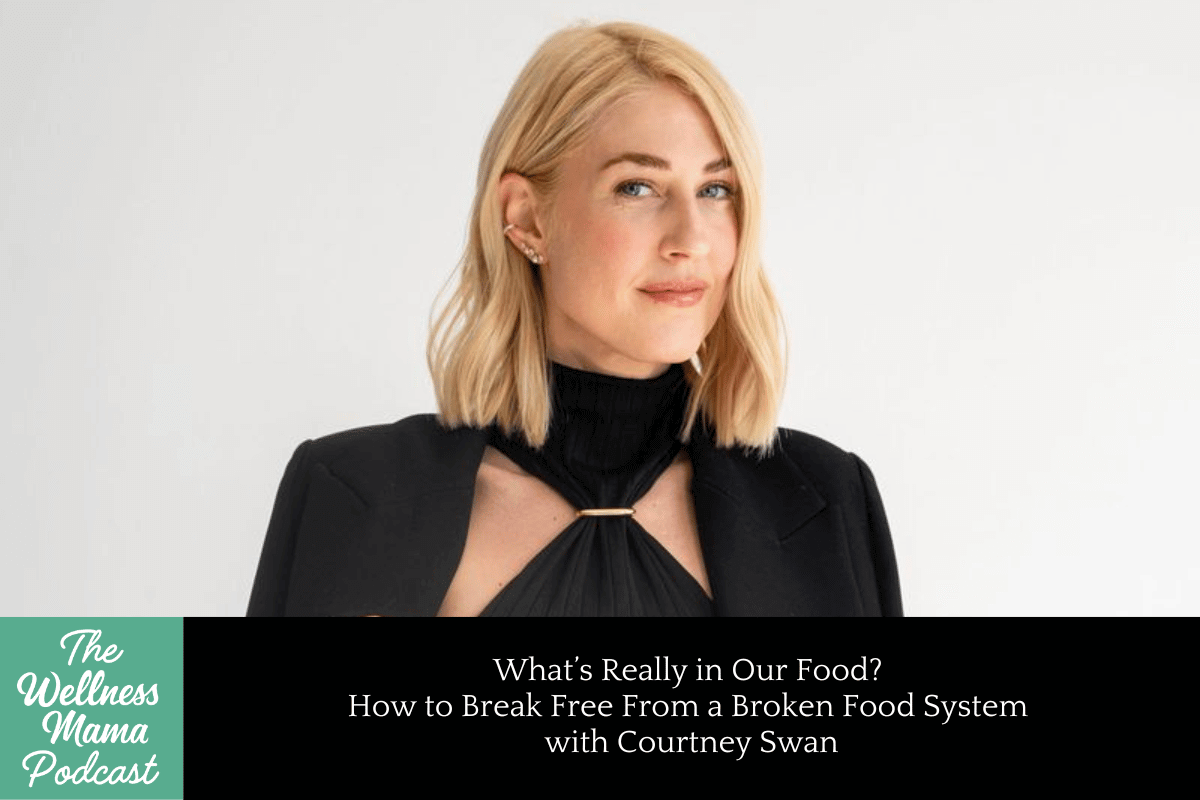
Hello and welcome to the Wellness Mama Podcast. I’m Katie from wellnessmama.com, and I am here today with Courtney Swan from Realfoodology to talk about what’s really in our food and how to break free from a broken system. And Courtney is an integrated nutritionist and a passionate voice in this space talking about regenerative agriculture, how we can all make small changes in our food that make a big difference.
She runs the website and podcast Realfoodology, which I’ll link to in the show notes and loves to challenge misconceptions around nutrition, food sources, sustainability, food policy, healthy living and more. And she began after she started suffering from some debilitating gut pain and some drastic health changes when she went to college.
And this led her to a deep passion about our food, nutrition, and especially our food supply, and she gives a lot of extremely practical tips. In this episode, I know that you will learn a lot. Let’s jump in with Courtney. Courtney, welcome. Thank you so much for being here today.
Courtney Swan: Thank you so much for having me Katie. I’m so excited to be here.
Katie: Oh, I am excited for this conversation and I feel like we’re going to get to go into so many important areas in this one simple conversation. And to start with, I would guess a lot of people listening are already aware of you. I’ll link to your many profiles in the show notes. People can follow you because you are always putting out such great content.
But I feel like for background for this conversation, I know that you’ve been a leading voice in trying to create positive nutrition and health changes in our country, and I would love to kind of delve into the reasons this matters right now more than ever. I know a lot of moms are right there with you, but why is this so critically important right now?
Courtney Swan: Yeah. Thank you so much I mean this is a really exciting time right now. I have been reflecting a lot recently on how long I’ve been in this fight and I started Realfoodology as a blog 14 years ago, which is really wild to think. So this has been a really long time coming and something that we have been hoping and praying that our government institutions would listen to and pay attention to. And you asked why this is so critical important right now. Well, 74% our American adults are obese or overweight and almost 50 of our children are obese are overweight.
I mean we’re seeing things like non-alcoholic fatty liver disease which is a disease that largely did not exist 50 years ago, is rising in in children right now. Diabetes is through the roof. Cardiovascular disease is through the roof, Nine out of 10 of the leading causes of death in America right now can be attributed to diet and lifestyle. So we are at this critical point right now where if we do not address what’s going on with our food system right now, we are going to be in really I mean we are we are we’re there. We’re already in the critical point right now and so we need to do everything we can to try to turn the ship around and get Americans healthier again.
Katie: Well, I know for me, part of my origin with Wellness Mama was reading that for the first time in two centuries, our kids would have a shorter life expectancy than we would. And I was holding my newborn son at that moment and it just struck me so hard that they would face what we’re now seeing all these rising chronic diseases that are avoidable.
And like you said, the majority, over 90% now of Americans are metabolically not healthy or have at least one marker of metabolic dysfunction. And from knowing you a little bit, I know that you also kind of had a personal origin story when it comes to this work. And if you’re willing, I’d love for you to share a little bit of what made this such a passion for you.
Courtney Swan: Yeah so I think a lot of people that come into this space come because they’re sick or they’re dealing with something and they get disillusioned by the our medical system. I think that’s like a common story for me. For me mine was actually the exact opposite I grew up with a mother who was making everything from scratch and I was very blessed and lucky to live a pretty healthy life growing up cause my mom really you know tried her best to feed me really healthy food and try to keep me off medication and antibiotics and all that whenever she could.
So when I went to college I had a complete 180 where I was you know having a fourth meal at Taco Bell and eating fast food and eating junk that I had never really eaten as a kid. I quickly was able to figure out like how the connection was between what I was putting in my body when I was eating and how it was making me really sick.
I mean I gained like 30 pounds and you know less than a year. I had fatigue I couldn’t study in school. You know I couldn’t pay attention in school. I was really struggling with that. I had cystic acne that I’d never seen before and so I was able to look back to where how I was feeling with my parents and when I lived at home versus then when I went to school and I was able to make that connection. And I got really lucky that I found a couple books early on that really just opened my eyes to the fact that what I was eating and putting in my body was having a direct connection and a direct effect on what I what I was feeling.
Katie: That makes sense and probably a huge benefit that you had such a solid foundation from childhood. I know like many people, like me included, got to un-pattern and heal a lot of stuff that I picked up in childhood,
Courtney Swan: Yes
Katie: and I know that we’re seeing this across the board and alarmingly, especially in children.
What do you see as some of kind of the biggest offenders or the biggest contributing factors to why all of these things are rising so rapidly?
Courtney Swan: Well, I would say first and foremost it’s really simple Katie. We’re not eating real food anymore is the problem. You know 60% of Americans calories are coming from ultra processed foods. Ultra processed foods are foods that have really long ingredient labels and these foods are not really resembling food anymore. If you look in and you read the ingredients in the back many of them have fillers, additives, preservatives so many non-food substances that have ended up in our food.
You know one of the really big things that just happened with the FDA and we I’m sure that we’ll probably dive into that more but is the food dyes I mean you look in the back of packages like um pickles for example have food dyes in there, have artificial petroleum-based food dyes in there. And it so I think a lot of people think what the food dyes, Oh it’s just junk and candy and you know that we shouldn’t be eating anyways. But it’s also in things like relish, it’s in yogurt. So largely what’s what has happened is that we’re not eating real food anymore And then you add on top of that the fact that there’s high fructose corn syrup in there which is linked to the obesity epidemic. We’re just and we’re also eating a ton of sugar. And so there’s just there’s a lot of different things happening right now but I would say the main issue is that we’re just not eating real food anymore.
Katie: Yeah, I’m right there with you and you’re right. The food dye conversation I feel like has really risen to the forefront right now. And I know some moms have had concerns about this for a really long time, and it seems like it’s finally entered the more mainstream conversation. I would guess a lot of people listening are already aware of the problems with food dyes, but for anyone who isn’t, can you just briefly walk us through why these can be so problematic?
Courtney Swan: Yeah so they are petroleum based so they’re a byproduct of the oil industry and there are concerning links to behavioral issues in children and also there’s very concerning links to cancer with these artificial food dyes. Most other countries across the world have already recognized that these food dyes are not good for us. In fact if there is American candy or American foods that have these food dyes like for example Fruit Loops if they end up in the UK or in Sweden they come with a warning label on there that says “May cause behavioral issues in children.” So a lot of other countries have already recognized that these food dyes are not good for us and yet in America for some reason we’re so far behind the curve on that. And recently on Tuesday the FDA just announced that they are going to be phasing all these food dyes out of the American food system which is a huge deal.
Katie: Yeah, that’s really drastic and I didn’t think I’d ever see that day, honestly. And I know a lot of moms are not waiting for the government to make these changes, to make them in our homes, which I love. I think moms are really driving the forefront of a lot of these changes we’re seeing and I love that.
I know another big one that you’ve talked about in depth is glyphosate and how this is also different in the US than many places in the world. And again, I would guess a lot of people listening have some awareness about this. But what are some of the big problems when it comes to glyphosate and all the compounds we use in farming here that are not used throughout the world?
Courtney Swan: Yes And I wanted to just make one point really quickly about the food dyes and just in general about mothers waiting for the government. So I’m the same way I’ve encouraged my audience for the last 14 years do not wait for the government to do anything. And this is on us. It’s our responsibility to take care of our health. I will say that something that I don’t think many people think about um I get many comments from people say oh just avoid it. You know don’t eat these. The problem is that these food dyes are in our School lunches across the nation. They’re also in nursing homes and they’re also in hospitals. So it’s easy for somebody to say just avoid it. But then people that are sending their children to schools that are feeding these food dyes they have no control over that. So I just wanted to say that it is a really big win especially for the lower socioeconomic families that do not have an option than to feed their children whatever is being fed at schools. And then same with people that are nursing homes and hospitals.
And this was something I had never really thought about until I started diving into it. So I just think it’s important for people to think about that and know that.
As far as glyphosate is something I’m incredibly concerned about. I’m really hoping that this is something that we will tackle in the next couple of years I know it’s something that Bobby RFK Jr is incredibly passionate about. In fact I found out about Bobby years ago because he was actually litigating against Monsanto which is the company that created glyphosate. So glyphosate is also known as Roundup, people have probably seen it in their in their garage. You probably have it in their garage and maybe right in their backyard. And I would urge you to throw that away if you have it in your home. It is an herbicide that is widely used and sprayed to kill off pests and well not pest cause it’s not pesticide but to kill off herbs. Um an herbicide so a lot of weeds and we’re spraying it very heavily in our food system right now unfortunately.
In fact it’s so ubiquitous that there was a recent study done and they found up to 90 something percent I think it was like 91% of Americans have glyphosate in their blood in their urine, we’re finding it in placenta. We’re finding it in breast milk everywhere because we are spraying it on our wheat after it has been harvested because it dries out the wheat and then it ends up in our grains that line our supermarket shelves there was a recent study done by the environmental Working Group released it I don’t remember who did the actual study they found 80 to 90% of popular grain products on grocery store shelves contained glyphosate. So I think things like Cheerios, Quaker Oats. So this is why I’m such a champion for buying and eating organic food because by law organic food is not legally allowed to be sprayed by glyphosate.
And the reason why glyphosate is so incredibly concerning right now is because there are very concerning links to cancer. The IARC which is the International agency for Research on Cancer through the World Health Organization has recognized glyphosate as a human carcinogen so it’s something that we are incredibly concerning concerned about and it’s also just it’s invisible. What I mean by that is meaning that you’re not going to see it on food labels even though it’s ending up in our food system and there’s a lot of things that we can do. I would say eat organic and also get to know your farmers and find out if they’re spraying glyphosate if you’re concerned about that and want to reduce your exposure.
Katie: And I know this has been talked about as potentially one of the reasons people can, for instance, who don’t handle gluten in the US can go to Europe and be perfectly fine with it because they don’t use glyphosate there. And I first became aware of this actually in high school on a school trip. I was in a farming area and they were showing us all these crops and like, look how awesome it is that we can keep all these plants away and these invasive plants by and….
It really struck me how it’s not like they’re just like lightly spraying this. It’s like they are dowsing the crops in it, like from either planes and helicopters or from these massive arms. I mean, it was completely drenched in this, and like you said, this is now so pervasive in our food supply. And you touched on something else that I think is really important, which is kind of the idea of misleading food labels because I know many people are very aware and trying to navigate this the best they can. And it seems like there’s also a lot of kinda shady things that happen when it comes to food labeling.
So even if we’re trying to be aware and read packaging, sometimes there’s ways things are hidden or mislabeled or like kind of greenwashed to make sure that we don’t actually know what’s in them. Can you talk about that and like how we can have more awareness in navigating it?
Courtney Swan: Yeah greenwashing is a is something you brought up and it’s really important for people to understand. So that I explain greenwashing is never take the front of the package as truth about what is in that product because the front of the package is a billboard for the company. They are trying to sell you a product and chances are the more Uh labeling there is on the front, low fat sugar free, you know all the different labels they slap on there, the more that are on there chances are the worse that the product is for you. Now that’s not always the case but um they’re often throwing that on there because they want to throw you off and they want to give the illusion that something is healthy and safe and good for you.
Oftentimes you’ll see uh you know rolling green pastures with chickens on the front and then you read the back and you see there’s canola oil and there’s things like BHT. So this is why I always urge people to just read the ingredients on the back. And most of the time when you are looking at an ingredient label if it is really long and it takes you a while to get through all the ingredients chances are that that’s probably something that you’re going to want to put back on the shelf. Things that you’re looking for in that label are real food ingredients that you recognize. I tell people often that if you’re going to buy things in packages read those ingredients. And if you could technically, like let’s say that you picked up a bag of crackers and you were like okay could I make these at home if I wanted to I’m not saying you have to but would you be able to buy all those ingredients that are on that label in the grocery store while you’re there? So, you know I always I always use simple Mills as an example because they always you know they use Rosemary as a preservative and so you would know where to buy rosemary in the grocery store. You would know where to buy almond flour. These are all things that that are real food ingredients. So that’s how I tell people to navigate it And it is it’s really hard and tricky right now to navigate this because there’s a lot of tricks that the food system implores on these products because they want to trick us and they want us to buy these products. And I would just say look for the real food ingredients.
Katie: Yeah, I think that’s a great tip, and like that alone can make such a massive shift if we all just did that. And another area that you brought up, I would love to go deeper on. Anytime I get a chance to step on the soapbox, is the topic of vegetable oils. Because this is a relatively new introduction to the human diet.
There’s some research in rat studies showing that vegetable oils are maybe a big contributor to the non-alcoholic fatty liver disease that you mentioned. In fact, even high carbohydrate or even refined carbohydrate diets without vegetable oils, rats did not get anywhere nearly as much fatty liver disease.
And these are so pervasive, I would say the majority of foods, certainly, if not upwards of 80% of foods and grocery stores have vegetable oils. So what’s your take on processed seed oils and the best way to avoid them, or if they’re, maybe they’re, they’re not as harmful as we think.
Courtney Swan: Okay That’s so fascinating Katie I actually haven’t heard that yet about the connection with non-alcoholic fatty liver disease. It makes sense though. You know a lot of this stuff is we have to zoom out and we have to look at has changed in the last 50 years in our food system. Our genes don’t change that fast If you look at photos from people in the early 1900s people look very different than they look today, and this is because we have changed our environment around us and we have changed what we’re eating.
And the thing with seed oils so seed oils it’s a whole it’s a trendy thing to talk about right now. Everybody’s um you know there and there’s also this kind of war in the wellness world right now about whether or not these are good for you. Here’s the truth about seed oils. I think the biggest issue is that we are eating them so much. Again same as similar as the ultra-processed foods I believe it’s around um it’s like 20% of Americans calories are now coming from these vegetable oils And if you look I’ll see if I can find this chart and send it to you afterwards, but I was really I was blown away by this. I saw this chart recently that showed that, before when we were you know thinner and we weren’t dealing with you know all this chronic disease and the obesity epidemic. We were getting the majority of our fats from animal fats.
So things like beef tallow um or olive oil which is obviously not an animal fat but we were eating real food fats and then something switched and now all of a sudden the you know we’re not really consuming tallow anymore. We’re not really consuming olive oil in the same amounts that we are consuming things like canola oil and it’s because we replaced those fats with Canola oil and industrial seed oil and one of the reasons that I think that it’s such a big issue is one because we’re eating so much of it two, it offsets the ratio of omega threes and omega sixes in our body
So we all know this this is very basic nutrition. Omega threes to omega sixes need to be in a ratio in our body and it should be about One to four Americans right now are eating one to 15 and up to one to 20 in the ratio. So what’s happening is we’re offsetting that ratio of omega threes for omega sixes in our bodies. And what happens when we’re doing that is that it’s increasing inflammation in the body. So we’re eating too much of them and we’re throwing off this ratio and we need to get back to eating more things like tallow and olive oil.
Katie: Yeah, that’s such a good point that in a sense, especially with this, the dose makes the poison and like the small exposure in a meal at a restaurant is likely not going to cause a problem. But that 20% of our calories coming from this is a big problem, especially when we know these are foods they feed to livestock to fatten them up and we’re consuming them in huge amounts.
When you talk about the Omega-3 and Omega-6 ratio, I’ve worked with a company called Function Health, and this actually seems to be one of the biggest problems that flags on most people’s lab results is that their omega threes are low and that ratio is off. And so I think this is like one easy area to focus on that can make a big impact.
We talked about, of course, we can all make changes within our own homes, and I think that’s really important. And to your point, you’re doing this work on a broader scale and trying to create change at the government level, which I think is also important. And I would guess a lot of people listening don’t understand kind of the role of big agriculture, the kind of relationships that exist below the surface there and how government subsidies work that are kind of contributing to these problems we’re talking about.
So for anybody not familiar, can you kind of walk us through why the government side of this is actually a big problem, too?
Courtney Swan: I think you know so let’s just think really basic agriculture. This is literally what feeds us as a population right. What we’re growing um is we’re feeding is what’s feeding us. It’s very basic, but the problem with big agriculture and our government is that a long time ago we created these subsidies where we pay our farmers a certain amount of money from taxpayer dollars to grow specific foods. So what we’re paying for right now in subsidies are corn wheat and soy. And what happens as a result when we incentivize people to grow more of that is we have an over surplus of it. It’s also why we give why we feed corn wheat and soy to our livestock cause we have an overproduction of it. And so and we also found out that we could feed those grains to our livestock to fatten them up and send them to slaughter much quicker. And so it’s you know a win-win for these companies. Um cause they’re able to send them to slaughter much quicker. But we also know that it fattens them up.
And corn wheat and soy are now in all of our foods because of this. Pick up any ultra-processed packaged food and you can read a label. It says may contain corn wheat and soy or just it may sometimes say just you know may contain wheat may contain corn. It’s in all of our foods because we are paying we’re incentivizing farmers to grow more of it. There’s an added layer to this that is incredibly concerning to me which is the GMO connection. So over 90% of our corn is genetically modified and over 90% of our soy is genetically modified. And what that means is that these corn and soy seeds were genetically modified to be able to withstand glyphosate. So that allows our farmers to just spray glyphosate, similar to what you said earlier where you just saw this at a farm or they just spray these fields all over with glyphosate and it allows the corn and the soy to still grow and everything else around it gets killed or dies you know.
Katie: Yeah, and there’s obviously gut implications there as well. I know you’ve done videos on this before, but when, especially when we’re consuming this in large amounts in most of our food supply, it seems like that has a really dramatic impact on the variety of our gut bacteria. And of course we know the gut is the second brain and responsible for a lot of aspects of health. But can you speak to that a little bit of like how we’re seeing even gut changes kind of in a population wide scale?
Courtney Swan: Yeah and you know okay so this is a full circle moment here. So glyphosate we know also acts like an antibiotic. It’s killing off not only all the good bacteria in our soil but it also is killing off all the good bacteria in our guts. And people are wondering why everybody’s having, you know gut issues. I actually I testified to the Senate last fall in this nutrition round table. One of the things that I brought up was there is a very concerning theory out there that um there’s a uh type of corn called BT corn And essentially so this comes back to the agriculture. So BT corn is corn that has something called BT Toxin in there. Now that BT toxin Uh makes the insects stomachs explode that eat it. And this is how it acts like a pesticide because you know if the insects try to eat it the insects die. And so then that’s how we get rid of our our insects But then people are eating this BT corn and now everybody’s getting something called leaky gut syndrome. Well what is leaky gut syndrome? It’s little holes in our intestine. So these pesticides and these herbicides that we’re eating in my opinion are one of the larger issues that we’re dealing with right now. And it’s mind blowing to me that we know the implications of these on like let’s say insects and other living beings for example.
But we somehow didn’t think that they would affect human health for some reason And these are toxic chemicals that we’re spraying on our food and that we’re also allowing in these seeds. And then we look at the rising incidents of gut issues I mean you know look around and I mean I personally know so many people in my life that that struggle with eczema, psoriasis, um asthma. All of these things especially the skin issues are directly linked and connected to our gut issues.
Katie: Yeah, and especially in kids, I feel like we see that so often and I’ve heard from many moms who have had that. And then with dietary changes and like being aware of these factors, they’ve been able to reverse a lot of those issues and really clean things up because of how impactful the gut is. And we’ve touched on a lot of different points related to kind of why we’re seeing some of these changes. I’d love to go a little deeper on like the historical context and maybe bring in like some diet culture myths and talk about the convenience food era. Because like you said, you know, 60 years ago we weren’t seeing these problems.
Like our great grandparents probably never counted calories. They weren’t like running checklist or having to take a million supplements to stay moderately healthy. So from a historical perspective, like why do you think we’re seeing so many of these shifts so quickly and what are the pieces within our control to start shifting things.
Courtney Swan: Yeah Oh my gosh Okay, you brought up so many things that I’m trying to think of how like where I can start with that. So I would say largely if you compare the difference between maybe like our great grandparents and what they were eating and us today. It’s interesting how this all comes full circle and it’s all connected. It’s all holistic right? So I mentioned glyphosate and glyphosate is in an antibiotic. So one of the things that we are incredibly concerned about is the soil health because we are only as healthy as our soil is.
And what’s happening there is when we’re spraying the soil with all these pesticides and herbicides, it’s killing off this whole ecosystem that exists in the soil. Good and bad bacteria that lives in that soil that’s actually creating food for our plants. Now what are we dealing with today that our great-grandparents weren’t really dealing with on such a large scale: The nutrients and vitamins and minerals in our plants are declining and you can look this up. This is something that we’ve been talking about for a while.
When we are killing off that whole ecosystem that exists in the soil the bugs and um the worms and everything that exists in that little ecosystem that gives the plants the new nourishment and food that it needs, our plants are now of amazing vitamins minerals and nutrients that we need in order to be healthy.
And it’s why so many of us are having to supplement now because you can look at all the studies that show that our vegetables are our fruits and vegetables are actually declining in vitamin and mineral content and everybody’s scratching their head going why. Well it’s very obvious to many of us that are studying this. It’s because we’re killing off all of the good nutrients in the soil and as a result our plants are not going to have as much vitamins and minerals and nutrients.
And something really really fascinating that I love about regenerative agriculture what we have figured out is that if we don’t put all these inputs in the soil like the glyphosate the pesticides the herbicides that are killing off all that good bacteria in the soil and killing off that ecosystem, there’s this really beautiful process that happens in nature where and it’s so amazing how God designed this so perfectly. Carbon is actually pulled out of the atmosphere and brought back down into the soil. Carbon is actually food for the soil but when we intervene and we destroy the soil, it’s it gets in the way of this beautiful process called carbon sequestration which actually brings the carbon back from the atmosphere into the soil to feed the plants. Now as a result we’re all having to take vitamins because all of our food is devoid of vitamins, minerals and nutrients. So that is a I think a really big one And you’d asked me something else that I’m forgetting now.
Katie: About the like diet, culture and convenience food era and how that’s contributed.
Courtney Swan: Okay so this is something I’m so incredibly passionate about because I see there’s this pushback right now against healthy eating, right. I see you know well-meaning registered dieticians I don’t know why but I’m seeing it from a lot of them. They say that if we eat this way that if you eat organic and you’re avoiding the chemicals and avoiding the pesticides that you will develop an eating disorder. This is absolutely crazy to me because we look at how addictive these ultra processed foods are, I mean there are literally food scientists that are hired by companies like think about Pringles, it’s literally in their name Once you pop, you can’t stop.
These food scientists are creating these chemicals and these foods to make them so incredibly addictive that once you pop you can’t stop eating them. I think everybody listening knows that feeling of opening a bag of Doritos and feeling like you literally cannot stop eating them. And it doesn’t even matter how full you are. Like I could polish off a whole bag of Doritos and then still be hungry afterwards because these are what we call empty calories that do not fill you up and they don’t nourish you.
And so to me, I think it’s absolutely crazy to say that it’s you know diet culture and dangerous to be avoiding these food chemicals because, and there’s all this conversation of willpower right? Oh it’s just willpower. These are chemicals that are hijacking your brain. They’re literally overriding your brain. This is not an issue of willpower. I don’t think anybody has ever had a hard time binge eating steak or binge eating salmon like there’s these satiety hormones that come up, right? The ghrelin and the leptin that tell you when you’re full, when you’re full, tell you when you’re hungry. And we’re overriding those very hormones and our own pallets we’re hijacking them with these chemicals these food-like products. And it’s why so many people are having a hard time putting these ultra processed foods down because they were quite literally designed that way. They were designed so that these food companies could make more money.
Katie: Yeah. And I feel like a lot of people don’t understand that and how much goes into that on the backend that we’re not even aware of. And it touches on something else that I’ve heard you talk about in videos and I would love to dispel, um, because we hear a lot about calories and calories out and there’s a lot of nutrition experts and trainers that I see talk about that all the time.
And my understanding, I’ve come over the last few years to understand is it’s really, um, I call it my protein and micronutrient theory of health in that it’s not about just the calories at all, but if our body isn’t getting the nutrient diversity it needs, it will continue to crave food for survival. It’s on our side, it’s trying to get us to eat enough nutrients.
So I feel very strongly that it’s not as Simple as calories in, calories out. Not that calories don’t matter, but that we’re only kind of acknowledging half of the story. But I would love your perspective on this because I’ve heard you in videos and I feel like you explain it so well.
Courtney Swan: Oh thank you. You know, it’s funny that you brought this up. I have this sticker sitting on my desk and it literally says count chemicals not calories. So you know I think every woman can at some point in their life relate to this. And I remember what it was like in my early twenties I had gained weight in college, I was eating slim fast Bars and lean cuisines and you know avidly counting my calories and I was in a prison. You’re literally in a prison when you sit there and you try to count your calories day in and day out. And I was also starving every day. And then as a result you know at the end of the day I think everybody knows what it feels like to have not eaten enough calories. And then or honestly I don’t even think it was calories to not have eaten enough nutritious foods. And then I find myself just like you know binging everything in my pantry.
I was able to stop all of that Like it never became an issue for me because I quickly realized oh I’m just not eating food and my body is not getting the nutrients that it needs. It’s not this is not a thing about calories and this is where we’ve been lied to. And again like you said I am not saying that calories don’t count. They absolutely play a role. At the end of the day if you overeat more than your body needs and is able to utilize throughout the day that is very basic like yes of course you are going to gain weight and you’re going to struggle and deal with the consequences of that.
However part of the reason that people are overeating is because they’re eating, we’re overfed and we’re undernourished. Is essentially what’s happening right now. We’re eating all of these dead food-like products that are just chemicals and contain no nutrients whatsoever. And then our cells our cells are literally begging for nutrients. Because think about it – bodies need nutrients and vitamins and minerals and protein and fats in order to run throughout the day. You know in order to just keep this whole our body moving and working properly. And so if we’re not giving it the very basic needs that it needs in order to run then we’re going to of course we’re going to be starving.
Katie: Yeah, that makes so much sense to me. And learning that shift internally was so drastic in the way I even approached health because like you explained, we cannot out willpower our survival mechanisms like our body’s doing that because it’s on our side. And if we can befriend it and work with our survival mechanisms and not against it, it’s much more pleasant and much more effective. And I, for me, I kind of think of the micronutrient density first now. And I try to look at and optimize, how do I choose the most nutrient dense foods at every given meal? Not how do I restrict calories. And even from a mindset perspective, that feels so much more empowering.
And you touched on regenerative agriculture a lot, and I love that we’re also talking about this more in the mainstream conversation, and I’ve heard you speak before about how even though they’re positioned to be organic and regenerative options are not a luxury. And I would love for you to kind of bring that reframe to this conversation because I feel like that’s an important step, especially for the majority of moms listening, who are the food decision makers in the household.
Courtney Swan: Yes absolutely. And I do want to say one more thing about what you just said is you know I had mentioned earlier that counting calories and being so concerned about just the calories and not actually looking at the quality of the food. I mean I was in a prison. And I think most people can relate to that now I have never had a more healthy relationship with food. And this is why this whole you know notion of diet culture makes me really upset. And I put quotes diet culture because I hate that conversation so much because it’s not it’s not actually helping people in my opinion. If you can encourage people to really focus on the nutrient density of their foods and they’re actually able to be full and satisfied throughout the day then they’re going to have a much healthier relationship. They’re not going to be chasing all these packaged foods and chasing this hunger all day that they feel like they have no control over.
Because when you’re eating satiety inducing foods things like steak and avocado and um you know all these nutrient dense foods that are going to actually keep you full and satisfied throughout the day you’re going to find and realize that you’re no longer in this prison of just chasing hunger all day and trying to you know keep in a certain amount of calories. It’s like I’ve never had a healthy relationship with food ever in my entire life. And it just truly is so freeing when you’re able to be in that position.
Okay so regenerative farming this is something that I’m very very passionate about as well I love it Everything you’ve been bringing up, I’m like yes I’d love to talk about this stuff. So there’s a and there’s actually two really amazing films. One just came out this week on Amazon Prime called Common Ground And then the uh the makers of common Ground also created another film that I believe is still on Netflix and it’s called Kiss the Ground. Now they are the reason that I’m so passionate about regenerative farming I watched these films years ago and it really sparked something in me because, you know for a long time waking up and realizing that everything we’re doing about our food is backwards and corrupt and there’s so much corruption and there’s so much that we’re doing wrong.
And when I discovered regenerative farming it gave me so much hope. And I think this is why it makes me so happy is because there is so much hope. And the thing is we have a solution to all of this Everything we’ve been talking about what did I say earlier It’s all connected and it’s all holistic and it all starts with the way that we’re growing our food. That is number one.
Regenerative farming, what it is, is it’s essentially working with nature instead of against nature. What we’re doing right now in conventional farming is working against nature. We’re working against God right now and we are spraying everything really heavily with pesticides We’re tilling the soil meaning that we have these machines that go through the soil and they rip up the top soil and I don’t have a ton of time to go into all the details of that, so I would encourage you to watch Kiss the ground to understand why that’s so important.
But essentially what we’ve learned is there’s so much minerals and nutrients in this ecosystem that I talked about earlier in that topsoil that we need for our plants not only to survive but also to get the nutrients that they need. What they found is that when we nurture the land and we work with nature what happens is that we create this beautiful ecosystem where everything is able to thrive. The food has more vitamins and minerals and nutrients. It’s pulling carbon out of the atmosphere. And so it’s this whole process that happens.
And what happens is you look at the soil in conventional farming which is we’re tilling we’re spraying everything with everything with pesticides it looks dead. Honestly, it starts to become like sand. And then you know if you have any…you know let’s say like a I’m trying to think of an example, like a tornado that comes through and just the soil’s just gone because it’s basically become deserted and so there’s no resilience there either versus when you have regenerative land the soil is rich and deep and dark and it goes really deep into the ground and so it’s able to be more resilient when you do have you know natural disasters that happen like let’s say for example so it also creates a more resilient food system.
And so what happens as a result of all of this is that we also get more nutrient dense food and we get just a better ecosystem and we’re actually taking care of the land. So I’m incredibly passionate about regenerative farming and it also gives me a lot of hope because there’s a lot of farmers right now. Joel Saliton, Gay Brown um there’s so many of them in the field right now Will Harris that are doing it on large scale and they’re showing us that it is possible because there’s this argument, oh well it’s not possible Conventional farming will never quote unquote “feed the world.” It’s actually the exact opposite because what’s happening is we’re creating a more sustainable farming system that can actually withstand everything else that we’re dealing with versus a very, I don’t think people understand how fragile our food system is right now.
Katie: Such a good point, and I will link to those documentaries in the show notes. I highly encourage watching them as well. And one thing I love about your platform is you don’t just talk about these things in a conceptual way, but you’re always giving tips for people on actually implementing these changes and being able to see really noticeable results, even from small shifts.
It doesn’t have to be that you change everything overnight. So I’d love to get a chance to kind of talk, touch on some of those points that you talk about. And of course I’ll link to some of your videos as well. But I’d love to start with kind of an 80/20 of top level like, what are some of the ways to start, what are the easiest ways to reduce our exposure to these harmful things and to increase our micronutrient consumption and the density of nutrients in our food.
Courtney Swan: Yeah, I would say first and foremost I mean turn it into a game, right? See how much real food you can eat in a day, try not to buy as many things in packages. Now look, I’m a realist And I believe that we can also buy things in packages because I know we’re busy. I mean I’m busy like I can’t buy everything just you know whole real foods and then just cook everything from scratch right So thank God we have companies that are creating healthier for you food that we can buy and that can be convenient.
But you know unfortunately we I think there also needs to be a little bit of a reframe here and that we need to recognize that convenience also is killing us. And we are not spending the time that we used to in the kitchen and we’re not recognizing and realizing that feeding ourselves is one of the most basic needs and it’s one of the most important needs that we have.
So it’s it is confusing and wild to me but I also get it cause we’re busy but that we’re not prioritizing this. You know it’s kind of a last minute thing Like I’ll just go through the drive-through and then I’ll just eat it on the way you know to something else instead of recognizing and realizing that we should be prioritizing this because it’s our health. I completely forgot the question because I went on off on such a tangent. Oh wow, where should people start Yeah Okay So sorry Sometimes I go off on these tangents and then I’m like oh what was the question again.
I think a really easy way to start is go look in your pantry. Start reading ingredient labels I think if you can start committing to reading ingredient labels. And I will tell you if you’re new to this and you’re just starting out I would imagine that you your audience is pretty well versed in this but for the people that are new to this, know and recognize that maybe the first couple trips to the grocery store will be longer and that’s okay.
Honestly when I was first learning and starting out, I would spend like hours in the grocery store reading ingredient labels and I actually loved it. I had a lot of fun with it. But just know that it will not always be that way. You learn the foods that you love and the foods that are you know cleaner and healthier for you and it won’t take you so long. But in the beginning, it may take longer and I would audit your pantry. I would go and I would look at the ingredient labels of every single thing in there. Don’t just take their word for it on the front. It’s a billboard. They’re trying to sell you the product. You want to look at the ingredients.
And I said this earlier but I will mention it again If you can read all of those ingredients and you recognize them as real food those that would be considered a packaged food that you could eat and is considered to be safe and clean. If it has things like BHT for an example I would toss that out or not buy it because that is a preservative. Preservative that is linked to colon cancer. Also too if you go to my website realfoodology.com and you plug in your email I email you my grocery guide. It’s really simple. You can save it on your phone and then you can go in the grocery store and you know if you’re thinking back like what was that that Courtney said about this one thing. Pretty much everything that I use to navigate the grocery stores all on there on a sheet that you can easily take with you to the grocery store and reference.
But I would say the yeah the number one is just start out start reading real food ingredients and then start trying to cook more at home if you can. If you don’t yet you know I think a lot of people spend way too much money post mating and ordering food and eating out and unfortunately the reality is that we’re spending a lot of money eating out for conventional food that’s not even organic that’s not even sprayed. It’s not even grass fed. It’s not even the high quality.
If you were eating at home and buying fed meats organic food it would actually be cheaper for you to make all those meals at home with higher more quality ingredients then it would be for you to be eating out every meal. It is significantly cheaper when you think about it from that regard. Also too if you’re on a budget and you are concerned about glyphosate and organic there’s something from the EWG the environmental working group called the Dirty Dozen. They have the Dirty Dozen and the Clean 15 I would use those as a way to navigate the grocery store. The Clean 15 are foods that are generally on the on the lower end of pesticides and those would be things that you could buy conventional and non-organic feel pretty confident that they’re going to be at least lower on the pesticide load versus the dirty dozen. These are foods that are the most widely spread and most highly spread with glyphosate and other pesticides and herbicides And those are the ones that you would want to buy organic
Katie: I love that. And I was going to ask you about the budget side too. Because I know that’s a concern for a lot of moms especially. And I think for me that was actually very instrumental in why I do cook almost every meal at home because it’s cost prohibitive to take six kids out to eat all the time.
But I’ve learned over time, especially with teenagers who eat an insane amount of food, is like getting bulk grass-fed beef from a local farmer and keeping it in the freezer, they can make things like beef patties as a snack and it’s always available. And over time, that actually is cheaper than if I had bought processed snacks and they were eating snack foods.
And I feel like that’s an initial, like relearning and that switch, but it really does save money over time. Which brings me to, I know that you’re a huge champion of supporting local and regenerative whenever possible, and I love that we’re seeing more people do this, but any tips for if people are not already making that shift to prioritizing local and regenerative when possible?
Courtney Swan: Oh wait say that again How can they switch over….
Katie: Yeah, or just any tips for how we can support local and regenerative farms. How can we find them? How do we kinda make that switch?
Courtney Swan: There’s an account called I believe it’s called My Health Forward and it’s a college student actually that’s really passionate about regenerative farming and he just he’s either releasing it or he just released a guide on his website where you can find regenerative farms near you. Because he’s incredibly passionate about this as well and wants to get more people involved. So I would just start doing some Googling. I was very blessed and lucky to live in California for 10 years and I was going to the LA farmer’s markets and I was just asking directly, I was asking the farmers like, “Hey how do you grow? Do you have a regenerative farm? Do you use pesticides? Do you use glyphosate?”
So if you have the ability to go to a farmer’s market I would start there and I would start asking around because I just found my favorite farmers and I was just going to them every weekend and buying directly from them. Because it’s very cool. You can you can buy directly from a farmer that you know lives an hour from you. Another way is just Google where you live and Google regenerative farms near me and see if you can find anything like that. Or even just Google Organic Farms near me. I know Um where my mom lives in San Antonio uh they don’t have an active farmer’s market all the time and she has found, she has a meat guy who drives in like once a month from a ranch like a you know little ways out of San Antonio and everybody comes to meet him and they pick up meat from him.
So there’s so many different ways around this I know there’s also, I am in Denver right now and there’s a farm that does a CSA Box. CSA Boxes are amazing It’s also a great way to get a variety of stuff because every month you’ll get you know a box of fruits and vegetables that are in season and meats and eggs depending on what whatever your CSA box looks like. And it’s a great way to get consistent local Produce and eggs and meat from a farm near you. And again I would just Google you know Google where you live and Google CSA box. And that would be another great way.
And something you said too that I wanted to touch on about the nutrient density of things and the budget I don’t think people understand Katie the cost of these ultra processed foods they’re not cheap anymore. Fast food is not cheap anymore. In fact I did a series on my podcast where I was buying foods from fast food popular fast food places So I’ll use Taco Bell as an example We bought the cheesy Gordita Crunch meal and we priced it out. And then we went to a local grocery store as like a or it was like a Vons or Ralph’s or somewhere like you know it wasn’t like a Whole Foods it was just like an accessible grocery store that anybody can go to. And we bought every single ingredient that was organic to make the cheesy gordita crunches at home. Not only was it cheaper every single time we did it and we did McDonald’s, we did Taco Bell, we did a couple of them. It was cheaper to buy all the ingredients organic and to make that meal at home.
Then on top of that we also had leftovers So then we were able to use those leftover ingredients to then make something else like a Taco Bowl or whatever it was the next day. So you know when you talk about budgeting and the expenses of everything, we’re paying for the convenience of this stuff. We’re paying for the convenience of things like fast food and things in packages. So if you can really get back in the kitchen and cook more if you have time and the ability to do that you will save so much money And if you’re buying nutrient dense foods like beef and avocado and you know carrots etc versus just buying a bag of tortilla chips, you’re going to go through, you’re going to be buying so many bags of Doritos because they’re not going to be full and satisfied versus if you’re giving your kids real nutrient dense. Buy them meat sticks, buy them things like that that are actually going to fill them up and give you more of a bang for your buck as far as nutrient density goes.
Katie: I love that. I feel like, yeah, kids especially naturally will not overeat, like you said, steak or ground beef or even fruit, like there’s a, your body’s hormones kick in with that. I will say like my kids can go through an astronomical amount of raspberries, for instance. But kids are naturally could have already have that so tuned in if they don’t lose it.
And I know you have so many practical guides. I’ll make sure I link to a lot of your resources in the show notes. But in our last couple minutes, I would love for you to just touch on, I’ve heard you talk about the idea of progress, not perfection. And I know we’ve talked about a lot of things and hopefully brought hope and awareness, not any stress of people like.
Feeling like there’s a lot to change, but I’d love to end by talking about how even little changes can make such a big difference. And it really is about us all making progress and not having to be perfect at this.
Courtney Swan: Yes It’s all about the progress and it’s all about consistency. So this is what I like to remind people. It’s not about perfection. It’s not about living in a bubble. It’s not about not going out to eat with your friends because you’re concerned that they’re not using organic food. I mentioned earlier I think I have a very healthy relationship with food. If my friends are going out to eat somewhere at a restaurant that I know uses canola oil, I know they use seed oil and they’re not using organic produce, I don’t decline that invitation I go and I say you know what thank God I’m buying and eating organic when I’m home I’m avoiding seed oils whenever, you know humanly possible not eating them on a consistent basis.
My body is resilient and it will be okay if I have this meal with my friends because I think we also forget the power and just how healthy it is to have a good meal in community with friends. That is also healthy. You it’s healthy to be in the world to have community to be with your friends to have a connective meal with people that you love. So there that is also very important and I don’t want people to lose sight of that and think oh I can’t ever eat out again because they don’t use organic produce and they’re using canola oil. I think I know what you brought up is something that I say often to my audience is it’s not about perfection. It’s not about trying to live in a bubble and avoid all these things. Look we have to live in the real world right? And we have to know and trust that if we’re doing the right things and we’re consistently eating healthy nutrient dense foods and taking care of our bodies we have to also have to trust in the resilience of our bodies.
I will say one more thing too, cause I know a lot of what I brought up is scary especially the glyphosate piece I know concerns a lot of people. Again our bodies are resilient and there are things that we can do in order to support the detoxification pathways of our bodies. And this is something that I like to do often. I sauna a couple a couple times a week. If you have the ability or the budget to get as sauna Um great. A lot of people have saunas at their gyms. My gym has a sauna that I can go use, but if you don’t even have the ability to do that something as simple as putting Epsom salts in a warm or like a pretty hot bath obviously you don’t want to be scalding yourself but like hot enough that it can work up a sweat. That’s also a great way to detox and get this stuff out of your body. Also exercising gets your lymphatic system moving. You can work up a sweat. You’ll get a lot of these toxins out of your body. But essentially I just like to remind people that you can also support the detoxification.
But essentially talking about you know the resilience of the body and just know and trust that you’re doing the best that you can I also don’t want to create guilt. I don’t want people to beating themselves up and I also don’t want them to look back with shame and guilt for decisions and choices that they’ve made in the past. Look, we’re all doing the best that we can and how can you possibly know the things that you don’t know until you know them right?
So I also encourage people to practice kindness and compassion for yourself Like you’re doing the best that you can. You did the best that you could with the information you had at the time. And now that you know better you can do better. And also trust in your body’s resilience and do the best you can buy the healthy foods, you and your kids are only going to eat the things that you buy that are in your home. So try your best to only bring in nutrient dense really good healthy foods in your home. And then when you’re out in the world you know have that pizza have that chips and guac and try to remind yourself and remember that your body is also resilient and just do the best you can.
Katie: I love that as my friend Lauryn says, humans are nutrients. And I’m with you of like, I won’t miss the chance for connection with other people just because of food quality. And I know that at home I have the choice to make sure food’s really nutrient dense, and I feel like we’ve covered so many amazing topics in this one conversation.
I will of course link to all the places people can find you and keep following you. I love your content. Thank you so much for your time and for being here today. This was such a joy.
Courtney Swan: Thank you so much Katie I really appreciate coming on and um yeah thank you for the opportunity
Katie: And thank you as always for listening, and I hope you will join me again on the next episode of The Wellness Mama Podcast.
This episode is brought to you by NativePath and in particular, something I have been experimenting with and really, really loving lately. And here’s what you need to understand. A lot of us think calcium is important for our health, especially for our bones. But is this actually true? Bad news. It turns out maybe not, or at least there’s more nuance here.
One of the largest bone health studies ever conducted followed thousands of women taking calcium and oral vitamin D daily, and the results were surprising, but not in the way you would think. They saw no significant reduction in their risk of fractures, and they saw no improved bone density. So all those calcium pills might not be doing what we think, and it turns out they might actually be counterproductive.
But here’s where it gets interesting. A brand new study found that women who did one thing every morning consistently for six months gained 7% bone density, which is massive. This is the same amount of bone mass the average person loses over the course of five years after a certain age. So what did they do?
It was not a medication or even a workout. It came down to one simple thing added to their morning routine. And that’s why a lot of people, especially people over 50, are making this one simple change and seeing massive results. I’m sure you’re probably curious what it is, and it’s a particular protein from one of my favorite brands called NativePath.
And they’re offering all of you up to 45% off of this, plus free shipping and a free gift. Right now you can visit them here to find out what it is and how to implement it and save up to 45%. So again, that special site for 45% off is savewithnativepath.com/wellnessmama And see why people are adding this to the routine with amazing results.
This podcast is brought to you by Hiya for children and especially I love to talk about their new greens line for children. Now, I have tasted these vitamins and they’re delicious, and my kids are the ones who really love them though. And I love that they’re getting the nutrients they need without the sugar because most children’s vitamins are basically candy in disguise with up to two teaspoons of sugar and dyes and unhealthy chemicals or gummy additives that we don’t want our kids to have.
So Hiya created a superpowered children’s vitamin that’s chewable, without the sugar or the nasty additives and it tastes great. My little ones love it. They especially are designed to fill the most common gaps in modern children’s diets to provide full body nourishment with a taste kids love. And it was formulated with the help of pediatricians and nutritional experts and pressed with a blend of 12 organic fruits and vegetables, then supercharged with 15 essential vitamins and minerals, including vitamin D, B12, C, zinc and folate among others.
It’s also non-GMO, vegan, dairy free, allergy free, gelatin free, nut free, and everything else you can imagine. I love that they test every single batch with third party testing for heavy heavy metals and microbials in a qualified GMP compliant lab using scientifically validated testing methods so you can be completely at ease knowing it’s safe and nutritious and it’s designed for kids and sent straight to your door so you don’t have to worry about ordering.
My kids really like these and I love that refills show up on schedule with no stress. Also, again, honorable mention to their new greens because if you are tired of battling your kids to eat more greens, their Daily Greens Plus Superfoods is a chocolate flavored greens powder designed specifically for kids and packed with 55+ whole food ingredients to support kids’ brains, their development, their digestion, and kids actually like it. We’ve worked out a special deal with Hiya for the bestselling children’s vitamin. Receive 50% off your first order. To claim this deal you must go to here. This deal is not available on their regular website. To get your kids the full body nourishment they need.





Leave a Reply