Read Transcript
Child: Welcome to my mommy’s podcast!
Katie: This episode is brought to you by BIOptimizers, and I love this company. And specifically today I wanna talk about one of the favorite things that they make, which is called Masszymes. So let’s be real. We all kind of start this part of the year saying, we’re going to eat cleaner, train harder, feel lighter.
But it’s not just what we eat and what we do, it’s what we absorb. And if our digestion is sluggish, the body just can’t keep up. And this is why I love Masszymes all year, but especially this time of year because it’s a simple digestive ritual that’s made a huge difference for me. It’s loaded with 18 enzymes, including four times more protease than top competitors, to help us break down dietary protein, carbs, and fats efficiently.
And I’ve shared before, I’ve done a whole episode on enzymes and how this was really, really impactful for me personally. But this means that we get better nutrient absorption, less bloating, and more real energy from the food we’re already eating. I’m also a big fan of nutrient loading and really maximizing that in our food too.
And enzymes help us get the maximal benefit from this. It’s this hardworking, yet smooth enzyme blend, and it’s been a favorite of mine for years, and a customer favorite for over 20 years. It’s a ritual that your stomach will thank you for anecdotally. I feel like I really don’t get sick now that I have made these a regular part of my routine.
A lot of people find they don’t have post-meal food hangovers or bloat after taking these, just clean energy to crush goals all year long. For a limited time, you can save up to 26% off their products and bundles during the New Year New You Sale by using my code wellnessmama at checkout.
And select bundles are on sale for up to 45% off, so you can get a massive discount there. Visit bioptimizers.com/wellnessmama and use the code wellnessmama at checkout. To get the best deal on Masszymes and all BIOptimizers products. So that’s bioptimizers.com/wellnessmama and the code wellnessmama.
So start 2026 with a stronger gut, more energy, and better digestion.
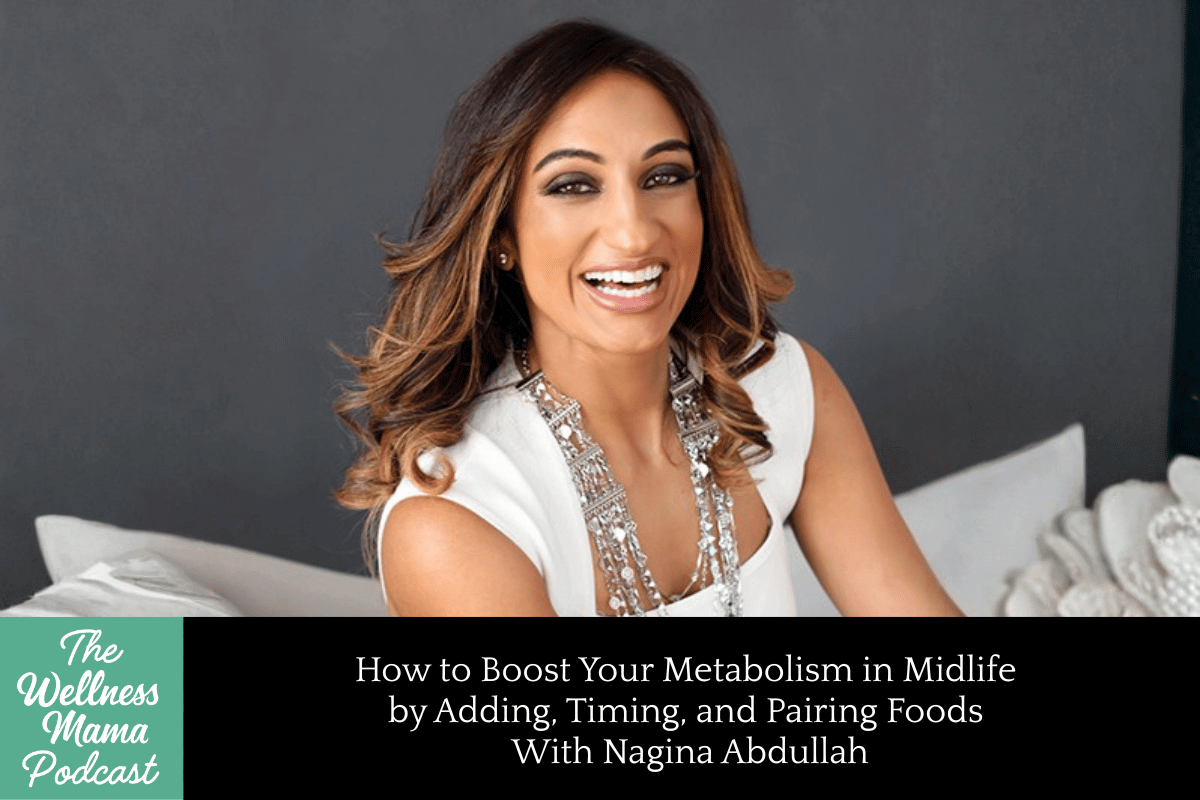
Katie: Hello and welcome to the Wellness Mama Podcast. I’m Katie from wellnessmama.com, and this episode is all about how to boost your metabolism in midlife, especially, by adding timing and pairing food, so not about restriction, and some really helpful key takeaways in this episode. I’m here with Nagina Abdullah, who is a weight loss coach for women in midlife, and founder of the top rated website, masalabody.com, which I’ll link to in the show notes.
She has a degree in molecular and cell biology from UC Berkeley. And is a graduate of NYU. She’s helped thousands of women in midlife to successfully lose weight permanently. And this episode really goes deep on her expertise related to metabolism. And specifically, why we often need more of certain key things in order to keep our metabolism strong in midlife, and we often get a lot of incorrect or conflicting information about this.
So lots of key takeaways in this episode. Lots of notes in the show notes. Without any further wait, let’s join her now. Nagina, welcome. Thank you so much for being here.
Nagina: Thanks so much, Katie. I’m so excited for our conversation.
Katie: Me too, and we got to chat years ago, I will link to that episode in the show notes and I got to reconnect with you recently and was so excited to have you back on to tackle a topic that I think is super relevant to a lot of people listening, which is the very broad and nuanced topic of metabolism in midlife.
And I know there’s a lot that goes into this and it seems like also like thanks to probably social media, there’s also a lot of like kinda misconceptions floating around about this. And a lot of, like, I’ve seen diets and cleanses and all these kind of like elaborate things sort of designed to tackle this topic.
I know it’s broad and like I said, we’re gonna go in a lot of directions, but can you kind of intro us in a broad way into the topic and maybe some of these kind of pillars that people don’t really understand when it comes to the metabolism for midlife women especially, and the things that shift.
Nagina: Yes, absolutely. Well, you know, in midlife is, it’s a different, things are different in midlife because we are, you know, our bodies have changed and we actually have to take different approaches to keep our body more lean and more fit and also more healthy, even from a gut health perspective. So things like restriction and dieting, they actually stop working in midlife. And that’s because our body requires more nutrients. And so when we give our body the right foods, which we’ll talk about in detail today, we increase our metabolism. And so what that means is that we burn more calories and burn more fat while doing the same activities and a lot of increasing metabolism during midlife comes purely from nutrition and from eating right. So it’s not coming from exercise, it’s coming from getting your diet aligned and in the right place.
And then our metabolism can increase and we can actually burn more fat. Now in midlife a lot of things are changing, so our metabolism could be naturally decreasing if we don’t take the steps we’re gonna discuss today. So some of the things that are happening is that, first of all, it’s natural to become more insulin resistant in midlife. What that means is that if we are eating things like carbs that break down to sugar or just eating sugar this includes eating, you know, foods that are considered healthy like granola or dried fruit, or even fruit.
Our body can’t always, is not going to release insulin in the same way as efficiently, our body is not reacting to insulin as efficiently. So what usually happens is when we have a carb or sugar, insulin is released. And what happens is that it takes that sugar that is elevating our blood sugar and it brings it into our body and often stores it as fat. Now this is happening more quickly in midlife. So when we’re eating carbs or sugar, we’re getting that fat storage much more quickly. And this is just because of changes that are happening due to hormonal shifts, due to muscle mass declines. And so this is one of the key things that’s, that why, this is why a lot of women will feel like they’re gaining weight, especially in their belly area, is because of this insulin resistance that starts happening.
But we can actually combat that simply with natural food. Another thing that happens is that our hormones are declining. So as our estrogen is declining, especially, we are more prone to inflammation that estrogen was protecting us from. So this inflammation starts to be released. And a lot of times we’ll feel like we’re gaining fat in our belly.
Some of it is fat, but it’s also inflammation. And so that’s gonna require something different than restricting your body from calories, which will just keep you stuck. And then finally, another key area that’s changing and a pillar that’s important to understand is that as we’re going through midlife and beyond, we are declining in our muscle mass.
And when our bodies transform from muscle to more fat, muscle burns more calories. So when you have less muscle on your body, which is happening naturally, unless you take actions to build it, you’re going to be burning less calories. And so when we have less muscle, our metabolism is slowing. And so for all of these reasons, restriction of food and dieting is just gonna keep women more stuck and actually keep women unhealthier than if you learn the right foods to add, which will increase your metabolism, help you burn more fat, and also be more sustainable.
Because it’s much easier to feel satiated and feel good, and feel energized rather than tired and restricted, which is really hard to keep up, you know, for longer than a few weeks.
Katie: I love this, and to double click on some, I think really important points you made, I love that you frame this kind of from the perspective of like, yes, these shifts are happening and the body’s always on our side. So if we’re not eating enough, if we’re not getting enough nutrients, it’s not ever that the body’s like working against us.
It’s trying to protect us because it’s getting the signal from us of like, not enough nutrients, not enough food, hold on to resources, protect the hormones, do all the things. So when we learn to speak its language, we get this amazing data. And I actually just had a similar conversation with my teenage daughters who are wanting to like gain muscle and get leaner and the culture tells them just like eat less food.
And I was kind of having that conversation with them of why that long term is counterproductive. Because are you sending safety signals to your body or are you sending survival signals to your body and telling it to hold onto things? And I think that part you said about the demand for nutrients goes up.
To me it makes sense. Like teenagers actually in a growth spurt would have a similar demand for more nutrients, but then we maybe don’t pay as much attention to that in midlife when we think about, we don’t think of that as kind of almost like, as just as much of a hormonal shift as puberty even. Like a lot changing.
And it makes sense to me that our body would need more nutrients during that time. But let’s go deeper on that topic. Because I feel like that point alone might be a new concept for a lot of people listening that we actually need more food and more nutrients, especially.
Nagine: Yes, so it’s really important that, you know, to really actually understand that if we’re not giving our body nutrients, our body can’t process in the correct way. And one of the biggest things that’s help, that’s happening for women in midlife is our gut health is declining. And so what that means specifically is that when we’re feeding ourselves, there’s a lot of foods and also hormones, and also toxins that are not able to be excreted from our gut. And a lot of it is our liver function.
Also, just other aspects of our gut. And what our gut is crying out for is more nutrients. And so if you underfeed your body because maybe you feel like you’ll put on weight, that’s a really big reason that a lot of women are undereating. Well, what’s gonna happen is that your gut will start to decline in function and it’s gonna recycle foods, hormones, and toxins, and you’re gonna get more of that inflammatory feeling and that inflammatory look. And so, you know, the thing is that it can feel scary to eat more because we’ve been taught our whole lives that we are supposed to eat less in order to lose weight, in order to be healthier or look healthier from a losing weight perspective.
But everything is really shifting in midlife. And so there’s a few key things that are important to eat less of, but when you start eating more of the foods, we’ll talk about even more, what will happen is that you’ll have less cravings for sugar. And so more sugar will cause a lower immune function.
It will cause gut disruption. And so of course we do know that it’s important to bring down sugar in order to increase metabolism, in order to lose weight and be in a healthier place. But instead of just pulling back from sugar, the better thing to do is to double down on adding the right foods that are nutrient rich, and then your body will feel like it has enough energy and it won’t be crying out for quick energy sources like sugar.
Katie: That makes sense to me. And it also just seems like a much more positive mindset approach is to come from a place of like positively supporting the body versus restriction, which I feel like psychologically like we’re wired to kind of resist restriction, and resist loss, and resist, like kind of too much structure and rules.
And I feel like so much of diet culture is centered around that, like restriction and avoiding and willpower, which only gets us so far, especially if we’re battling the body’s like survival cues and things it’s legitimately asking for. And in fact for me, I’m not fully in like a menopausal area yet.
But I did have this when I was healing my thyroid was realizing I had kind of worked myself into this cycle of restricting more and more and more and more. Because the problem is once you start doing that, you have to keep doing it more for it to keep working. And then I was eventually eating so little that my body was probably getting like complete stress signals all the time, thinking it was in a famine, and part of my healing was actually adding much more food and making the mental shift away from macros and calorie counting and into how can I maximize the nutrients I’m getting in any meal that I eat.
And so I stopped even like thinking of calories or even macros other than just making sure I got enough protein and healthy fats. But I would say like of all the choices available, how can I choose the most nutrients? And that was such a more positive reframe to come from and to make choices from rather than like restriction.
Nagina: Absolutely. And that, you know, you said something really, you know, so many things that are so important. But one of the key things that you, you know, you mentioned is the stress that you had been putting your body under. And this is really important to talk about in midlife because we are not able to handle as much stress as we were.
Our cortisol rises, which is our cortisol is our stress hormone, rises much more quickly than it does, than it did before. But the thing is, a lot of times we feel that the only way that we can lower stress is to lower stress in our lifestyle. But actually there’s more to it because, you know, one of the biggest reasons I’ve seen that women in midlife are not losing weight is actually because they’re under eating. And it’s not because they’re overeating, it’s not because they’re eating too many things or they’re not exercising, it’s because they’re undereating.
And what happens is when we undereat, we put our body in a stress state, our body is stressed because it’s not getting enough food, enough nutrients. And so it has to hold on to the whatever calories we give it and store it in weight because it doesn’t know when we’re getting in our next meal.
And so, for example, like when you had a thyroid issue and you replenished your body, your body was, your thyroid was needing more nutrients, it was needing that food, and that’s what actually got it going. And really started the thyroid to function correctly. And you know, specifically the thyroid is an area that many women struggle with in midlife because we, when we’re undereating, our thyroid isn’t functioning as well as it should be, and that’s our metabolism boosting gland. So when it’s underperforming, our metabolism is lower, but it also comes into play that we’re stressing our gut. We’re stressing our body when we’re undereating because we’re undereating the nutrients that our body needs.
I mean, we’re humans. We need food. And we need nutrients. So when we look at it from a restriction perspective, that actually doesn’t come into play anymore. When our body is more needing of nutrients in this midlife stage.
Katie: I feel like this is of course like most important for the things that we’ve already talked about. Of course, like your gut health, your even bone density, not losing muscle, like all of these vital bodily functions and seemingly also ties into the physical appearance of aging as well. Like if we’re not getting basic nutrients, if we’re not getting enough protein and nourishing our body at a basic level, the skin also ages faster.
I don’t think that’s like the front line or the most important thing to consider at all, but I know that is important to a lot of people and so I feel like it’s also worth noting that like not giving the body the nutrients it needs will also make us look older faster than we need to.
Nagina: That is so true and you know, it’s really important to know that what we’re putting in our bodies is coming out in our skin and is coming out in our hair. I know when I got off of sugar about 15 years ago, and that’s where, you know, I started adding a lot of metabolism boosting foods to my diet and I naturally wanted less sugar and so I actually lost 40 pounds in nine months and it’s now stayed off for 16 years. And it feels it’s completely a lifestyle. But what happened during that process is that people started commenting that I looked so much younger than I actually was, and that those comments have continued for all of these years and it’s because sugar also is a drug.
It’s impacts our skin, it impacts our energy, and it really brings that out. So there’s really no amount of creams that we could put on our face that could cover up a bad diet of sugar or other processed foods. And so really starting with your diet, you’re gonna see the effects on your skin.
You’re gonna feel it in your hair, and of course it’s gonna show up in your metabolism increasing and you releasing that unhealthy fat, especially that visceral fat is where it’s often stored.
Katie: And that’s something I see often. The building where I actually record the podcasts and where I work, there’s a DEXA machine. And that is something we see of course as a trend is often visceral fat increases for men and women, but women especially, in midlife, like that’s one place within the body where fat tends to increase disproportionately.
And like we know statistically, visceral fat is much more dangerous than, for instance, fat on our legs or our glutes or places that we would store it more from like a nutrient reserve perspective. Like we don’t want fat around our organs. And that is something most women will encounter like you said, if we don’t do something to be proactive around that. And you mentioned sugar. I would love to go deeper on the sugar topic and kind of a deeper explanation on what it’s doing in the body. What we can do about it. Especially, I know we like are a holiday culture in the US and there’s just like a whole series of sugar related holidays.
But what are some of the reasons, especially in midlife, that it would be worth, like drastically reducing or avoiding sugar altogether?
Nagina: Yes, absolutely. So the thing about sugar is that when you have some sugar, it makes you want more sugar. Okay? So this is really key. And sugar is truly a drug where it’s very addictive. So if we have sugar in our diet we’re going to want different forms of sugar. Now, sugar, when you eat, when you eat it, your body actually grows bacteria in your gut that responds, it responds to it and it starts wanting more of it. So if you’re eating foods that break down to sugar, even if they’re healthy foods or marketed as healthy, but they have hidden sugars in them, they will cause your gut biome to grow the bacteria that is feeding off of sugar. But when you actually transform this and you start feeding your body foods like vegetables, like protein, foods that have fiber in it as well then your body actually starts feeding off of those foods and it starts wanting more of those healthier foods.
And you know, I used to feel like I was born with sugar cravings. I actually felt like if I walked into a room and there was donuts or there was cookies, there was nothing that would keep me from just straight, going straight towards that table.
But I’m at a new place now where I just am okay with it if I want it, but I’m not craving it and it’s not calling my name, and this isn’t because we are born with sugar cravings or we’re not born, it’s because we can actually transform our gut biome with what we’re eating and then the actual process of losing weight and getting healthier is very easy, and it’s downhill, and you’re not fighting yourself. You’re not creating this relationship with willpower that doesn’t work very well. Instead, your body’s actually craving foods like vegetables instead of sugar, and that may seem so contrasted and so different. But that’s often what happens. And that’s actually what happened to me is that my body craves vegetables at every single meal, and I need it first before I can eat anything else. But I still enjoy sugar. I’ll still enjoy it when I’m on the weekend. I still like dark chocolate once in a while, but I’m not thinking about it all the time.
So now the key thing about sugar, what happens is when you’re eating foods that are high in sugar, is that your body quickly breaks it down. It, it’s a food that is broken down. There’s not a lot of other elements to it that causes a slower digestion. So when your food is broken down quickly and it transforms into sugar, your blood sugar rises. This is really important for women in midlife to understand because when our blood sugar rises, that’s when our insulin is released from our pancreas and brings that blood sugar down and then stores it as fat. And it’s often happening first in our belly.
And so, you know, when we are eating foods that are spiking our blood sugar and then we’re bringing, it’s coming down really quickly, you’ll experience this in your energy because you’ll have a quick sugar high and then you’ll have a sugar crash and you’ll feel really tired and you’ll also feel more hungry, which will make you want to eat more calories. And so it’s actually doing a double disservice to our bodies because it’s causing us to be really low energy.
When many of us have a lot of things to do, and we’re also hungrier, so we’re taking in more calories than our body really needs. And so really understanding that we can actually still eat foods that break down to sugar, but we can eat, we can pair them and combine them with other foods that slow down that digestion.
That way we can still enjoy a lot of the foods that we love, but we’re gonna be understanding what foods to combine them with in order to have an even energy throughout the day and to prevent that fat storage. There’s also a few ingredients that you can just add to your diet that are gonna cause your blood sugar to be more stable and more of a straight line.
And so, you know, there, this one area of blood sugar really understanding it in midlife can completely transform your metabolism because instead of it just being about calories in, calories out, you’re really understanding what your food is made of and what the impact is to you causing increased fat storage or preventing that fat storage.
And so this is why it’s really important to know, you know, where sugar’s hiding, what to combine it with, what to pair it with, and how to keep your blood sugar even throughout the day because you can really increase your metabolism from that.
Katie: And also your energy levels and how you feel I feel like improved drastically when you have stable blood sugar. Like I remember feeling that shift when I was working on my thyroid and have kind of being shocked between that and like getting my choline levels figured out. Like actually like, wow, I have so much energy, I forgot what it felt like to have this much energy. And you’ve talked about a couple of the like metabolism boosting foods, but I would love to go deeper on these as well because I feel like social media especially kind of has a lot of strange ideas of the foods to focus on, and I see still advice of people getting like the very like low fat or like processed versions of high protein foods that have kind of a bunch of strange ingredients, but from the language of our body, what actually does our body prefer, especially at this time of life?
Nagina: Yes. Oh my gosh. Thank you for asking that question. Such a great question. And you know, the first food I’m gonna mention is also one of the secret foods that helps us get off of sugar. Imagine not having any sugar cravings by adding a certain food instead of taking foods away. And that’s why, you know, really thinking of this concept of adding foods can change everything, especially your metabolism.
And it can really become a lifestyle instead of a diet. And so that food, the number one metabolism boosting food is protein. And, you know, we have heard about protein, but I really wanna break down why this is so important and what amount of protein we need as well. So the first thing is, you know, for what protein does is it digests much more slowly.
And so when you’re eating protein, it helps to cause even blood sugar. And especially if you’re eating a food that has sugar in it. If you eat it with a protein, it will slow down that sugar digestion and it will really, really decrease the amount of blood sugar spikes and as a result, decreasing the amount of fat storage that you’re having.
So because protein digests more slowly, it’s really preventing those blood sugar spikes. The other thing about protein is that it has the concept of thermogenesis where it is burning 30 to 40% more calories just as you’re digesting it. Like it takes that much more calories to digest it. And the thing about protein is that it’s a very steady digestion, so it stays in your body for longer and so you’re not hungrier, you’re, you actually feel less hunger, and this is the number one food that when I, when I happen to miss the amount of protein that I know my body needs, I actually start to feel really sharp sugar cravings. Sometimes in a few hours, it could be that quick that it transforms.
And that’s why it’s so important to know the amount of protein your body needs and to keep it steady throughout the day. Because the moment that you skip it, you will start having more sugar cravings. And the thing about sugar cravings is that our body is crying out for energy in a quick form because it doesn’t have enough energy and that’s why it’s crying out for sugar. But when you actually front load your energy by giving yourself protein before you get those hunger cravings, your body will be very satisfied with the energy that it has and you will no longer crave sugar.
because your body has the energy it needed and you already gave it to it before it was searching for it from a quick form. So this is really a key concept to understand is that not to wait till you’re hungry to eat, but to actually eat protein ahead of time and you will watch your sugar cravings literally disappear. You’re gonna watch your blood sugar. For those of you that wear a continuous glucose monitor, you know, I started adding protein as I was wearing my continuous glucose monitor, monitor, and there was really no other hack. There was no other secret.
There was no other, you know, really kind of trendy food that brought down my blood sugar better than just adding protein to my diet. And so remember, when you have your blood sugar that steady, you will store less fat and you will burn more fat. And that’s why this protein addition is so important. And so those are, you know, those are some, some key, some key reasons for protein.
But let me tell you about how much and some examples of what that would be. So. For, you know, to get started, it’s really important to really make sure you’re having enough protein at breakfast. This is because many women are either skipping breakfast, usually either doing intermittent fasting and likely eating less than your body needs throughout the day. Or you may be just having a quick breakfast, like grabbing something or having some coffee on an empty stomach, which actually increases our cortisol and causes more fat storage. So really starting with your breakfast and making sure that you’re getting 30 grams of protein at breakfast is an amazing way to start.
And in fact, my clients, once they start adding a, more protein to their breakfast in the form of 30 grams, they start to see weight loss start happening right away. In fact, two to four pounds is normal to lose in one week when you’re adding the right amount of protein during the day and making sure you’re having protein throughout the day and kind of taking out those high sugar foods. So, some examples of how to get that because it’s very possible to do it, is to do something like, for example, two eggs as a start. But that’s not where you stop because one egg is only six grams of protein. So if you’re having two eggs and feeling like it is a lot of protein, it’s good that it’s more protein, but you still will feel sugar cravings or you still will feel hungry and your metabolism will be slow if you stop at those two eggs. So a good way to supplement those 12 grams of protein from the eggs is to do something like Greek yogurt, which often has 20 grams of protein.
You can also put some berries, a cup of berries into that Greek yogurt or on the side because that also adds fiber, which is another metabolism boosting food, and especially important for women in midlife because it’s helping push food through our gut, and it’s also keeping us more full and satiated because we can’t digest fiber, but it’s a heavier molecule that keeps us full until it’s excreted. So it’s really the secret of this protein and fiber, which is really important. So you can get fiber from berries and especially low sugar fruit, like berries, are amazing to include. Another idea is if you don’t eat dairy or you don’t wanna have Greek yogurt, is to do two eggs with a half a cup or a cup of egg whites, and then still have that, those berries on the side. And then if you don’t eat eggs and or you’re vegan and you want it to have something quicker, you could also do a protein, what I call a metabolism boosting morning protein smoothie.
And that’s where you have a non, a cup of non-dairy milk or water. You add a scoop of protein powder. You can use any protein powder that you like, whether it is plant protein, egg white protein, whey protein, whatever your body responds to. And if you don’t wanna use protein powder, you can use Greek yogurt as another option. Add a cup of berries for the fiber and then what I call my secret ingredient, two tablespoons of flax seeds. And that gives you the fiber that will keep you satisfied and really push food out of your gut.
And then if you wanna add a little bit of a flavor, you can add six mint leaves that are muddled. That, if you use strawberries as your berry, I love that smoothie. It’s called my strawberry mint and berry smoothie, and it’s so delicious to get your metabolism going in the morning. So those are some different options. And you can also try having Greek yogurt on your own without the eggs and just adding some berries, adding a little bit of nuts to it. Nuts are mainly a fat, they’re, they’re really not as much of a protein, which is a myth that a lot of people have for nuts, but adding a little bit of that for a healthy fat is also very satiating. So that’s a really great way to get started is to increase your protein at breakfast.
And then for lunch and dinner, try to have 30 grams of protein, which is really easy in the form of, you know, four to five ounces of chicken, salmon, seven ounces of tofu. You can also have Greek yogurt. Really increase that protein during the day and add in some veggies on the side for your fiber and some healthy carbs are also really important.
But those are a few examples of metabolism boosting foods that really get your fat burning going.
Katie: That’s awesome. And like I said, I have felt the difference, like when you’re not getting enough protein and then you start, it’s like a light bulb turns on in your brain, your body’s energy goes up drastically. And I feel like this also, of course, ties into what we talked about at the beginning of like focusing on the nutrient consumption and like protein being a big part of that with all the amino acids that we need for literally everything that happens within the body.
Are there any other key nutrients that women are especially like prone to not getting enough of in midlife?
Nagina: Yes, there are. Thank you so much for asking. So it’s really, so, you know, I mentioned the fiber, that’s really key. But another thing I would, I really wanna really share more of, you know, it’s really important that we each have all of the macronutrients. So we don’t need to take out fat. We don’t need to take out carbs.
Our body needs these foods. And though, even though you may have found success in terms of weight loss previously in life where maybe you were low carb and you found that you lost weight, this actually stops working in midlife. And so eating healthy carbs are really important. And so healthy carbs are carbs that have complex fiber in them. So they’re not just the typical complex carbs, but they actually have added fiber in them. They’re super carbs or what I call slimming carbs because when you eat more of these, they help push food out and you’re, they’re, you’re also replenishing your body, especially your thyroid.
So healthy carbs are foods like sweet potatoes, beans, lentils. Also foods like, you can use Ezekiel bread or a sprouted grain bread, and if you enjoy rice instead of rice, I recommend having what I call slimming grains, which are alternatives to rice. So they’re foods that don’t spike your, they don’t, they’re not as high in spiking your blood sugar. And these are foods like quinoa, millet, buckwheat and farrow. So if you still like grains, these are really great alternatives. And when you add your protein and have that first, you’ll find that you won’t be as hungry for the grain.
So have a little bit less than you may have been eating otherwise, but still make sure you’re getting it at least one to two times a day. And it’s really important for you to do this. Now, when I see women skipping carbs, what I see, it’s very interesting, but it’s a direct correlation to later that evening, they start having late night cravings that are uncontrollable. Cravings for things like ice cream, peanut butter, chocolate, and, you know, it feels very frustrating because you may have been healthy all day and then you’re getting these uncontrollable cravings.
But I’ve seen this and traced it directly back to not having enough carbs, especially at lunch. And so when you add in the right amount of carbs and the right quality of carbs, like the ones I just mentioned, your body will be more satisfied throughout the day. The other macronutrient I wanna mention that’s really important as well is healthy fats. And you know, healthy fats are something that maybe we feel like we, in the past, you know, we felt like, oh, low fat was good. The thing is, I agree and I believe in moderate fat. I’ve seen that have the best metabolism boosting effect for women and healthy fats also slow digestion, so they help you so that your body is not increasing blood sugar and they keep you full for longer. Now, the important, really important thing about healthy fats is increasing what’s called our Omega-3 fats. This is really important for women in midlife because Omega-3 fats and having the right balance of them is going to decrease swelling and decrease inflammation.
And what’s really important and helpful to know, is that, you know, there’s these other fats called Omega-6’s that are often found in processed foods. If you are eating processed food and it has fat in it, it’s going to be an Omega-6 fat. They’re also found in vegetable oils, soybean oils, a lot of restaurant food that’s unhealthy. And it’s also found in healthy foods as well. But there’s a balance that we’re supposed to have for a healthy lean body, and that balance is two to one Omega-6’s to Omega-3, so two times the Omega-6’s to Omega-3’s. And some people even say one to one.
But what’s really interesting and really surprising is that the typical American diet, that balance is 16 to one. 16 Omega-6’s to one Omega-3. And when you are this off balance, that is what creates swelling and inflammation. And so we really wanna take a lot of effort to make sure we’re getting enough Omega-3’s in our diet because when you get that balance more correct to the two to one that I mentioned, you will notice your inflammation is gonna decrease so quickly.
I mean, it’s not about calorie cutting, this is really about getting the right nutrients. And these ones are specific Omega-3’s. And the way that we can get Omega-3’s is foods like salmon, foods like sardines. But the number one food that you can add to get the most Omega-3’s is to use flaxseed oil in your day. And flaxseed oil has three times as much Omega-3’s as salmon does. And so if you were to do something like use two teaspoons of flaxseed oil and put it over your food so that it doesn’t have to heat up doing this plus adding, you know, foods like salmon, other healthy, using foods like avocados, that’s gonna really help you decrease that inflammation.
And so, you know, I put this together in something called the fat burning food framework, which kind of, to make it really easy to visualize, is this isn’t very complicated. It’s really about, if you look at your plate having about 50% of it be protein, 50% of it be vegetables, so you’re getting your protein and your fiber at lunch and sometimes at dinner.
Have about a fourth of your plate be healthy carbs and then add 3 servings of healthy fats a day. Those are often in the proteins we’re eating. So things like salmon has enough healthy fats, beef, chicken thighs, tofu. So when you’re eating a fatty protein, that will be where you get your healthy fats.
Or you can always add a half an avocado or two tablespoons of nuts or nut butter. And an easy way to think about getting the right amount of fat is fat three times a day. And so, you know, the number two reason I found that women in midlife are not losing weight is because they are mistakenly eating too much fat. So it’s really easy to, it’s really important to know the balance because fat is very caloric. So if you mistakenly eat too much, because a lot of women may be eating nuts. Or maybe eating a healthy nut butter and feeling like it’s a healthy food to eat, but not realizing that it adds up very quickly.
So if there’s one food to really understand the portions for it is any healthy fats that you’re eating and try to have fat three times a day. And that will really help you lean, you know, get into that leaner place. But try to have those fats be those Omega-3 fats as well.
Katie: That makes sense and like fats are used in hormone production, so we don’t wanna avoid them entirely, like you said, but it’s about threading that needle because they also like they’re very calorically dense, so our body won’t burn our own fat if we’re getting too much. It also seems to not, if we’re getting too little, because that’s another of those stress signals.
What about from, I know this is like a different sort of category and I prefer when possible to get everything from food anyway, but I know from my own experimentation, like I have felt better when I got my mineral levels in the right range, both through food, and I do supplement some of those.
I avoided eggs for a long time because I was intolerant before I fixed my gut, and I was very, very deficient in choline personally because I hadn’t eaten eggs in like a decade at that point. And so fixing a few kind of key deficiency for me was a really big game changer. Are there any things that either through food or through supplements that women in midlife commonly need more often that we’re just not getting enough anymore?
Nagina: Yes, there are some things, definitely. And it’s, you know, it’s really important to know which of these things are really important because there’s so much conversations. So many supplements out there, it can feel really overwhelming. And a lot of times we’re looking at supplements as the magic bullet to increasing our metabolism or fixing the problem. So you know, the number one thing to do to increase your metabolism is to eat the right foods in the way that I just shared, because that will completely shift your metabolism. But we do need some support of certain foods that are really hard, certain ingredients and minerals and vitamins that our body can’t actually get can’t make as much of anymore.
And so I’m gonna name a few of the most key ones that are really important. So number one, magnesium. Having about 200 milligrams of magnesium is very helpful. A lot of women in midlife are deficient in this. And it’s also gonna help you with sleep, which is something that many of us notice that we don’t get as well.
So having magnesium is important. You can get it over the counter. And magnesium glycinate is you know, the one that I recommend, but other magnesiums can also work. So that’s really important. Vitamin D is extremely important and ideally we should be between 50 and 80 in our blood work. Now. If you are not taking a vitamin D supplement and you do have those numbers, that’s great, but it’s one of the, the rare you know, vitamins that we will actually get enough of. So this is the reason vitamin D is so important is it is a precursor to our hormones. So the hormones that we’re still making, we wanna be able to make them in the right amount.
It’s also important for our bone health. And so if you’re not getting enough vitamin D, you are gonna see some things that are gonna decline more quickly. So that’s really important. The other thing that is also helpful is adding creatine to your diet and what creatine does, and I wanna dispel a myth, you know, while I’m talking about this, about creatine, but creatine is very important for us to increase our joints really help us be able to lift heavier for those of us that are lifting weights.
And it just really gives us a lot of support that as we age, will help us in terms of our joint movement. Now creatine, you only need to add five grams a day. You can add this into your water, you could add this into anything that you’re having. And there’s a myth that it will help you, that what creatine does is it creates water retention. And so a lot of women are afraid to start using it, but it actually would only do that if you were to bulk up with it and add 20 grams a day in the very beginning, which some people like to do so that they quickly get the effects of creatine. But if you just start off by adding five grams a day, you’re not gonna see that water retention and you’re going to be able to really get that joint support that’ll be important. So those are a few that are really important. I also recommend definitely getting your thyroid checked in a complete panel.
Katie, I know you’re very familiar with that as you’ve done so much work and just done amazing, had amazing progress with it too. But really getting your T3 levels checked, your T4, your reverse T3, and then also of course TSH, but not stopping at TSH. Those are really important to understand if you are, if you may have hypothyroidism or you may have Hashimoto’s by getting your antibodies checked. And really. Just taking action on doing it sometimes on your own or sometimes with the help of a thyroid specialist. Even if you’re not getting that direction from your, you know, regular physician in some cases. And then one other area, you know, that our, that is, you know, your personal preference to replenish with is our, you know, our hormones and our body will not make the hormones that decline in midlife.
And so our estrogen is declining, but it’s not just estrogen and it’s estrogen declines at different rates for different women. But it could be happening, you know, likely in your early forties, around 43 is a, is kind of a magic age where a lot of women start experiencing some changes and they don’t just, they don’t feel like themselves anymore. But the other areas that, you know, estrogen is very, is known to be a hormone that declines. But one that I find is so important to understand is testosterone. And knowing the effect of testosterone and getting your testosterone levels checked because that can really cause a decline in testosterone, which happens in midlife as well, if you have a large decline in it will cause a brain fog, will cause low energy. It will cause zero libido if it goes down too low. And you also won’t be able to build muscle. So if you’re working out, you won’t be able to build that muscle that increases your metabolism. And then of course, progesterone.
So I really advise women to get a full blood panel of their hormones as well as their full thyroid as well as just their regular metabolic markers and really get this more frequently in midlife. So that you are understanding what’s changing. And what you can do about it. But you know, the supplements that many women can take is, you know, are those ones that I mentioned, magnesium, creatine, and vitamin D and those will be very helpful.
Katie: I love that. And I will say anecdotally, just because anytime I get a chance to talk about the importance of sunshine and natural light, I feel like that’s another area that controversially, but in my opinion, we kind of unfairly misunderstood or demonized. So I’m one of the people that due to genetics and VDR receptors, I was taking vitamin D forever and it did nothing.
And it wasn’t until I got sunshine, adequate sunshine, that my levels started increasing so I don’t convert well from oral vitamin D supplements. One other hack there, I learned I can put vitamin D supplements on my skin and absorb them slightly better. But I know there is a subset of the population that is kind of like odd, like I am when it comes to that, but I always just say like, there is a time and a place I think for healthy sun exposure, and for me, vitamin D was one of those categories, and my level’s now 86 naturally.
I don’t take any supplements anymore. So I’ve seen firsthand it work and I just always love the chance to step on the soapbox about the sunshine as well. I also know this topic is so deep and nuanced and that you do a lot of one-on-one work with people and even workshops to help women really understand and apply this to them. Can you talk about your workshop and I’ll, of course, I’ll link to it in the show notes as well.
Nagina: Oh yes, absolutely. Well, I host a workshop called The Five Day Metabolism Boost for Midlife Women. And during this workshop, I tell you all of the next steps of everything that I’ve shared today. Day one is the four part metabolism boosting morning routine where I share four steps to jumpstart your morning and really get your metabolism going. And it’s very easy to take action on these things. I also have a full day where I talk about how to get off sugar without feeling tired or restricted, and I share very specific food combinations and food timings that will increase your metabolism.
And then I also share the four part fat burning food framework in detail, and I show you what foods you can add to your breakfast, lunch, and dinner, and how to combine them and in what portions. So my next workshop, I’m so excited, is starting next week on January 12th. So we will include the show notes. I invite you. It is complimentary. It’s five days. We also do have replays if you’re not able to come live. And if you are watching this episode after that, I have one coming up very soon after.
And so you can just click the link as well, and you’ll be directed to that date. But we are gonna show you a very easy five step process to increase your metabolism using delicious foods and by adding the right foods that get your metabolism fired up.
Katie: Amazing. Well, I will link to that as well as to your website and so many other resources that you have available in the show notes. I am sure this has been inspiring and educational for so many people listening and highly recommend all of the resources you have available and like the in-depth guides on all of these things.
If you guys are interested she goes so much deeper on all of these. I’ll put all those links in the show notes at wellnessmama.com. Is there anything else that we did not touch on that you feel like is a vital pillar of this or that you would point women into looking deeper into?
Nagina: Well, one other thing that you’ll, you know, that you’re gonna share the link for, which I think will be really helpful for women is my Sweet Spice Cheat Sheet, and this is gonna be a cheat sheet that talks about one spice to add and it’s a sweet spice and you likely already have it in your kitchen cabinet. And so this really is helpful in the first steps of getting off of sugar and knowing what to add it to. And I also have a fat burning fire tea that uses this sweet spice in it that you can use at night to get your metabolism going and help you sleep better.
So, you know, really coming from the place of what foods to add, what ingredients to add is gonna increase your metabolism further. And so really just double downing on understanding that and moving away from the restriction way of thinking is really gonna help you transform your lifestyle. And that’s what this is. This can be a lifestyle. And this is what in midlife, we really, it’s our time to put ourselves first. If we don’t put ourselves first, things are gonna change in a way that we don’t want them to. But if we take this extra effort and really look at what we can add and how we can make it enjoyable, it can actually be so pleasant and so much fun to create this healthy lifestyle.
Katie: Amazing. Well, this has been such a fun conversation. I will, like I said, put all those links in the show notes. I took a lot of notes while you were talking as well. So all of those will be in the show notes at wellnessmama.com as well as ways to find and go deeper with you. But for today, thank you so much for your time.
I know I learned a lot. This was such a fun conversation to have. I’m so grateful for your time. Thank you.
Nagina: Thank you.
Katie: And thank you as always for listening and sharing your most valuable resources, your time, your energy, and your attention with us today. We’re both so grateful that you did, and I hope that you will join me again on the next episode of The Wellness Mama Podcast.




Leave a Reply